The Power of Nonfiction: Lessons from Salt by Mark Kurlansky
I’ve always loved walking—it clears the mind and opens the heart. And when I walk with an audiobook, the world around me becomes part of the story. Footsteps, wind, voices, and ideas move together in rhythm, transforming reading into a kind of journey. These walks become my personal “OnTheRoad Book Club” where the books themselves became loyal walking companions and book club members.
Salt: A World History by Mark Kurlansky was a non-fiction book that walked beside me.
I have learned over the years that nonfiction doesn’t ask us to escape the world—it asks us to see it more clearly. When I read nonfiction, I approach facts not as footnotes, but as echoes of real lives, real choices, and real consequences. I listen for the stories behind the statistics, the humanity beneath the history. It means reading slowly. With questions. With curiosity. It means allowing myself to be changed—not just informed—by what I discover.
When a nonfiction book walks beside me, it becomes more than knowledge. It becomes memory, insight, and sometimes, a quiet call to action.
My father loved nonfiction, and he encouraged me to read with critical thinking. That may be the most enduring lesson he passed on to me—not just to absorb information, but to weigh it, question it, and carry it forward with care. It’s what turns reading into understanding—and understanding into wisdom. Salt – A World History by Mark Kurlansky gave me much to consider.
Drawn by a Salt Shaker
Looking back, it seems strange that what first drew me to “Salt” was the simple cover. A lone salt shaker. Unassuming, familiar, domestic. What I didn’t know then was that the book would open the door to a sprawling, unforgettable history. Perhaps, that’s the magic of nonfiction done well—it begins in the ordinary and leads you into the extraordinary.
I read Salt many years ago, on a plane en route to one of my adventures. But I didn’t finish it in one go. I returned to it over time—in airports, public transit, quiet evenings, and coffee-scented mornings. This is one of those books you live with. It walks beside you, not just as information, but as a persistent thought. A reminder that what seems simple often holds the weight of millennia.
Salt in the Story of the World
Salt is now common, cheap, and ever-present—but that wasn’t always the case. Kurlansky reminds us:
“Salt is so common, so easy to obtain, and so inexpensive that we have forgotten that from the beginning of civilization until about 100 years ago, salt was one of the most sought-after commodities in human history.”
Before the 20th century, salt’s value was both strategic and symbolic. Governments regulated it. Cities formed around it. Rebellions erupted when its price became oppressive. (I was surprised to discover that Canada, is the world’s sixth largest producer—with Ontario supplying much of America’s demand.)
Salt is more than a seasoning! Salt enabled food to last, to travel, to nourish armies and explorers alike. Salt was once currency, its value foundational to roads, markets, and empire. From the French Revolution to the American colonies, salt taxes sparked unrest.
Mark Kurlansky positioned salt as a global storyteller.
Salt in Sacred Rituals
From ancient offerings to protective circles, salt has been used for purification in Jewish, Christian, Shinto, and Buddhist traditions.
Salt in Our Language
The word salary comes from salarium, the Roman soldier’s allowance to purchase salt. Even expressions like “worth your salt” reflect its historic value.
Salt Sparked Early Tech
Ancient China used brine drilling techniques—powered by bamboo piping and natural gas—to extract salt more than 2,000 years ago. These were some of the earliest examples of industrial engineering.
Salt as Political Power
In pre-revolutionary France, the gabelle (salt tax) was deeply resented and became a symbol of class injustice. Similarly, British control of salt in India inspired Gandhi’s 1930 Salt March—a peaceful protest that shifted the tide of colonial resistance.
Salt with a Sense of Place
Not all salt tastes the same. Kurlansky explores regional varieties like fleur de sel in France, moshio in Japan, and volcanic black salt from India—each holding its own story of land and labour.
This is not a book to finish in a weekend. It’s a book to savour. I recommend reading it with a pen in hand—or a pot on the stove, for there are recipes interspersed with history, politics, science, commerce, fashion, and dining rituals.
Mark Kurlansky, a James Beard Award winner, is an excellent guide into the unexpected depths of Salt: A World History. With a blend of wit, research, and storytelling, he transforms salt into an unforgettable journey through time. He ends with a haunting truth: “We once lacked salt but had an abundance of fish. Now we have an abundance of salt, and very little fish.” This contrast between scarcity and excess is a mirror of our time. Salt becomes not just a mineral, but a metaphor.
My greatest takeaway from Salt: A World History is this: what seems ordinary is often essential—and what we take for granted may hold the key to understanding how we live, who we are, and what we must protect. Nonfiction like this doesn’t simply inform—it awakens.
Thank you for sharing this moment with me in my reading room,
Rebecca
#MarkKurlansky #NonFiction #NonFictionSalon #RebeccaSReadingRoom #SaltAWorldHistory
 hgfernan
 Rebecca's Reading Room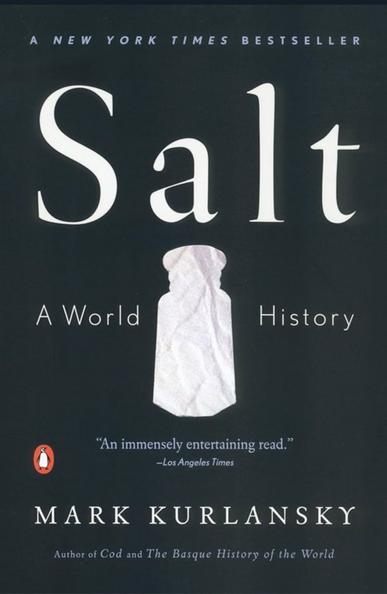
 Out of Context Podcast Quotes