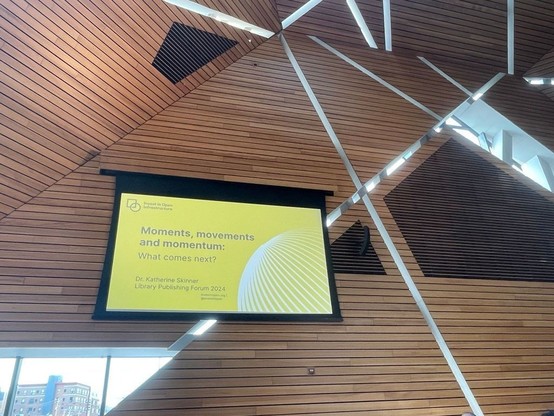
https://docs.google.com/presentation/d/1kwCQL_LncpBv3l1Fvhv_H8YYqQOdvrAAts-x9pf1wJQ/edit?usp=sharing

To sum up my remarks at the close of the final #LPF24 session:
As library people we have no business asking for things and doing things that do not comport with our values as librarians. when we abandon who we are, we abandon what makes working in libraries important and special. so don't do bad stuff. only do good stuff.
blog post forthcoming next week.
‘Equitable Access’ An Existential Threat to OER Publishing and Adoption? This work (https://bit.ly/lpf24-equitable) by Edna Fugate and Kelly Smith is released under a Creative Commons Attribution 4.0 International License.
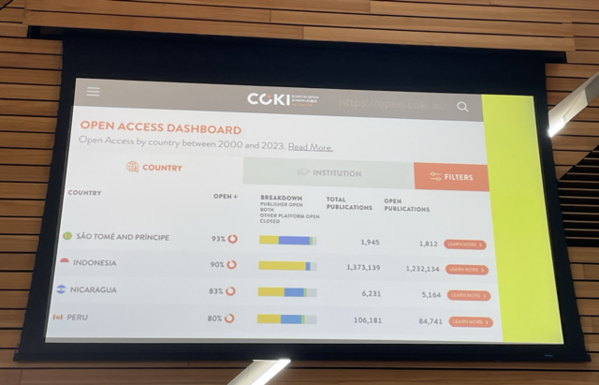
Professor Cameron Neylon of Curtin University talks telephones, power outlets, chat services, persistent identifier education, federated versus centralized curation, providing actionable information to universities, and why the COKI Open Access Dashboard relies on ROR.
#LPF24: (similar to what I said last night, tbqh: https://tilde.zone/@anelki/112442751016398118)
Put money where our values are honored!
I will say, and I'm sure this will come up at #LPF24 tomorrow and Thursday: for all we talk about "open infrastructure," many libraries are adopting tools/platforms that on the technical side are over-engineered, require substantial computing power, and often, considerable attention from people with technical expertise. To say nothing of the fact that to load a single page, you are asking your users (who aren't using the latest MacBook Pros on 1+ gbit connections like many developers or first-world librarians, especially in the US/Canada) to load tons of webfonts and JavaScript, asking them to do all sorts of stuff in order to access an ostensibly open textbook. The result of the first part is that our 'open' infrastructure becomes highly centralized, we surrender privacy protections that we (hopefully!!) have for things we host/manage ourselves, and we risk locking ourselves into a vendor/client relationship. Just like with Elsevier/Springer/et al. And lol, what happens in 5-6 years when you can't afford whatever they're charging? Or when the company that you pay for hosting realizes that maintaining this complicated code monster isn't worth the effort? The result of the second part is that we make it actively harder for people who aren't at ARL Libraries, who don't have lots of resources, who have a hard time accessing sites because the only internet connection outside of campus is their phone? Compare this to something like @[email protected]'s Open Journal System which is a drastically simpler application based on 20+ year old technology that is rock solid.* That is easy to maintain. That is easy to understand. That is secure. Serving pages that are lightweight and easily accessible. Not based on the popular programming language of the week. Not based on whatever the latest trend is. Built on technology that very simply: **JUST WORKS.** ...and yes, we can make it have a slide carousel on the front page. *technical: it's a (BSD/Linux/Mac/Windows)/Apache/MariaDB/PHP stack #PKPSprint #LPF24 #C4L24