
T.A.E.’s Book Reviews – Rose (Bone #0) by Jeff Smith

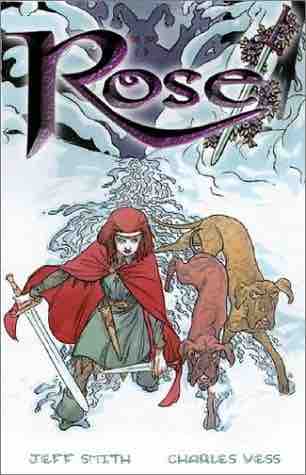
Jeff Smith’s Rose is a prehistory written with the pressure of legend. It does what the best origin stories do: it enlarges the world without flattening it. Rather than functioning as mere background for Bone, the book deepens the moral architecture of that universe by showing how inheritance, fear, and choice take root long before the main saga begins. What emerges is a story less about one character’s fate than about how a whole mythic order is born from fracture.

The novel’s greatest achievement is its double portrait of sisterhood. Rose and Briar are not simple opposites so much as two divergent responses to the same hostile world. The author draws them as figures of emotional and ethical asymmetry: Rose is steadier, more sacrificial, more earthbound; Briar is restless, hungry, and increasingly receptive to forces that promise power in exchange for surrender. The tragedy of the book lies in how convincingly it makes both women legible. Briar is not reduced to a villain; she is rendered as a human being whose desires have been cultivated by fear, resentment, and the seductive rhetoric of destiny. Rose, meanwhile, is heroic not because she is invulnerable, but because she persists in responsibility even when certainty collapses around her.

That tension gives the book its literary gravity. Smith repeatedly returns to images of dwelling, weather, and enclosure—farmhouse spaces, winter landscapes, hidden chambers, narrow roads—so that setting becomes a moral language. The world feels perpetually on the edge of being overrun, and that atmosphere is crucial: Rose is not just about people in danger, but about the vulnerability of ordinary life itself. Small acts of care matter here because they are performed against the backdrop of gathering ruin. In that sense, the book’s visual storytelling is inseparable from its ethics. The illustrator’s clean line and expressive staging let silence, gesture, and negative space do much of the narrative work, giving the story a stately, almost folk-ballad rhythm.

The dialogue and narration are equally effective in their restraint. Smith rarely over-explains, preferring a pared-down language that sounds inherited, as if the story were being retold from memory rather than invented anew. That tonal choice matters because Rose is concerned with how history turns into legend. Details are not merely information; they are transformed into emblems. A glance, a warning, a journey through snow, a moment of hesitation—these become the kind of narrative units from which folklore is built. The book’s emotional resonance comes from this compression. It knows that myth is not the opposite of intimacy; myth is what happens when intimate suffering is remembered too well.

As a prequel, Rose also performs an elegant reversal. Instead of explaining away mystery, it preserves it. Even as it offers backstory, it leaves behind the haunting sense that history is always larger than what can be fully told. That withholding is one of its strengths. Smith understands that the past should not feel solved; it should feel charged. Rose achieves precisely that, giving Bone its ancestral depth while standing on its own as a bleak, tender meditation on sisterhood, corruption, and the lonely courage required to remain good in a world that rewards surrender.

It is a beautifully disciplined work: modest in surface, rich in implication, and quietly devastating in retrospect.

#BONE #BookReviews #GraphicNovels #JeffSmith #LiteraryCriticism #Smith
T.A.E.’s Book Reviews – Bone, Vol. 9: Crown of Horns by Jeff Smith

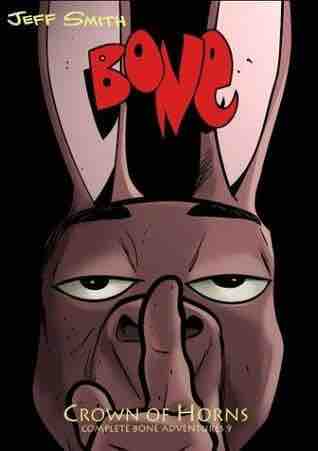
Jeff Smith’s Bone, Vol. 9: Crown of Horns is the series’ most overt movement toward apocalyptic resolution, yet it remains deeply committed to the intimate emotional textures that have always distinguished Bone from simpler fantasy adventure. What might have been a mere end-of-quest climax becomes, in this author’s hands, a meditation on fear, sacrifice, memory, and the terrible cost of choosing life over power. The volume gathers the story’s mythic materials into one final storm, but it never loses sight of the small human feelings that give those materials their force.

One of the book’s great achievements is the way it turns grand fantasy into a drama of moral weather. The Crown of Horns, with its near-Biblical menace, represents not just magical catastrophe but the temptation to submit to destruction as a kind of release. It stages this temptation against the tenacity of love and loyalty, especially in the alliance between the central figures who have endured so much suffering that survival itself has become an act of resistance. The language repeatedly emphasizes endings, but the emotional logic insists on continuation. Even in the shadow of annihilation, the characters keep making claims on one another, as if relationship itself were the only force strong enough to answer ruin.

Smith’s tonal control is especially impressive here. Bone has always balanced comedy and dread, but Crown of Horns sharpens that balance into something elegiac. The humour does not disappear; instead, it becomes tragically necessary, a fragile human countermeasure against cosmic scale. That tonal doubleness is one reason the book feels so alive. The world may be tipping toward collapse, but the characters remain recognizably themselves: stubborn, frightened, brave, petty, affectionate. The writer understands that the apocalypse is most affecting when it happens to ordinary emotional beings rather than abstract symbols.

The visual storytelling deepens this effect. Smith’s line remains supple and expressive, able to carry both spectacle and nuance. In the climactic sequences, he uses composition to create a sense of inexorable pressure: bodies cluster, space compresses, and the page itself seems to lean toward fate. Yet he also finds room for stillness. Those quieter images matter because they let the reader feel what is at stake in the larger catastrophe. The book’s emotional climax depends not on the shock of battle alone, but on the recognition that endurance, grief, and tenderness are all intertwined.

A sample of the book’s emotional register appears in its repeated insistence on the finality of the moment: “the Crown of Horns,” “the last battle,” and “all is lost” are the kinds of phrases that define its atmosphere. Smith is not merely building suspense; he is testing whether hope can survive inside language that seems designed to extinguish it. Against those apocalyptic markers, the characters’ acts of care become luminous. The result is a story in which the smallest gestures carry the weight of a worldview.

What gives Crown of Horns its lasting power is that it refuses a simplistic victory narrative. The ending is earned, but not triumphant in a naive sense. Smith closes the long arc of Bone with a vision that is hard-won, emotionally resonant, and morally serious. He understands that the deepest fantasy is not escape from reality, but a sharper encounter with its essential truths: that love is vulnerable, that loss is real, and that choosing to continue is itself a profound kind of heroism.

In the end, Bone, Vol. 9: Crown of Horns succeeds because it makes apocalypse feel personal. Its magic is not just in dragons, prophecies, or ancient forces, but in the ache of attachment and the courage of staying when everything invites surrender. Few graphic novels conclude so boldly, or so humanely.

#BONE #BookReviews #GraphicNovels #JeffSmith #LiteraryCriticism #Smith
T.A.E.’s Book Reviews – Bone, Vol. 8: Treasure Hunters by Jeff Smith

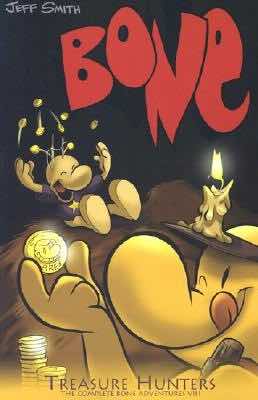
Jeff Smith’s Bone, Vol. 8: Treasure Hunters deepens one of the series’ most appealing paradoxes: it is at once playful and grave, elastic with humour yet increasingly governed by fate, memory, and inheritance. Even the title is revealing. “Treasure Hunters” sounds like a child’s adventure serial, but the writer uses that promise to expose how unstable “treasure” really is in this world. Gold, power, lineage, friendship, and survival all compete for the same narrative space, and the volume quietly suggests that the most consequential treasure is never the one that can be dug up from the ground.

What is especially impressive here is Smith’s control of tonal layering. He can stage slapstick, menace, and melancholy on adjacent pages without breaking the emotional continuity of the book. The visual language remains crucial to this effect: broad gestures, elastic expressions, and clean pacing make the comedy immediate, but the book’s shadows are never far away. In panels that dwell on the valley, on ruined spaces, or on the language of pursuit, Smith turns the landscape itself into an argument about history. The world is not just a setting; it is an archive of loss. That is why recurring terms such as “the valley,” “treasure,” and “dragon” feel heavier than their fantasy-stock equivalents. They accumulate symbolic pressure.

Fone Bone remains one of the author’s great achievements as a protagonist because he is so open to enchantment and so resistant to cynicism. His innocence is not emptiness; it is a moral stance. In Treasure Hunters, that innocence is tested by a world in which motives are never pure. The title phrase works doubly well because it applies not only to the comic schemes of the Bone cousins but to nearly everyone in the narrative: each character is, in some sense, searching for value, for origin, or for a usable past. Smith’s genius lies in making these searches feel both grand and absurd. The result is a quest narrative that understands greed not as a cartoon vice but as a distorted form of longing.

The volume also sharpens the series’ meditation on doubling. It demonstrates Smith’s fascination with pairs: comic and tragic, rustic and mythic, childlike and ancient, surface and depth. That tension is visible in his dialogue, which often sounds breezy on the surface while carrying a second, darker register underneath. Even a simple phrase like “treasure hunters” becomes ironic when set against the book’s larger concern with what is buried, forgotten, or inherited against one’s will. His world is full of people who think they are looking for objects, when they are actually being drawn toward destinies.

As a work of fantasy, Treasure Hunters is less interested in spectacle than in resonance. Its adventure machinery is finely tuned, but its real force comes from the way it links comic motion to moral consequence. Smith never lets the book become merely whimsical; he keeps reminding us that whimsy can coexist with danger, and that wonder is most valuable when it is underwritten by vulnerability. That balance is what gives Bone its lasting authority. It is funny without being frivolous, epic without being inflated, and intimate even when it seems to be roaming through myth.

In the end, Bone, Vol. 8: Treasure Hunters feels like a hinge volume: outwardly full of pursuit, inwardly full of recognition. It is a story about hunting treasure, but also about learning what kind of treasure can be trusted. Smith answers that question not with a speech, but with craft—with pacing, irony, and a visual imagination that makes every seemingly light moment carry the weight of old stories.

#BONE #BookReviews #GraphicNovels #JeffSmith #LiteraryCriticism #Smith

T.A.E.’s Book Reviews – Bone, Vol. 7: Ghost Circles by Jeff Smith

Jeff Smith’s Bone, Vol. 7: Ghost Circles is one of the series’ most haunting achievements (no pun intended), a volume in which the fantasy adventure grows stranger, darker, and more inward-looking without losing its wit or momentum. What makes the book so compelling is that it does not simply escalate the plot; it deepens the atmosphere. The valley is no longer just a stage for comic peril and mythic pursuit. It becomes a place where memory, fear, and enchantment blur into one another, as though the land itself were remembering older wounds.

At the centre of the volume is the eerie idea of the “ghost circles,” those supernatural zones where the ordinary laws of the world are warped or suspended. Smith uses them not merely as a plot device, but as a literary emblem. They externalize the emotional disorientation that has been gathering across the series: the characters are not only trying to survive danger, they are trying to understand what kind of world they inhabit. In that sense, the ghost circles function like a visual metaphor for instability itself. They suggest that reality in Bone is never solid for long, and that beneath the surface of comedy and quest narrative lies something ancient, unsettled, and fearful.

This volume is especially strong in its tonal control. The author balances the grotesque and the whimsical with remarkable precision. A scene can begin in near-fairy-tale simplicity and end in uncanny menace. That oscillation is part of the book’s power: laughter never fully cancels dread, and dread never erases tenderness. The result is a world that feels alive because it is internally contradictory. Even the more playful moments carry undertones of loss, while the most frightening passages are haunted by absurdity.

One of Smith’s great virtues as a storyteller is his refusal to flatten his characters into functions of the plot. In Ghost Circles, their reactions to the valley’s strangeness reveal as much about them as the dangers themselves. Fone Bone’s decency, for instance, remains a stabilizing moral center, but it is tested by uncertainty rather than rewarded by clarity. Thorn’s growing awareness of her own place in the larger mythology gives the volume real dramatic force, because her identity is no longer merely something to be discovered; it is something that seems to be unfolding under pressure. Even the supporting figures are drawn with enough personality to make the world feel populous rather than merely populated.

Smith’s art is crucial to the novel’s effect. His line work can turn a panel from open, humorous clarity into dense visual unease with almost no warning. He understands pacing in a deeply literary way. Pages do not simply advance the action; they modulate suspense. The use of shadow, spatial distortion, and repeated visual motifs gives the volume a dream logic that suits its subject perfectly. The ghost circles are not only described; they are felt in the structure of the page.

If the earlier volumes of Bone sometimes leaned more heavily on the pleasures of adventure and comic relief, Ghost Circles marks a maturation of the series into something more ambitious. It is still accessible, still fast-moving, still funny, but it now carries the weight of a fable about perception, inheritance, and the instability of the real. Smith seems increasingly interested in the way stories themselves create zones of uncertainty: once characters cross into myth, they may not return unchanged.

The book’s achievement, then, is not simply that it entertains, but that it alters the reader’s sense of the whole series. It widens the emotional and symbolic field. By the end, the valley feels less like a setting than a living pressure system of memory and fate. Ghost Circles is a reminder that fantasy can be playful without being shallow, and that children’s literature, in the hands of a serious artist, can carry real metaphysical unease.

What lingers most is the atmosphere: that sense of being watched by the past, of moving through a world where the ground may not be trustworthy, and where every strange threshold opens onto another, stranger one. Jeff Smith gives us adventure, yes, but also a meditation on instability, and that is what makes this volume so memorable.

#BONE #BookReviews #GraphicNovels #JeffSmith #LiteraryCriticism #Smith
T.A.E.’s Book Reviews – Bone, Vol. 6: Old Man’s Cave by Jeff Smith

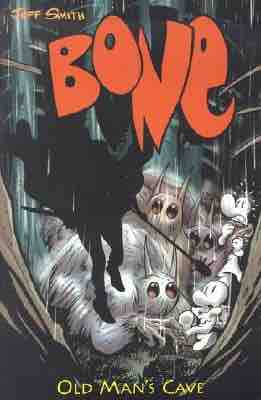
With Old Man’s Cave, Jeff Smith deepens Bone’s strange alchemy of pastoral comedy, epic fantasy, and uncanny menace. What has gradually become clear by this sixth volume is that the author is not merely telling a children’s adventure story that happens to grow darker over time; he is building a mythic world in which humour, dread, and tenderness are inseparable. This instalment intensifies that balance. The result is a book that feels both nimble and ominous, light on its feet yet shadowed by forces far older and larger than any of its characters.

One of the volume’s great strengths is its control of tonal contrast. It can move from playful banter to genuine peril without fracturing the narrative’s emotional logic. That matters because Bone has always relied on the reader’s willingness to accept tonal instability as a feature rather than a flaw. In Old Man’s Cave, the jokes are not a distraction from the story’s seriousness; they are part of its structure. The comic rhythms make the danger more vivid, and the danger in turn lends the comedy a tremor of fragility. The world feels lived in because it refuses to stay in one register for long.

At the centre of the volume is the continuing development of Fone Bone, whose moral clarity remains one of the series’ quiet achievements. He is not “heroic” in the conventional sense. He is earnest, frightened, loyal, and often overmatched. Yet that very modesty gives him force. Smith uses Fone Bone as a kind of ethical compass in a world where power is frequently tied to deception, appetite, and illusion. Against the volume’s growing sense of historical burden, Fone Bone’s decency reads not as naïveté but as resistance. He is one of the rare fantasy protagonists whose goodness is not a superpower but a discipline.

The title itself, Old Man’s Cave, signals one of the book’s central concerns: the past as an enclosed, half-buried space that still exerts pressure on the present. Smith repeatedly suggests that history in this series is not a distant backdrop but an active environment. The cave becomes more than a setting; it is an image of memory, secrecy, and inheritance. Like much of Bone, it evokes the idea that the landscape itself remembers. Characters move through it as if through an archive of unresolved violence. In that sense, the volume’s fantasy geography is also psychological geography.

The comic artist’s visual storytelling continues to be one of the series’ great pleasures. His line-work is supple and expressive, capable of shifting from cartoon exuberance to eerie stillness with remarkable ease. He trusts gesture, silhouette, and pacing. Whole emotional transitions can happen across a panel or two. The reader does not simply receive information; the reader is made to feel the rhythm of discovery and alarm. This is especially effective in sequences where characters confront hidden spaces or ambiguous presences. Smith understands that suspense in comics depends not only on what is shown, but on how the eye is guided from image to image, from expectation to revelation.

Another of the volume’s notable qualities is its expanding sense of moral complexity. The forces at work in Bone are never reducible to simple good and evil, and Old Man’s Cave sharpens that ambiguity. Threat is often wrapped in seduction. Power presents itself as destiny. Characters are tempted to believe that they are participating in a story that has already been written for them. Smith resists that fatalism. Even as the mythic machinery grows more elaborate, he keeps insisting on choice, responsibility, and consequence. The result is a fantasy that feels less escapist than interpretive: it asks what kinds of people we become when we are forced to live under inherited narratives.

What makes Old Man’s Cave especially strong is that it advances the series without abandoning its openness to wonder. The book never becomes grim for the sake of grimness. Instead, it lets mystery remain mysterious. That restraint is crucial. Smith knows that the deepest enchantments are often the least explained ones. By leaving room for uncertainty, he preserves the reader’s sense that the world is larger than the plot. Few fantasy comics achieve that without losing momentum.

Ultimately, Bone, Vol. 6: Old Man’s Cave stands as a fine example of serialized storytelling that is both cumulative and self-renewing. It enriches the larger arc while functioning as a compelling chapter in its own right. More importantly, it reveals Jeff Smith’s rare gift for making a comic feel simultaneously accessible and mythologically resonant. The volume is funny, tense, and beautifully paced, but its deepest achievement lies elsewhere: it persuades us that even in a world of monsters, prophecy, and hidden caves, character still matters most.

#BONE #BookReviews #GraphicNovels #JeffSmith #LiteraryCriticism #Smith

T.A.E.’s Book Reviews – Bone, Vol. 5: Rock Jaw, Master of the Eastern Border by Jeff Smith

Jeff Smith’s Bone, Vol. 5: Rock Jaw, Master of the Eastern Border is the series at its most adventurous and, at the same time, one of its most morally alert instalments. What first seems like a comic detour into wilderness peril becomes, on closer reading, a sharp meditation on power, hierarchy, and the uneasy alliance between comic-book exuberance and mythic seriousness. This volume deepens the saga not by enlarging the stakes in a merely epic sense, but by making the landscape itself feel politically charged: the forest, the borderlands, and the mountains all become arenas in which competing forms of authority struggle for dominance.

At the centre of the volume stands Rock Jaw, a creature who is less a simple monster than a force of law. Smith presents him as the embodiment of territorial sovereignty, a figure who rules by fear and by a brutally coherent sense of place. His presence gives the book a heavier, more archaic atmosphere than earlier volumes. The title’s promise of mastery is not ironic. Rock Jaw is truly a master, but his mastery is destructive, absolute, and isolating. He is strongest when the terrain itself seems to conspire with him. In that sense, he resembles one of those elemental antagonists from myth who do not merely oppose the hero but define the terms of the world the hero must cross.

What is especially impressive is the way the Smith balances this menace with comedy and warmth. The Bone cousins remain wonderfully distinct: Fone Bone’s sincerity, Phoney Bone’s opportunism, and Smiley’s absurd elasticity create a rhythm that prevents the book from hardening into grimness. The dialogue is deceptively simple, but it has remarkable tonal range. A small exchange can pivot from slapstick to dread in a single panel, and that flexibility is one of the series’ great strengths. Even in the middle of danger, the characters continue to feel like themselves, which gives the peril emotional credibility. Their smallness against the vast borderland makes them vulnerable, but also human.

Thematically, Rock Jaw is one of the clearest demonstrations of the writer’s interest in borders—not only geographical ones, but moral and imaginative boundaries as well. The eastern border is a place of transition, but also of exclusion. The book repeatedly suggests that to cross into another domain is to enter another logic of life. This gives the volume a subtle philosophical dimension. Power here is not abstract; it is local, embodied, and tied to claims of ownership. Rock Jaw’s rule is a parody of order, a kingdom built on the threat of force. Against him, Smith places not a conquering hero but cooperation, endurance, and improvisation. That choice matters. The book refuses the fantasy that violence can be met with a cleaner, better violence. Instead, it privileges wit, solidarity, and survival.

Visually, Smith’s storytelling is among the volume’s finest achievements. His line work keeps the world buoyant and readable, even when the action becomes tense. The expressive faces, wide compositions, and carefully paced sequences give the book a cinematic clarity, but never at the expense of intimacy. The forested spaces feel alive, and the quieter panels have real resonance. Smith knows how to make a pause carry meaning. That control of rhythm is what allows the book to feel simultaneously playful and epic.

As a whole, Rock Jaw, Master of the Eastern Border strengthens the larger Bone cycle by proving that whimsy and seriousness are not opposites. Smith is building a world where comedy can coexist with myth, and where a monstrous border guardian can reveal something essential about authority itself. The volume’s accomplishment lies in that doubleness: it is a thrilling adventure story, but also a reflection on what it means to belong to a place, to resist domination, and to remain oneself under pressure. In the long architecture of Bone, this book stands as one of the most elegant crossings between childhood wonder and literary depth.

#BONE #BookReviews #GraphicNovels #JeffSmith #LiteraryCriticism #Smith

T.A.E.’s Book Reviews – Bone, Vol. 4: The Dragonslayer by Jeff Smith

Jeff Smith’s Bone, Vol. 4: The Dragonslayer is the point at which Bone stops feeling merely playful and begins to reveal the moral architecture beneath its comedy. The series has always balanced cartoon buoyancy with old-world menace, but here the writer sharpens that balance into something more intricate: a story about inherited violence, mistaken identity, and the uneasy burden of legend. The volume’s title is brilliant in its irony. “The Dragonslayer” sounds like a heroic assurance, yet Smith treats the very idea of heroism with suspicion. In this world, anyone can be called a slayer; the harder question is whether they understand what they have destroyed.

What gives the volume its force is the way it stages contrast. Fone Bone remains the emotional center—earnest, curious, and often hilariously outmatched—but the narrative around him darkens. Gran’ma Ben’s toughness is more than comic bluster; it becomes a sign of lived survival, a practical wisdom born from dangerous history. Thorn’s presence adds another layer: she is introduced not as a fully legible heroine but as a person whose identity is still unfolding under pressure. Smith is especially good at making revelation feel incremental. Instead of handing out backstory as exposition, he lets character emerge through gesture, hesitation, and confrontation. The result is a story that feels discovered rather than arranged.

The volume also deepens one of the series’ great themes: the instability of appearances. Smith’s visual language constantly reminds us that a friendly face, a goofy expression, or a pastoral scene may conceal threat, grief, or ancient power. The dragons themselves are not simply monsters to be slain; they are symbols of a world whose history exceeds the narrow moral labels imposed on it. The title figure, then, is less a triumphant knight than a mythic misunderstanding. The author uses that misunderstanding to question the stories cultures tell about courage, enemies, and purity.

In that sense, The Dragonslayer is morally more sophisticated than its whimsical surface suggests. The book is full of comic relief, but the jokes are never empty. They create breathing room around fear. Smith understands that laughter can sharpen dread rather than erase it. One of the volume’s quiet achievements is its tonal control: the reader is invited to smile, then suddenly to recognize that the smile has made the danger more vivid. The art helps this enormously. The illustrator’s clean line and expressive staging allow him to move from slapstick to suspense with almost musical precision. His pages are easy to read but difficult to exhaust.

What is most impressive, finally, is how the volume expands the series’ emotional register without losing its accessibility. Bone remains a story of adventure, but it is increasingly a story about memory, inheritance, and the costs of survival. The “dragon” in Smith’s hands is never just a creature; it is a test of interpretation. Who names the threat? Who benefits from the name? Who gets to become a hero in the story afterward?

The Dragonslayer is thus one of the volumes where Bone most clearly reveals its ambition. Beneath the wit and momentum lies a fable about how legends distort reality—and how, occasionally, reality pushes back. It is charming, suspenseful, and quietly unsettling, which is to say that it is exactly the kind of book that lingers after its final page.

#BONE #BookReviews #GraphicNovels #JeffSmith #LiteraryCriticism #Smith
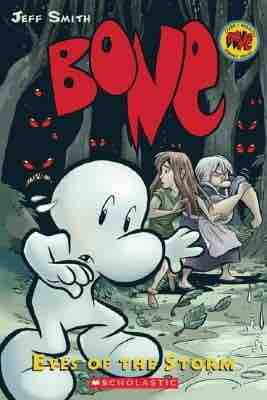
T.A.E.’s Book Reviews – Bone, Vol. 3: Eyes of the Storm by Jeff Smith

Jeff Smith’s Bone, Vol. 3: Eyes of the Storm is the series beginning to reveal its full weather system: comic mischief is still everywhere, but beneath the laughter the atmosphere darkens, thickens, and begins to press in with real narrative force. What makes this volume so compelling is not simply that “something happens,” but that the author learns how to make the ordinary and the epic feel inseparable. A storm is no longer just weather; it becomes mood, omen, and dramatic architecture. The title is beautifully apt, because this is a book about being caught in the centre of forces larger than oneself, while still trying to keep one’s footing in mud, fear, and family chaos.

One of Smith’s great strengths is his tonal range. He can move from broad comedy to genuine menace without breaking the story’s spell. The Bone cousins remain distinct comic personalities, especially Phoney Bone, whose bluster and self-interest continue to create friction wherever he goes, but the humour now feels increasingly precarious. It is no longer just there to entertain; it exposes character. Phoney’s schemes reveal his vanity and desperation, while Smiley and Fone Bone show, in different ways, how innocence and foolishness can look deceptively similar until the stakes sharpen. Smith understands that characterization is often strongest when placed under pressure, and the storm of this volume serves exactly that function.

The book’s visual storytelling is especially sophisticated. Smith’s line is clean and approachable, but its clarity is deceptive: he uses it to stage tension with remarkable precision. Weather, shadows, and enclosing landscapes give the volume a sense of threshold and instability. Rooms feel temporary. Roads feel vulnerable. Even moments of quiet seem haunted by what is about to arrive. The artist’s compositions often make the reader feel that the world is leaning forward, as if listening. That sense of anticipation is one of the volume’s deepest achievements.

There is also a notable widening of the series’ mythic dimension. The earlier volumes introduce the world’s oddity; this one deepens its memory. Dreams, legends, and hints of old conflict begin to gather more weight, particularly around Thorn and the mysterious forces that seem to be awakening around her. Smith never rushes this material. He allows the mythic elements to emerge gradually, so that the reader experiences discovery rather than exposition. That patience gives the fantasy an unusually lived-in quality. The story feels less like an invention being explained than a world remembering itself.

At the same time, Eyes of the Storm remains grounded in very human concerns: fear of loss, the burden of responsibility, the fragility of trust, the comic absurdity of greed. That balance is what keeps the book from becoming merely atmospheric. Even when the larger myth begins to loom, Smith remembers that his characters are still small, fallible creatures stumbling through danger with incomplete knowledge. In that respect, the volume has a quiet emotional intelligence. It does not pretend that wonder and terror are opposites. They are twin experiences, often arriving together.

What stays with the reader most is the sense that Smith is deepening his world without abandoning its charm. Eyes of the Storm is less sprawling than consequential; it turns the screw. Its power lies in the way it binds comedy to suspense, and fantasy to emotional uncertainty. By the end, the storm has not merely passed over the valley—it has entered the story’s bloodstream. This is the kind of volume that expands a series’ meaning while still feeling playful, and that is a rare accomplishment.

#BONE #BookReviews #GraphicNovels #JeffSmith #LiteraryCriticism #Smith
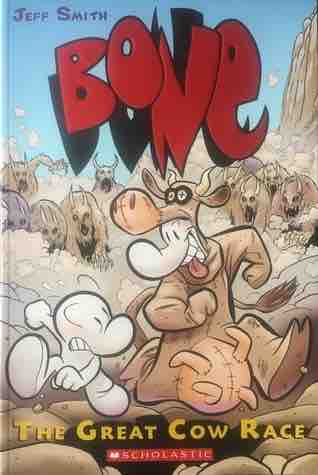
T.A.E.’s Book Reviews – Bone, Vol. 2: The Great Cow Race by Jeff Smith

Jeff Smith’s Bone, Vol. 2: The Great Cow Race is the point at which Bone begins to reveal the full strength of its design. What first seemed in volume 1 like an amiably strange fantasy becomes, here, something sharper and more deliberate: a comic pastoral that is also a study in greed, spectacle, loyalty, and the thin veil between rustic comedy and genuine menace. The author deepens the world not by abandoning charm, but by making charm itself unstable. The result is a book that is funny, swift, and deceptively layered.

At the centre of the volume is the Great Cow Race, a local celebration that Smith turns into both set piece and social microcosm. The race is not merely an eccentric regional custom; it is a lens through which the book observes community life. The townspeople gather, wager, brag, and jostle, and the event becomes a small theatre of human desire. Smith understands that festivity often exposes character more clearly than crisis does. Phoney Bone, with his appetite for schemes and shortcuts, treats the race as an opportunity for manipulation, while Fone Bone remains a more accidental witness to the moral weather around him. The contrast between the cousins is one of the volume’s most effective structural devices: Phoney embodies appetite without wisdom, while Fone Bone carries the book’s conscience, curiosity, and emotional openness.

Smith’s writing is especially strong in the way it balances comedy with threat. The volume is full of slapstick and comic exaggeration, yet the Rat Creatures and the ominous currents surrounding Thorn prevent the book from settling into lightness alone. The juxtaposition is crucial. A scene may begin in broad humour and end with a shadow crossing the frame, and Smith lets that tonal shift register without strain. This gives Bone its singular atmosphere: it is never merely cute, because danger is always at the edge of the joke. The book’s humour therefore does not deflate tension; it sharpens it.

Thorn, in this volume, becomes more compelling as a character of transition. She is not yet fully aware of the larger forces gathering around her, but she is no longer simply a local girl in a small town. Smith gives her a kind of inner brightness that makes her feel like the moral centre of the narrative even when the plot is distracted by chicanery and comic disorder. Her scenes have a calm, grounded energy that contrasts beautifully with the noisier antics of the Bone cousins. She helps anchor the book’s emotional realism. In a story with rats, dragons, and folklore, Smith knows that the most important thing is to make the human heart recognizable.

Visually, The Great Cow Race is a masterclass in graphic storytelling economy. Smith’s linework is clean, expressive, and highly readable, but what stands out most is his command of timing. He knows when to crowd a panel with motion and when to let silence or a held expression carry the beat. The race sequence, in particular, demonstrates how comics can stage action with a rhythm more akin to cinema and theatre than prose alone. The page turns create punchlines; the panel layout becomes part of the joke. Yet the artistry is not merely mechanical. The artist’s drawings also carry tone, giving the valley a lived-in warmth even when the plot turns uneasy.

Thematically, the volume is preoccupied with value: what is worth chasing, what is worth selling, and what is worth protecting. Phoney’s schemes make greed look ridiculous, but not harmless. Smith treats avarice as a kind of comic self-deception, a belief that the world can be reduced to leverage and profit. Against this, the book places friendship, loyalty, and simple attentiveness as quieter but sturdier forms of value. Fone Bone’s affection for Thorn, and his generally unheroic but sincere manner, make him one of the book’s most quietly persuasive protagonists. He is not impressive in the conventional sense, but he is trustworthy, and that matters more in Smith’s moral universe.

What makes The Great Cow Race so effective is that it expands the series without explaining it away. The mythology remains partial, the dangers remain half-seen, and the world remains larger than any single volume can contain. This book resists the temptation to over-clarify. Instead, it deepens atmosphere, strengthens character contrast, and lets the reader feel that the story is moving from whimsy toward destiny. That is the book’s hidden achievement: beneath the jokes and rural bustle, it quietly teaches us how to read uncertainty.

In the end, The Great Cow Race is a comic fantasy of remarkable control. It is playful without being flimsy, accessible without being thin, and warm without becoming sentimental. Jeff Smith has a gift for making a reader smile and then, almost in the same breath, feel the ground shift. This volume shows that Bone is not just an entertaining series of adventures; it is a carefully tuned work of narrative balance, where comedy, folklore, and foreboding are all part of the same spell.

#BONE #BookReviews #GraphicNovels #JeffSmith #LiteraryCriticism #Smith
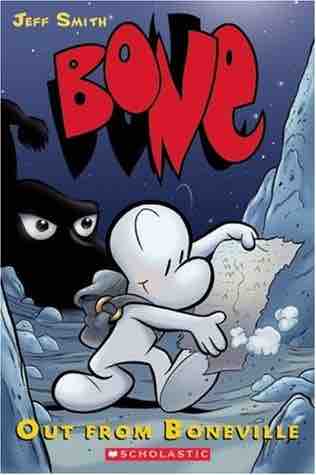
T.A.E.’s Book Reviews – Bone, Vol. 1: Out from Boneville by Jeff Smith

Jeff Smith’s Bone, Vol. 1: Out from Boneville is a remarkable feat of tonal balance: at once a woodland fable, a sly comic adventure, and the first movement of an unexpectedly expansive epic. What appears, at first glance, to be a light, cartoonish fantasy quickly reveals a work of real formal intelligence. Smith understands that innocence can be a mask for danger, and humour a vehicle for dread. The result is a book that feels deceptively simple on the surface while steadily opening into something mythic.

The volume begins by displacing its protagonists from the familiar logic of the everyday and depositing them into a landscape that is both whimsical and ominous. The Bone cousins—Fone Bone, Phoney Bone, and Smiley Bone—arrive as figures of comic incongruity: small, white, and apparently harmless, yet immediately entangled in forces they do not understand. Smith’s brilliance lies in how fully he commits to this mismatch. Their rounded, almost toy-like designs stand in contrast to the grandeur of the world around them, creating a visual irony that is central to the book’s charm. The art invites laughter, but the narrative keeps reminding us that laughter is only one layer of experience.

One of the volume’s most appealing qualities is its tonal elasticity. The author moves from slapstick to menace with astonishing ease. A line like “We’re not in Boneville anymore” captures more than a joke; it signals a threshold-crossing into uncertainty, a classic fairy-tale gesture recast with comic economy. The book’s world is governed by this same doubleness. Even the supposedly comic figures—especially Phoney Bone, whose greed and bluster constantly complicate the group’s survival—have a satiric sharpness that prevents the story from becoming merely cute. The humour is never decorative. It reveals character.

At the same time, Out from Boneville is deeply interested in the archetypal patterns of quest narrative. Fone Bone’s quiet curiosity, his evident openness to wonder, and his immediate attraction to Thorn and the valley’s strange inhabitants position him as a kind of ingenuous knight or pilgrim. But Smith resists the usual heroic polish. Fone Bone is earnest, not triumphant; vulnerable, not destined. That vulnerability gives the story emotional credibility. The adventure feels earned because it is entered by someone who still believes in the possibility of meaning.

The book also demonstrates this writer’s gift for world-building through suggestion rather than exposition. He does not over-explain the valley’s mysteries; he lets them accrue through atmosphere, gesture, and interruption. This method gives the narrative a strong sense of submerged history. We feel that the landscape has memory, that the social relations around Thorn and Gran’ma Ben are part of a larger, older conflict. The reader is not given the whole architecture at once, only glimpses—enough to feel the depth beneath the surface. That restraint is one of the volume’s greatest strengths.

Visually, Smith works in a clean, supple line that appears simple but is highly controlled. His pages have an exceptional clarity of staging, allowing action, expression, and mood to coexist without confusion. He can render a comic chase, a quiet domestic scene, or a moment of uncanny stillness with equal fluency. The pacing benefits enormously from this economy. The reader is never overloaded, yet the book never feels thin. Instead, it achieves a rare clarity that makes the more dramatic developments land with greater force.

What gives the first volume its lasting appeal, though, is its emotional tone: a mingling of wonder, threat, and loneliness. The title itself, Out from Boneville, suggests departure, exile, and the beginning of story. These characters have already left one world behind, and the new one they enter does not promise safety. In that sense, Smith is writing a coming-of-age narrative disguised as a fantasy romp. The book’s deeper subject is not merely adventure but dislocation—what it means to be unmoored and yet still capable of friendship, courage, and curiosity.

In the end, Bone, Vol. 1 succeeds because it treats enchantment seriously without losing its sense of play. It is funny without being trivial, accessible without being shallow, and mythic without becoming ponderous. Jeff Smith’s achievement is to make a comic book feel like folklore in the making. The first volume is not just an introduction; it is an invitation into a world where the silly and the solemn are inseparable, and where even the smallest figures may be carrying the weight of a very old story.

#BONE #BookReviews #GraphicNovels #JeffSmith #LiteraryCriticism #Smith