Most “exciting” releases break your code. #Java26 doesn’t. It compiles, runs, and improves performance—thanks to G1 GC and HTTP/3. Lutske de Leeuw & @parttimen3rd explain why boring wins.

See why boring tech is a competitive advantage: https://javapro.io/2026/04/17/java-26-is-boring/

#Java #JVM

“Can I block here?” With #Java26, the answer is increasingly yes. #VirtualThreads & #StructuredConcurrency reduce the need for callback-heavy code & oversized thread pools.

Damiana Nascimento explains what modern #JVM-first design looks like: https://javapro.io/2026/05/06/java-26-in-practice-how-the-jvm-is-changing-the-way-we-write-code/

@openjdk

On-prem #LLMs in regulierten Umgebungen… aber wer kontrolliert Daten, Rollbacks & Blast Radius? Cornelius May & Eldar Sultanow zerlegen den Mythos „einfach API nutzen“ & bauen ihn mit #DevOps + #Java26 neu.

Hinterfrage deinen Stack: https://javapro.io/de/devops-patterns-und-java-26-fuer-on-premises-llm-plattformen-in-sicherheitskritischen-umgebungen/

#Java #Kubernetes

#Java developers spent years tuning pools, GC & startup behavior manually. With #Java26, the #JVM increasingly handles concurrency, warm-up and optimization itself.

Damiana Nascimento explains what developers should adopt — and avoid: https://javapro.io/2026/05/06/java-26-in-practice-how-the-jvm-is-changing-the-way-we-write-code/

Still relying on --add-opens? Not enough. #Java26 separates access from mutation capability. Final-field mutation now warns by default and will be denied later—affecting reflection-heavy code. Babneet Singh explains the key flags!

Learn more: https://javapro.io/2026/04/29/final-is-no-longer-a-hint-in-java-26/
#Java #JDK26

Ein Paketverlust und plötzlich steht alles? HTTP/2 über TCP leidet an Head-of-Line-Blocking. Wanderson Xesquevixos erklärt, wie #HTTP/3/QUIC das löst & wie es in #Java26 aktiviert wird.

So simpel ist der Einstieg! Jetzt lesen: https://javapro.io/de/java-26-uebernimmt-http-3-mit-der-weiterentwicklung-des-httpclient/

#Java #HTTP3 #Performance

Java 26 übernimmt HTTP/3 mit der Weiterentwicklung des HttpClient - JAVAPRO Germany

die Zukunft der Kommunikation zwischen Microservices Moderne verteilte Architekturen, wie etwa Microservices, sind eng mit der Weiterentwicklung von…

JAVAPRO Germany

#Java26 introduces warnings for illegal final field mutation. Future releases will deny it by default. Start migrating now: inventory with debug, enforce in CI.

Learn how to avoid breakage & unlock safer JVM optimizations with Babneet Singh: https://javapro.io/2026/04/29/final-is-no-longer-a-hint-in-java-26/
#DevOps #Java

Why do so many Spring services collapse under real traffic? @vvauban explores how #SpringBoot4 + #Java26 — and a certification-style mindset — quietly fix the blind spots most teams ignore.

Steal the playbook for resilient services: https://javapro.io/2026/03/13/java-26-spring-boot-4-from-certification-skills-to-production-ready-apps/

springboot #java

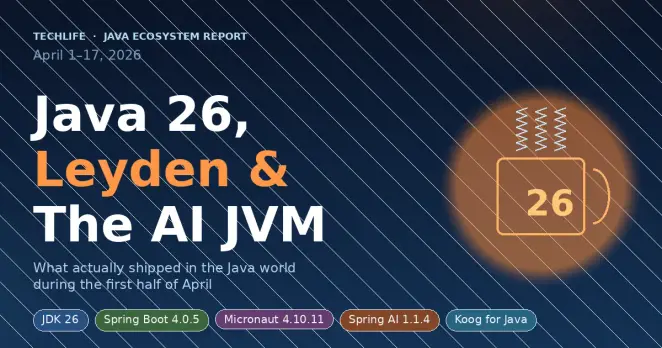
Java in April 2026: Leyden Grows Up, Spring Gets Smarter, and the JVM Quietly Reinvents Itself for the AI Era

https://techlife.blog/posts/java-ecosystem-april-2026

#Java #Java26 #ProjectLeyden #SpringBoot #JakartaEE #VirtualThreads #SpringAI #Koog #JVM

Java in April 2026: Leyden Grows Up, Spring Gets Smarter, and the JVM Quietly Reinvents Itself for the AI Era

Java 26 has landed, Project Leyden is chipping away at the cold-start problem, and the JVM's AI tooling story finally feels grown-up. Here's what actually happened in the Java ecosystem during the first half of April 2026.

TechLife — AI, Software Engineering & Emerging Technology

Most “exciting” releases break your code. #Java26 doesn’t. It compiles, runs, and improves performance—thanks to G1 GC and HTTP/3. Lutske de Leeuw & @parttimen3rd explain why boring wins.

See why boring tech is a competitive advantage: https://javapro.io/2026/04/17/java-26-is-boring/

#Java #JVM