 Contemporary Classical - Thea Derks
Franghiz Ali-zadeh at Cello Biennale 2024: ‘Composing is the unfolding of amorphous chunks of energy’
The Amsterdam Cello Biennale celebrates its second lustrum in Muziekgebouw aan ‘t IJ from 31 October through 10 November 2024 with lots of premieres. Among them the Cello Concerto SÖVQ that the Azerbaijani composer Franghiz-Ali-zadeh composed for Amsterdam Sinfonietta. This will be premiered with the renowned cellist Kian Soltani. As in most of her music Ali-zadeh connects traditional music from her homeland with Western compositional techniques.
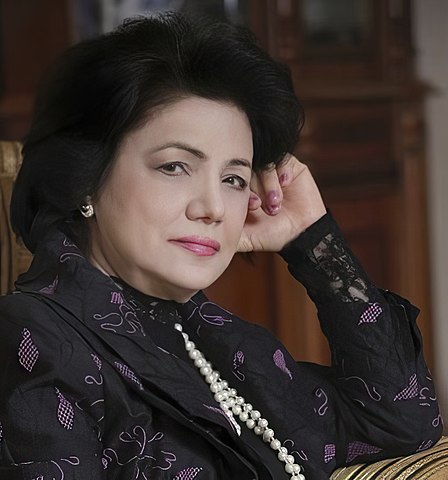
Franghiz Ali-zadeh (c) By Natella.MI first heard music by Franghiz Ali-zadeh (Baku, 1947) in 1997. A year before, I had finished my musicology studies at the University of Amsterdam and had started working as a programmer for the Dutch classical radio station NPO Klassiek. For both my teachers in Amsterdam and my colleagues in Hilversum a composer was obviously a dead, white male. A music friend took my ongoing complaints about this to heart and bought me the CD Crossings by La Strimpellata Bern, entirely dedicated to Ali-zadeh.
Melodic richness
I was at once captivated by the melodic richness, delicate colour palette, spaciousness and meditative atmosphere of the five pieces on this album. I was particularly impressed by how organically Ali-zadeh interweaves Western compositional techniques with traditional Azerbaijani mugham, a system of modes in which ancient, orally transmitted scales and melodic fragments express a particular mood on which the performer improvises. As soon as I saw even the slightest opportunity, I seized my chance to play this enchanting music to the listeners of NPO Klassiek.
Twenty years later, I met Ali-zadeh in person, when I interviewed her in a pre concert talk on her brand new Nassimi Passion, which she had composed for the Royal Concertgebouw Orchestra. With infectious enthusiasm, she recounted the creation of this large-scale composition for baritone, choir and orchestra, in which she once again realised a synthesis between East and West. While her Passion does tell a story of suffering, this is not inspired by the life of Christ, but that of Azerbaijani poet, Sufi and martyr Nasimi Imadeddin, who was gruesomely murdered in 1417. Among other texts, she used his mystical poetry for the libretto.
Ear-catching lyricism, rousing percussion
Musically, Ali-zadeh hooks into the Azerbaijani Mersiye tradition of lamentations alternately sung by a solo voice and a choir. With unprecedented flexibility, she mixes the gliding string tones so characteristic of Eastern music with a chorale by Bach. Ear-catching lyricism alternates with passages in which the orchestra growls and rants with overwhelming bellowing and rousing percussion.
The work was premiered on 7 April 2017 by the Royal Concertgebouw Orchestra, the Dutch Radio Choir and baritone Evez Abdulla, conducted by Martyn Brabbins. The live recording of this impressive composition appeared a year later on the Royal Concertgebouw Orchestra’s own label Horizon. Although she composed works for several Dutch ensembles, Franghiz Ali-zadeh is not yet a household name in the Netherlands.
Baku
She was born in 1947 in Baku, the capital of Azerbaijan, which was still part of the Soviet Union at the time. ‘The city lies on the coast of the Caspian Sea,’ Ali-zadeh says with a smug smile. Nice tidbit: in 1969 one of its central districts was named after Nasimi, to whom she would dedicate her Passion half a century later. Ali-zadeh grew up in a well-to-do, though not particularly musical milieu. ‘My father was an engineer in the oil industry’, she recalls, ‘but in his spare time he liked to play the tar.’ This long-necked lute with eleven strings is widely used in Central Asia, especially in Persian and Caucasian music.
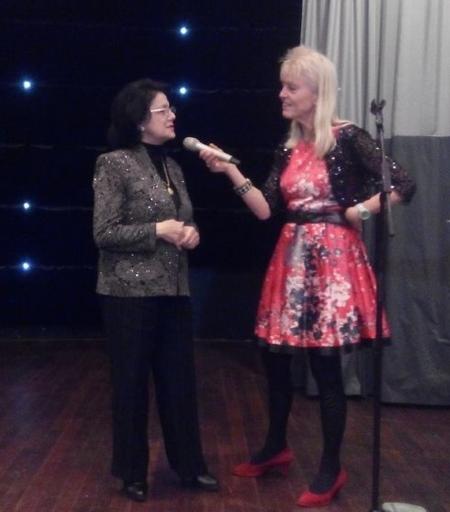
Franghiz Ali-zadeh & Thea Derks,Concertgebouw Amsterdam, 7 April 2017
When she was five, the family purchased a piano and from 1954 to 1965 she attended the youth department of the State Conservatoire in Baku. ‘Since we belonged to the Soviet Union, we mainly studied music by composers such as Prokofiev, Shostakovich, Sviridov and Shchedrin,’ she says. ‘But we also immersed ourselves in works from Bach to Mahler, and in addition we listened to the rich Azerbaijani tradition of classical and folk music.’
She finds it hard to say who her favourite composers were then and now: ‘My preferences are constantly changing, it depends on my mood, my age, events in my life. But there are two who will always admire: Wolfgang Amadeus Mozart and Uzeyir Hajibeyov (1885-1948).’ Thus Ali-zadeh nicely encapsulates the two worlds in which her own music moves: Hajibeyov composed the Azerbaijani national hymn and wrote the first oriental opera, Layla and Majnun, in 1908.
Improvising and composing
Like many children, the young Franghiz soon struck up improvising and composing on her instrument: ‘When I was seven, I wrote a few preludes and a children’s song, whereupon my teachers advised my parents to enrol me for composition alongside piano lessons.’ This appealed to her so much that around the age of nine she decided to become a composer.
This by no means entailed giving up the piano, she made a brilliant career as a pianist and still gives concerts. There’s the proud smile again: ‘I have played many Azerbaijani premieres, by composers such as John Cage, George Crumb, Olivier Messiaen, Alfred Schnittke, Sofia Gubaidoelina and Edison Denisov, as well as members of the Second Viennese School, Schoenberg, Berg and Webern.’ Because of her efforts on behalf of Schoenberg’s work, she was appointed a member of the Schoenberg Institute in Los Angeles in 1988.
Her composition teacher at the Baku conservatoire was the renowned Kara Karayev (1918-1982), whose music is not entirely unknow in the Netherlands. After completing her studies in 1972, she became his assistant and later started teaching there herself. In 1980, she won the annual prize of the Azerbaijani Composers’ Union and nine years later she obtained her doctoral degree with the thesis Orchestration in Works by Azerbaijani Composers. In 1992, the Soviet Union having now disintegrated, she moved to Turkey. This gave her international exposure a strong boost.
International fame
In 1999, she was the first female composer-in-residence at the Internationale Musikfestwochen Luzern (now Lucerne Festival). That same year, a DAAD Stipend allowed her to live and work in Berlin for a year. She decides to settle there and today she divides her time between the German capital and Baku.
In 2000, Ensemble Continuum places her work at the centre of a concert in New York, and that same year she composes Dervish for Yo-Yo Ma’s Silk Road Project. But her real breakthrough came in 2002, she says: ‘That was when Yo-Yo Ma and the pianist Joel Fan recorded my piece Habil-Sayagi for cello and prepared piano on CD.’ And from 2005 onwards, the Kronos Quartet developed into one of her most ardent advocates.
Ivan Monighetti
Incidentally, she had composed Habil-Sayagi in 1979 not for Yo-Yo Ma, but for the Russian cellist Ivan Monighetti. That tasted like more and in 2002 she also wrote her first Cello Concerto, Mersiye, for Monighetti and the famed Gulbenkian Orchestra. It was premiered in Lisbon and is named after the same Azerbaijani tradition of lamentations that inspired her for the Nassimi Passion.
The trigger was the devastating attack on the Twin Towers in New York on 11 September 2001: ‘It is a kind of confessional monologue of the cello, in which the feeling of mourning over the tragic loss of aesthetic values and ideals prevails. Never before had the world been so vulnerable. The cello part interprets the human voice, alternating between recitative and cantilena.’ The piano shades the argument with forlorn chords and unsettling tinkling.
https://www.youtube.com/watch?v=L4BGIoHtY2Q&ab_channel=QuinoneBob
Twenty-two years later, she writes her second Cello Concerto, SÖVQ, again for Monighetti. The latter was to present it to the public with Amsterdam Sinfonietta at the Cello Biennale on 6 November 2024, but had to cancel the premiere due to personal circumstances. However, his star pupil Kian Soltani was able to take over the concert effortlessly; he was programmed as one of the main guests in the Muziekgebouw aan ‘t IJ anyway.
Ali-zadeh does not seem too bothered by this last-minute change. ‘Kian Soltani is one of the best cellists of our time,’ she says. ‘Moreover, he is not unfamiliar with my music: in 2012, together with Monighetti and others, he put my piece Metamorphoses for eight cellos on CD, and in the 2016 Cello Biennale he already performed Habil-Sayagi.’
She cherishes her collaboration with Monighetti, she hastens to add: ‘I have enjoyed working with Ivan since 1979 and have written several pieces for him. I consider the Mersiye Cello Concerto an absolute milestone and hope that the collaboration with Kian will be just as fruitful.’
Love for the cello
When artistic director Stephan Heber of Amsterdam Sinfonietta commissioned her to write a concerto for cello and string orchestra to be premiered in the Cello Biennale, she was delighted: ‘I love the cello immensely and immediately set to work.’ Asked whether it is not tough to write a concerto for solo cello and string orchestra, she answers pragmatically: ‘Of course it is a difficult task, but I see it as a challenge: nothing is impossible!’
Yet in the score, we encounter percussion instruments such as vibraphone, glockenspiel, triangle, drums and chimes, which definitely don’t belong to Amsterdam Sinfonietta’s regular lineup. Why did she decide to include them and what is their function? ‘This was an idea of Ivan Monighetti’s,’ she replies. ‘It gives me the chance to expand my colour palette and make the sound of my concerto richer and more varied.’ How did Heber respond to this idea? ‘Stephan agreed, on condition that only one percussionist can play all the instruments, and he found Dominique Vleeshouwers ready to perform all the parts.’
From the beginning, she worked closely together with Monighetti on her concerto: ‘We were in continuous contact. Especially about technical aspects, because playing techniques for the cello are constantly being renewed and enriched. By the way, it was also his idea to insert a cadenza before the second movement.’
Although she again draws on the Azerbaijani mugham tradition in SÖVQ, this second Cello Concerto is completely different from the first, she stresses: ‘Instead of a tragic atmosphere and mournful images, this has a much more optimistic tone, with nostalgic feelings and a desire to explore new horizons.’
Personal memories and new goals
This is already evident in the title, which is by no means unequivocal. Ali-zadeh: ‘The Azerbaijani word sövq is polysemantic and harbours many meanings and values, including impulse, inspiration, passion, dedication. I chose it after I finished my piece because, to my mind, it captures the essence of its two contrasting parts.’
The first movement is called ‘Dreams’, the second ‘Fighting’. The first indeed has a dreamlike atmosphere, with a very open, transparent fabric and a remarkably long intro by the orchestra. When the solo cello finally enters, it is accompanied only by the soft tinkling of a triangle and tremoli of the first violins.
As the cello gradually starts playing more virtuoso and faster, the other strings very slowly rejoin the argument, with descending and ascending glissandi and delicate tremoli against stray motifs on glass chimes and vibraphone. ‘In this movement, I reflect on personal memories and feelings, unfulfilled desires, images from nature, encounters with great musicians,’ Ali-zadeh explains.
‘Fighting’ opens next with a cadenza of the solo cello and a tambourine, the cello playing double stops and triplets in a slow tempo, marked ‘maestoso e pesante’. This time it takes a long time for the orchestra to join in. Ali-zadeh: ‘For me, the cadenza is a concentration of strength and feeling, in preparation for the battle to come.’
This manifests itself in decisive sixteenths rhythms of the orchestra versus fiery parts of the soloist, tumbling through all registers. Notable is the ‘military drum’ that figures only in this movement, where it appears about halfway through and is only heard for a few bars. Why? ‘I wanted to create an alarming atmosphere. This movement expresses the desire and determination to overcome obstacles in life and brace yourself to achieve new goals.’
Amorphous chunks of energy
The question as to how her compositions come into being leads to a slightly desperate sigh: ‘It is a mysterious process, which I never seem to fully master. Interesting thoughts come up at the most unexpected moments – or don’t come at all for a long time when you sit down to work. Sometimes I improvise at the piano, sometimes I hum something, sometimes I hear a sound or intonation that pleases me in the oddest places, for instance a child crying in the street. Or I get inspired by a plane in the sky, seeing clouds or mountains and so on. Composing is the gradual unfolding of amorphous chunks of energy. The process is totally unpredictable!’
This may be so, one constant in her output is the love for her homeland: ‘SÖVQ is dedicated to Azerbaijan.’
In the concert on 6 November Amsterdam Sinfonietta will also perform Reqs, which Ali-zadeh composed for the Kronos Quartet.
Vleeshouwers withdrew before the premiere and Yifan Du stepped in at short notice, doing an excellent job.
https://www.youtube.com/watch?v=7iVniKdkg5U&ab_channel=ScoreFollower
This article first appeared in Dutch in the Nov-Dec issue of De Nieuwe Muze
#AmsterdamSinfonietta #CelloBiënnale #FranghizAliZadeh #IvanMonighetti #KianSoltani #NassimiPassion #SÖVQ
 Lars Holgersson 🎶