Referenced link: https://medicalxpress.com/news/2023-04-scientists-drug-like-cocktail-regenerate-hair.html
Discuss on https://discu.eu/q/https://medicalxpress.com/news/2023-04-scientists-drug-like-cocktail-regenerate-hair.html
Originally posted by Phys.org / @physorg_com: http://nitter.platypush.tech/medical_xpress/status/1648339624006172678#m
RT by @physorg_com: Scientists use drug-like cocktail to regenerate #haircells in preclinical study @masseyeandear @PNASNews https://pnas.org/doi/10.1073/pnas.2215253120 https://medicalxpress.com/news/2023-04-scientists-drug-like-cocktail-regenerate-hair.html
Effective hearing loss treatments have eluded medicine because once sensory cells in the inner ear called hair cells are damaged or destroyed, they cannot be regenerated. This loss of hair cells, which can be caused by aging, noise exposure and other factors, renders an individual's hearing loss permanent.
Lattice structured illumination microscopy and surface rendering reveals that inner ear hair cells constantly supply stereocilia building blocks to the hair bundle, but the unique protein composition at the tips of each row of stereocilia ensures that the rows grow differentially.
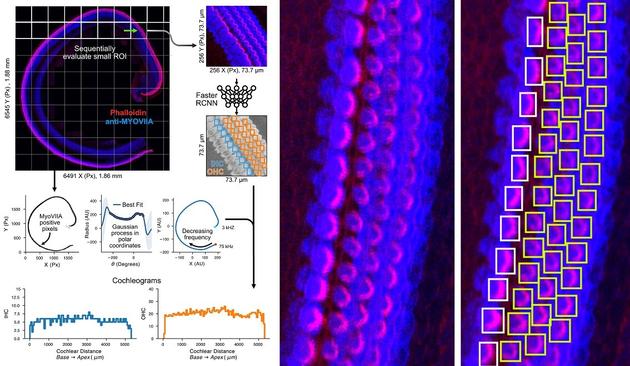
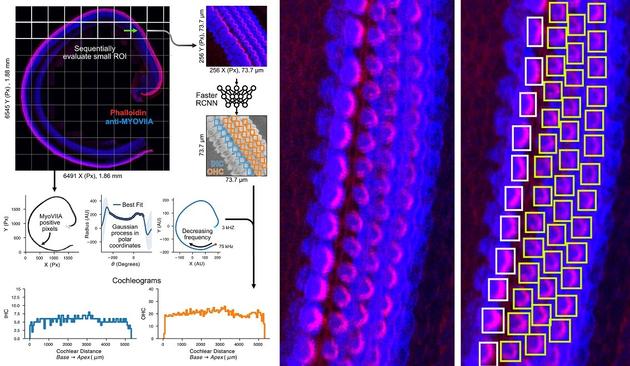
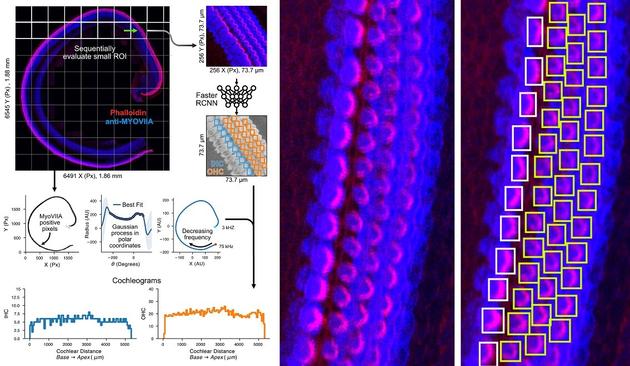
This study presents the Hair Cell Analysis Toolbox (HCAT), which automates common image analysis tasks such as counting hair cells, classifying them by subtype and determining their optimal frequency. HCAT removes a considerable barrier in cochlear image analysis, allowing for faster, unbiased, and more comprehensive data analysis practices.