
Ancient Greek Coin, Head of Alexander II Zebina

(This post is being modified)

https://gregurbano.com/2026/01/22/ancient-greek-coin-head-of-alexander-ii-zebina/

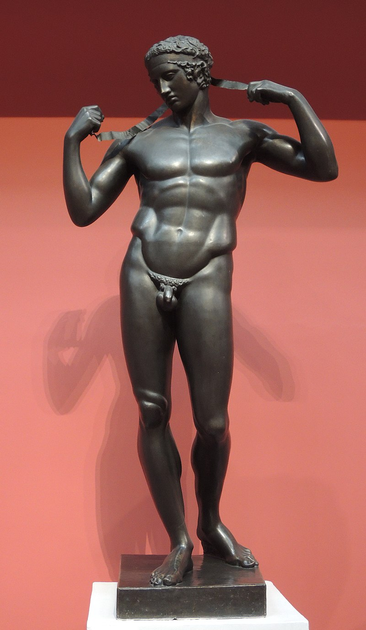
We must ensure that the celebration of classical ideals of masculine beauty does not become the exclusive terrain of the right wing cranks of the manosphere.

Image: Reconstruction of the Diadumenos of Polyclitus by a patinated cast at the Pushkin Museum, Moscow -- By shakko - Own work, CC BY 3.0 -- Wikimedia Commons

#Diadumenos #Polyclitus #GreekArt #ClassicalSculpture #GreekAntiquity #MasculineBeauty #Beauty #Manosphere #ToxicMasculinity
~ The life of Aspasia of Miletus, part I ~

Aspasia of Miletus (470-410/400 BCE) is best known as the consort of the great Athenian statesman Pericles. Her life story has always been given in the shadow of Pericles' fame, but she was a woman of great eloquence and intelligence in her own right who influenced many of the writers, thinkers, and statesmen of her time.

She was a metic (not born in Athens), was not allowed to marry an Athenian and had to pay a tax to live in Athens, but it is most likely because of her foreign status that she was not constrained by Athenian policies regarding women's behavior. She bore Pericles a son out of wedlock, taught men and women, and seems to have lived freely however she pleased.

This much is known as well as that she lived, wrote, and worked in Athens c. 450 -c. 428 BCE and operated a salon of some sort, but little else can be said for certain. It is not even known if Aspasia was her actual name or a "professional name" as she was famous as a hetaira (a high-class courtesan).

Ancient writers from Aristophanes (l. c. 460 - c. 380 BCE) to Plato (l. 424/423-348/347 BCE) to Plutarch (l. c. 45/50 - c. 120/125 CE) reference her eloquence and power in controlling men, and this established her reputation as none of her own works, if she actually wrote any, have survived. In the 19th and 20th centuries, Aspasia came to be viewed as a romantic heroine of the Golden Age of Athens and she and Pericles as exemplifying the romantic couple. She is recognized as an important figure today as she defied the restrictive policies of Athenian society regarding women to live her life according to her own vision. In the modern era,she is understood as an intellectual and teacher of enormous ability whose influence on famous male writers and thinkers of her day was significant.

Painting : autoportrait as Aspasia,by Marie-Geneviève Bouliard

#aspasia #aspasiaofmiletus #antiquity #greekantiquity #art #arthistory #history #painting #womenfromhistory
~ Women in Sparta, part VI ~

Contrary to Aristotle’s assertion, Spartan women had nothing to do with the decline of the city-state. Sparta was at its height, even after decades of warfare, when it challenged the strength of Thebes. At the Battle of Leuctra in 371 BCE, Sparta was defeated by the Theban army under the command of Epaminondas (l. c. 420-362 BCE), a force which included The Sacred Band of Thebes – a unit of 150 same-sex male couples – under the brilliant leader Pelopidas. Epaminondas and Pelopidas inflicted heavy casualties on the Spartans who lost 400 of their 700 hoplite foot soldiers and their king Cleombrotus in the battle.

Prior to Leuctra, Sparta had seemed invincible and so Greek writers, before and after Aristotle, had to find some reason for their defeat other than the obvious - that Epaminondas and Pelopidas had outmaneuvered and outfought Cleombrotus – because that was somehow just unacceptable. The reason these later writers came up with was the autonomy of the Spartan women, which had weakened the state to the point where it was bound to fall.

In reality, Sparta was at its best when men and women were regarded as equals. The female Spartan was honored as the equal of the male in her own sphere of power and authority and, even in the accounts of detractors, performed admirably. It could be argued, in fact, that the strength of the Spartan women allowed for the formidable reputation of the same in the Spartan men.

Painting : The Rape of Helen by Tintoretto

#sparta #antiquity #greekantiquity #archeology #history #art #arthistory #painting #womenfromhistory
~ Women in Sparta, part V ~

Women’s rights were directly linked to their responsibilities. Since the men were away so often at war, a female Spartan had to run an estate by themselves. Their chief duty was to give birth to sons who would bring honor to the family and the state through bravery in combat and women were expected to maintain their physical fitness primarily for this purpose. Daily chores which were considered "women’s work" – especially weaving, house cleaning, and childrearing – were done by helot women. The helots were a class of people subjugated by the Spartans who were not slaves but not regarded as equals.

Spartan women concentrated on finance, agriculture, and the efficient operation of the home. The female head of the house had the last word in whatever decisions were to be made and kept the farm and home running smoothly. They were also expected to participate in religious rituals honoring the gods of the state. There were also a number of cults women dedicated themselves to regarding fertility (such as the Cult of Artemis-Eileithyia-Orthia) or feminine strength as in the case of the Cult of Cynisca, the first woman to have won the Olympic games by training her own horses.

Spartan women’s attire reflected the value of austerity that characterized the culture. They usually wore a peplos, a body-length dress, belted at the waist and drawn up to their knees.Unmarried women wore their hair long and married women sometimes covered by a veil that fell over their faces. Although Lycurgus had outlawed silver and gold because it led to avarice and crime, this law was later amended for the production of jewelry, and women wore gold and silver bracelets and necklaces. Ostentation was frowned upon, however, as equality was a central cultural value.

Illustration :Helen of Sparta boards a ship for Troy,fresco from the House of the Tragic Poet in Pompeii

#sparta #antiquity #greekantiquity #archeology #history #art #arthistory #painting #womenfromhistory
~ Women in Sparta, part IV ~

Unlike girls in other city-states who might marry as young as 13 or 14, a Spartan woman usually continued her education until 18 or 20 and only then considered proposals by suitors brokered by her father or older brother.

The marriage ritual in Sparta began with a symbolic kidnapping in which, after the families had agreed to the union, the female Spartan was forcefully taken by the man to their new home and left with female attendants who prepared her for the marriage night. Her head was shaved, and she was given a boy’s clothes and left in a darkened room. At some point in the night, her new husband would surprise her, the couple would have sex, and then the man would leave to return to the barracks where he lived.

The wife was then expected to keep her hair closely cropped throughout the marriage. Some scholars have suggested this ritual was enacted to make the man, who had known only the company of other males up to this point, more comfortable in having sexual relations with a woman. The wife’s closely cropped hair, in the same style as a Spartan male’s, is also thought to relate to this same situation, making the woman appear boyish or manly.

Illustration : Bronze figure of a Spartan running girl, 520-500 BCE

#sparta #antiquity #greekantiquity #archeology #history #art #arthistory #painting #womenfromhistory
~ Women in Sparta, part III ~

The reforms of Lycurgus covered every area of Spartan life from currency to land ownership and warfare as well as spheres which might be considered a citizen’s private affairs such as dining, marriage, and childrearing. Spartan men and women were expected to eat together in dining halls, the men separated from the women, and children of both sexes were to be brought up physically fit and educated.

Boys were raised by their fathers until the age of seven when they were taken to live communally with others and begin life in the agoge, the Spartan education program mandated for all males, which emphasized military training. Spartan girls remained under the tutelage of their mothers but were expected to participate in the same physical fitness routines as the boys, as well as attend festivals and religious rituals where males and females contributed to the event.

Sports a female Spartan participated in could include wrestling, long- and short-distance running, horseback riding, hurling the javelin or discus, boxing, and racing. Education for girls also included singing, playing a musical instrument, dance, and the composition of poetry all of which came under the umbrella term mousike (“music”) which was thought to enrich and ennoble one’s character.

Painting : The selection of the infant Spartans, by The selection of the infant Spartans

#sparta #antiquity #greekantiquity #archeology #history #art #arthistory #painting #womenfromhistory
~ Women in Sparta, part II ~

Although Athens is frequently referenced as the “birthplace of democracy”, Athenian women had no voice in politics or their husband’s business whereas Spartan women participated freely in almost every aspect of their city-state’s political and social life. Women in Athens were relegated to the background except for their participation in certain religious festivals and rituals. An Athenian girl was raised to learn how to weave from her mother and care for children and the home.

Through liaisons with men other than their husbands, Spartan women could also acquire control of more than one home and surrounding lands, and many became wealthy landowners. There were a significant number of widows in Sparta who had lost husbands and sons in the wars but never had to worry about survival because they owned the land and knew how to make it profitable.

Although some Athenian women are mentioned as merchants, potters, or pursuing other careers, they were routinely secluded from men (possibly even in the home) and had no legal recourse in the courts, limited economic power, and no political voice. A female Spartan had all of these rights and were brought up from childhood with the understanding they had as much to contribute to the state as men.

Painting : Spartan Women defending themselves against the Messenians, by Jean Francois Jacques Le Barbier

#sparta #antiquity #greekantiquity #archeology #history #art #arthistory #painting #womenfromhistory
~ Women in Sparta, part I ~

Spartan women had more rights and enjoyed greater autonomy than women in any other Greek city-state of the Classical Period (5th-4th centuries BCE). Women could inherit property, own land, make business transactions, and were better educated than women in ancient Greece in general. Unlike Athens, where women were considered second-class citizens, Spartan women were said to rule their men.

Aristotle, who spent most of his adult life in Athens, criticized the independence and influence of Spartan women in his Politics, claiming that women’s autonomy in Sparta was responsible for its decline. But the equality of the sexes in Sparta actually made the city-state stronger and more efficiently run than others.

The laws of Sparta were reformed by the king Lycurgus (l. c. 9th century BCE) and emphasized equality among all citizens. Girls were given the same physical fitness regimen as boys and were educated at the same level at home (while boys would attend a public school). The subjugated class of people known as helots took care of menial labor, allowing a female Spartan to concentrate on what Lycurgus believed their most important role: motherhood. Spartan women were famously proud of their children who were expected to honor the city-state through virtuous behavior. At the same time, women had the responsibility of running the farm or estate, managing finances, and operating businesses as the men were frequently away at war.

The purpose of sex within marriage was to create strong, healthy children, but women were allowed to take male lovers to accomplish this same end. Same-sex relationships among men and women were for pleasure and personal fulfillment. These relationships were regarded as natural as long as both parties had consented.

Painting : A spartan woman giving a shield to her son, by Jean-Jacques-François Le Barbier

#sparta #antiquity #greekantiquity #archeology #history #art #arthistory #painting #womenfromhistory

this find at the bookstore! Untangling Blackness in Greek Antiquity by Sarah F. Derbew

this opinionated table on nuances around key terms and nomenclature is the kind of thing i love about style guides and i would be so curious to read more about how these terms are used. i've also learned from Index, A History Of to always check the index, and sure enough this book has a good one.

https://www.cambridge.org/core/books/untangling-blackness-in-greek-antiquity/5520140757B8E3C8CD5EA8BD4CAFD8A4#fndtn-information

#classics #GreekAntiquity #ClassicalStudies

Untangling Blackness in Greek Antiquity

Cambridge Core - Classical Art and Architecture - Untangling Blackness in Greek Antiquity

Cambridge Core