 Bryan King
Why God Chose the Night Shift: When Heaven’s Greatest Announcement Went to Society’s Rejects
3,631 words, 19 minutes read time.
I’ve been thinking about that night in Bethlehem when God did something that still makes religious folks uncomfortable. He took the most important announcement in human history—the birth of the Messiah—and delivered it first to a bunch of guys who smelled like sheep and couldn’t get invited to a synagogue potluck if their lives depended on it. Let me tell you why this matters for every man who’s ever felt like he’s on the outside looking in.
This isn’t just a sweet Christmas story we tell kids. This is God showing us exactly how He operates, and brother, it’s going to challenge everything you think you know about who gets a seat at God’s table. We’re going to dig into three game-changing truths: first, why shepherds were the absolute bottom of the social barrel in first-century Judaism; second, how God’s choice reveals His upside-down kingdom values; and third, what this means for men today who feel disqualified from God’s work because of their past, their job, or their reputation.
Look, I get it. Most of us have been in rooms where we didn’t belong. Maybe it was a church where everyone seemed to have their act together while you were still trying to figure out which end was up. Maybe it was a family gathering where your relatives looked at you like you were the black sheep—pun intended. Or maybe you’ve just carried that weight of knowing you’re not the guy people think of when they imagine “godly men.” Well, buckle up, because what happened in those fields outside Bethlehem is about to flip your perspective on who God uses and why.
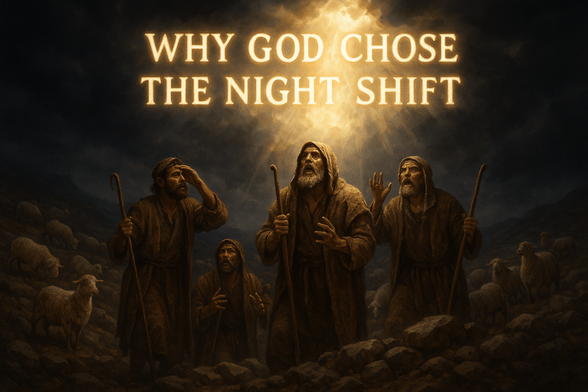
The shepherds weren’t just working-class guys pulling an honest wage. In the religious economy of first-century Palestine, they were untouchables. These men couldn’t testify in court because their word meant nothing. They couldn’t keep the ceremonial laws because their job made them perpetually unclean. They were the guys that “good” Jewish families warned their daughters about. And God looked at all the priests in the temple, all the scribes with their scrolls, all the Pharisees with their phylacteries, and said, “Nah, I’m going to tell the sheep guys first.”
That decision wasn’t random. It wasn’t because God couldn’t find anyone else awake at 2 AM. This was strategic. This was intentional. This was God firing the first shot in a revolution that would turn the religious world upside down. And if you’ve ever felt like you’re too messed up, too far gone, or too ordinary for God to use, then you need to understand what really happened that night when heaven invaded earth and chose the night shift to be its first witnesses.
The Untouchables: Understanding the Shepherd’s Place in Jewish Society
Let me paint you a picture of what it meant to be a shepherd in first-century Judea, and trust me, it’s not the romantic image we get from stained glass windows. These guys were the ancient equivalent of the crew that cleans portable toilets—necessary for society but nobody wanted to shake their hand afterward. The religious establishment had basically written them off as a lost cause, and here’s why.
First, the job itself made you religiously unclean pretty much 24/7. Think about it like being a diesel mechanic who can never quite get the grease out from under his fingernails, except instead of grease, it’s ritual impurity that excludes you from worship. Shepherds had to handle dead animals, work on the Sabbath (because sheep don’t take days off), and live in the fields where they couldn’t perform the ritual washings required by Jewish law. They were perpetually disqualified from temple worship by the very nature of their work. It’s like being a Christian who can never go to church because your job requires you to work every Sunday forever.
The Mishnah, which is basically the Jewish rulebook from that era, lumps shepherds in with tax collectors and gamblers as people whose testimony wasn’t valid in court. Let that sink in. If you were a shepherd and you witnessed a crime, your word literally didn’t count. You were legally invisible. The religious leaders considered shepherding such a sketchy profession that they taught young men to avoid it at all costs. There’s actually a rabbinic saying that goes, “No position in the world is as despised as that of the shepherd.” These weren’t just blue-collar workers; they were pariahs.
But here’s where it gets even more interesting. Many scholars believe the shepherds watching their flocks that night near Bethlehem weren’t just any shepherds—they were likely watching the temple flocks. These were the sheep destined for sacrifice in Jerusalem, just six miles away. So you’ve got these religiously unclean men raising religiously pure animals. They could touch the sacrifice but never participate in the worship. They provided the lambs for Passover but couldn’t celebrate it properly themselves. Talk about irony—they were essential to the religious system that excluded them.
The social stigma went beyond religious issues. Shepherds were often accused of being thieves because they grazed their flocks on other people’s land. Whether this was always true or just a stereotype, it stuck. Imagine being automatically suspected of theft every time you showed up in town, like a biker gang rolling into a suburban neighborhood. Mothers would grab their kids, merchants would watch their goods more carefully, and “respectable” people would cross to the other side of the street.
These men lived on the margins in every sense. They slept under the stars not because it was romantic but because they had to. They smelled like animals because they lived with animals. They were tough as nails because they had to fight off wolves and bears with nothing but a staff and a sling. They were the ancient world’s roughnecks, doing dangerous, dirty work that nobody else wanted to do. And when they came to town, everybody knew it and nobody was happy about it.
This is the crowd God chose for the greatest birth announcement in history. Not the high priest in his fancy robes. Not the Sanhedrin with their theological degrees. Not even the righteous common folk who kept the law and said their prayers. God sent a sky full of angels to guys who probably hadn’t seen the inside of a synagogue in years. He chose men whose testimony wouldn’t hold up in a human court to be the first witnesses of the divine invasion. And brother, if that doesn’t tell you something about how God operates, you’re not paying attention.
God’s Upside-Down Kingdom: Why Heaven Chose the Outcasts
When that night sky exploded with angelic glory over those shepherds’ fields, God wasn’t just making a random personnel decision. He was declaring war on every human system that says some people matter more than others. This wasn’t God working with what He had available—this was God making a statement that would echo through every generation about how His kingdom operates. And let me tell you, it’s the complete opposite of how we naturally think.
Consider the logistics for a moment. God could have announced Christ’s birth anywhere. The temple in Jerusalem was just six miles away, filled with priests who knew the prophecies backward and forward. Herod’s palace had scribes who could have immediately connected the dots to Micah’s prophecy about Bethlehem. There were synagogues full of faithful Jews who had been waiting for the Messiah for generations. But God bypassed all the “qualified” candidates and went straight to the disqualified. It’s like a CEO skipping the board meeting to announce the company’s biggest news to the night janitors first.
This pattern runs throughout Jesus’ entire ministry, but it starts here in the fields. The shepherds become the prototype for everyone Jesus would later choose—tax collectors like Matthew, zealots like Simon, fishermen like Peter who couldn’t keep his foot out of his mouth. Jesus consistently picked the people the religious establishment had written off. He touched lepers, ate with sinners, and made a Samaritan the hero of one of His most famous parables. The shepherd announcement wasn’t a fluke; it was the mission statement.
But here’s what really gets me: the message the angels delivered. “Do not be afraid; for behold, I bring you good news of great joy which will be for all the people.” All the people. Not just the religious elite. Not just the morally upright. Not just the people who had their act together. The angels were essentially telling these outcasts, “This includes you. Especially you.” The very men who couldn’t bring a lamb to the temple for sacrifice were the first to meet the Lamb of God who would take away the sins of the world.
The Greek word for “good news” in Luke’s account is “euangelion”—the same word we get “evangel” and “evangelical” from. In the Roman world, this word was used for major imperial announcements, like the birth of an emperor or a military victory. But God didn’t send this “euangelion” to Rome or even to Jerusalem’s power brokers. He sent it to men who represented everything the power structures despised. God was establishing a new empire, and He was recruiting from the bottom up.
Think about the shepherds’ response. They didn’t form a committee to discuss whether they were worthy to go see the Messiah. They didn’t worry about their appearance or their smell. They didn’t say, “But we’re unclean!” They just went. Luke tells us they went “with haste.” These men who were used to being excluded didn’t hesitate when heaven included them. They ran toward the invitation instead of away from it. That’s what happens when you finally realize God’s grace isn’t dependent on your religious resume.
And when they found Mary and Joseph and the baby, something beautiful happened. These rough men became the first evangelists. Luke says they “made known the statement which had been told them about this Child.” The guys whose testimony didn’t count in court became heaven’s witnesses. The men who were kept at arm’s length by religious society became the first to spread the good news. God didn’t just include them; He commissioned them. He turned their disqualification into their qualification.
This is the scandal of the Gospel in its first moments. Before Jesus challenged a single Pharisee, before He healed on the Sabbath, before He claimed to forgive sins, God had already thrown down the gauntlet. By choosing shepherds, He declared that His kingdom operates on different principles than human kingdoms. In God’s economy, the last are first, the weak are strong, and the outcasts get front-row seats. The very people religion pushes to the margins, God pulls to the center.
What This Means for Men Today: Your Disqualification Might Be Your Qualification
So here’s where this ancient story crashes into your life like a sledgehammer. Every man reading this has felt like those shepherds at some point. Maybe you’re the guy who works with his hands while others work with their minds, and you’ve wondered if God speaks more clearly to people with theology degrees. Maybe you’ve got a past that makes you feel permanently stained, like those shepherds who couldn’t get ceremonially clean no matter how hard they scrubbed. Or maybe you’re just an ordinary dude doing ordinary work, wondering if God really has any use for someone who isn’t changing the world from a platform or a pulpit.
Let me tell you something straight up: God’s recruitment strategy hasn’t changed. He’s still looking for shepherds. He’s still bypassing the self-righteous to get to the real. He’s still choosing the foolish things to shame the wise, the weak things to shame the strong. That thing you think disqualifies you? That might be exactly why God wants to use you. Your testimony might not hold up in the court of religious opinion, but it counts in the kingdom of God.
I think about men I know who feel like modern-day shepherds. The construction worker who thinks his vocabulary is too rough for church. The recovering addict who’s sure everyone can still smell the addiction on him. The divorced guy who feels like he’s wearing a scarlet letter in the singles ministry. The businessman who made some shady deals before he met Christ and wonders if that disqualifies him forever. The blue-collar father who can’t quote Scripture like the seminary graduates but loves Jesus with everything he’s got. Brothers, you’re in good company. You’re in shepherd company.
Here’s what the shepherd story teaches us: God doesn’t need your perfection; He wants your availability. Those shepherds didn’t clean up before they went to Bethlehem. They showed up smelling like sheep, and that was exactly how God wanted them. Your authenticity, your brokenness, your rough edges—these aren’t obstacles to God using you. They’re often the very things that make you useful. Because when God does something amazing through someone like you, nobody can mistake it for human achievement. It’s obviously God.
The shepherds also teach us about immediate obedience. When heaven shows up in your life—through a Scripture that hits you between the eyes, through a need you can meet, through an opportunity to share your story—don’t wait until you feel qualified. The shepherds didn’t form a self-improvement committee before they went to see Jesus. They went immediately, as they were. That’s the kind of response God is looking for. Not perfect people, but responsive people. Not the qualified, but the available.
But here’s the real kicker: after meeting Jesus, the shepherds went back to their sheep. They didn’t become priests or scribes or anything other than what they were. But Luke tells us they returned “glorifying and praising God for all that they had heard and seen.” They went back to the same fields, the same sheep, the same low-status job—but they were different. They had a story to tell. They had met the Messiah. Their occupation hadn’t changed, but their purpose had. They were still shepherds, but now they were shepherds who had seen the Lamb of God.
This is what God wants to do with you. He doesn’t necessarily want to change your job or your circumstances. He wants to change you. He wants to take you—with all your baggage, all your failures, all your ordinariness—and make you a witness to His grace. He wants to use your story, especially the parts you’re ashamed of, to reach other shepherds who think they’re too far gone for God to care about.
The religious establishment of Jesus’ day never got over His preference for the wrong crowd. They killed Him for it, actually. But He never apologized for it. From the shepherds at His birth to the thief on the cross at His death, Jesus consistently chose the outcasts. And He’s still doing it today. He’s looking for men who know they don’t deserve grace but are desperate enough to receive it anyway. Men who won’t let their past disqualify them from their future. Men who understand that God’s power shows up best in human weakness.
So whatever field you’re watching tonight—whether it’s a literal job site or a metaphorical place of isolation—know this: you’re not too far from God’s reach. Your disqualifications might be exactly what qualify you for God’s use. The same God who sent angels to shepherds knows exactly where you are and what you’re dealing with. And He’s got good news of great joy for you too. The question is: will you respond like the shepherds? Will you run toward the invitation instead of away from it? Will you let God use your story, mess and all, to reach other men who need to know they’re not too far gone?
The shepherds teach us that God’s grace doesn’t wait for us to get our act together. It meets us in the field, in the middle of our ordinary, messy lives. It chooses us not in spite of our outsider status but because of it. Because God’s kingdom has always been built by the wrong people—the ones religion rejects but heaven recruits. And brother, if you’re reading this and feeling like you don’t measure up, like you’re too stained or too simple or too far gone, then congratulations. You’re exactly the kind of person God specializes in using. Welcome to the shepherd club. The angels have a message for you too.
Conclusion
Brothers, we’ve walked through those ancient fields together and discovered something that changes everything. God chose shepherds—the untouchables, the unreliable, the unclean—to receive heaven’s greatest announcement. Not because He had no other options, but because He was establishing a kingdom where the last are first and the outcasts get front-row seats. This wasn’t a divine accident; it was a divine declaration about how God operates.
We’ve seen how these shepherds lived on the absolute bottom rung of Jewish society, excluded from worship by the very work that provided animals for worship. We’ve discovered how God’s choice of these men was the opening shot in a revolution that would flip every human value system on its head. And we’ve connected those ancient fields to our modern lives, recognizing that God is still recruiting shepherds—men who think their past, their job, or their struggles disqualify them from God’s work.
Here’s what I want you to take away from this: Your story matters. Your mess has a message. Your disqualifications might be exactly what God wants to use. Those shepherds went back to the same fields, but they went back changed. They had encountered the Lamb of God, and even though their circumstances didn’t change, their purpose did. They became witnesses to grace, living proof that God shows up for the people religion writes off.
So here’s my challenge to you: Stop waiting to be good enough for God to use you. Stop believing the lie that your past mistakes or current struggles put you on God’s bench. The same God who sent angels to shepherds knows exactly where you are right now, and He’s got work for you to do. Not when you get cleaned up. Not when you get your theology degree. Not when you finally have your life together. Right now, as you are, with all your rough edges and sheep smell.
If this hit home for you, if you’re realizing that maybe God’s been trying to recruit you while you’ve been disqualifying yourself, then let’s keep this conversation going. Subscribe to our newsletter where we dig into more truths about how God uses ordinary, broken men to build His extraordinary kingdom. Leave a comment below and share your own shepherd story—how has God used your disqualifications as qualifications? And if you need someone to talk to, someone who gets what it’s like to feel like an outsider looking in, reach out to me directly. Sometimes we all need another shepherd to remind us that we’re not too far gone for grace.
The shepherds teach us one final thing: when God includes you, you don’t keep it to yourself. They couldn’t help but tell everyone about what they had seen and heard. That’s what happens when grace breaks through—it overflows. You become a witness not because you have to, but because you can’t help it. Your story of being found in the field becomes hope for other men still hiding in theirs.
So whether you’re reading this at 2 AM because you can’t sleep, sitting in your truck on a job site, or stealing a few minutes between the chaos of life, hear this: The God who announced His Son’s birth to shepherds is announcing something to you today. You’re not too rough, too stained, or too ordinary for His purposes. In fact, you might be exactly what He’s looking for. The fields where you feel most alone might be where heaven shows up with good news of great joy.
The angels are still singing, brother. The question is: are you ready to leave your field and see what God has for you? The shepherds didn’t hesitate. Neither should you. Your Bethlehem moment might be closer than you think, and trust me, you don’t want to miss it because you thought you weren’t good enough to show up. In God’s upside-down kingdom, the shepherds get the first invitation. And that invitation still stands today.
Welcome to the story, shepherd. Now go tell somebody what you’ve seen.
Call to Action
If this study encouraged you, don’t just scroll on. Subscribe for more bible studies, share a comment about what God is teaching you, or reach out and tell me what you’re reflecting on today. Let’s grow in faith together.
D. Bryan King
Sources
- The Social Status of Shepherds in Biblical Times – Journal of Biblical Literature
- The Shepherds’ Fields Near Bethlehem – Biblical Archaeology Society
- Shepherds and Temple Flocks in First-Century Judea – Tyndale Bulletin
- Ritual Purity and Social Status in Ancient Judaism – Jewish Quarterly Review
- Shepherds in the Ancient World – Bible Odyssey
- Occupational Stigma in Ancient Palestine – Journal of Social History
- Barnes’ Notes on Luke 2 – Bible Study Tools
- Cambridge Bible Commentary on Luke 2
- The Mishnah’s View of Shepherds and Testimony – Studies in Judaism
- Why Shepherds? The Significance of the First Christmas Witnesses
- The Christmas Outcasts: Understanding the Shepherds – The Gospel Coalition
- The Shepherds and the Glory of God – Desiring God
- The Shepherds in the Fields – Biblical Training
- Shepherds as Social Outcasts in Biblical Times – Logos Bible Software
- The Historical Context of the Nativity – Patheos
Disclaimer:
The views and opinions expressed in this post are solely those of the author. The information provided is based on personal research, experience, and understanding of the subject matter at the time of writing. Readers should consult relevant experts or authorities for specific guidance related to their unique situations.
#biblicalMasculinity #biblicalOccupationalStigma #biblicalShepherdLife #biblicalSocialHierarchy #biblicalSocialOutcasts #ChristmasShepherdsStory #ChristmasStoryMen #divineRecruitmentStrategy #firstChristmasWitnesses #GodChoosesOutcasts #GodChoosesShepherds #GodChoosesTheLowly #GodRecruitsOutcasts #GodUsesBrokenPeople #GodUsesImperfectPeople #GodUsesOrdinaryPeople #GodUsesTheDespised #GodUsesTheRejected #GodUsesTheUnqualified #GodUsesTheWeak #GodSGraceForMen #GodSGraceOutcasts #GodSKingdomValues #GodSSurprisingChoices #GodSUpsideDownKingdom #JewishSocietyOutcasts #Luke2Shepherds #menFeelingUnworthy #menSBibleStudy #menSBibleTeaching #menSChristianGrowth #menSChristianLiving #menSDevotionalStudy #menSFaithJourney #menSSpiritualEncouragement #menSSpiritualGrowth #outcastsInTheBible #shepherdsAndAngels #shepherdsAnnouncementBirth #shepherdsBethlehemFields #shepherdsBiblicalTimes #shepherdsDivineAnnouncement #shepherdsFirstEvangelists #shepherdsFirstMissionaries #shepherdsGlorifyingGod #shepherdsGoodNews #shepherdsHumbleBirth #shepherdsImmediateObedience #shepherdsMeetJesus #shepherdsNativityStory #shepherdsReligiousExclusion #shepherdsRitualImpurity #shepherdsSocialStatus #shepherdsSpreadNews #shepherdsTempleFlocks #shepherdsTestimonyInvalid #shepherdsWitnessChrist #templeShepherdsBethlehem #uncleanShepherds