Turning #FlatClamFriday on its head; in New England, a long stretch of coastal mud exposed at low tide is called a clam flat. Interspersed below the surface will be infaunal (burrowing) clams like quahogs, razor clams and others. New England has a long history of local fishery management, with the clam flats being managed by a network of shellfish wardens! So be sure to get a clam permit from the warden before you set out to harvest for your chowda!
https://www.themainemag.com/how-to-go-clamming/
#clamFacts
How to Go Clamming - The Maine Mag

Along with the lauded lobster, one reason tourists flock to Vacationland every year is to consume basket upon basket of fried clams (along with steamed and chowdered clams). But did you know that anyone can dig for buried bivalves here?

The Maine Mag
For #FlatClamFriday, did you know some bivalves have a flat top? The zig-zag scallop for example is strongly "inequivalve", with one valve convex and the other flat or slightly concave! This is an adaptation for a "reclining" lifestyle on soft sands. The convex valve is like the hull of a boat, resting in the sediment and helping it avoid sinking into the quicksand-like substrate, while the flat valve is up top, helping the scallop keep a low profile just below the sand's surface. #clamFacts
For #FlatClamFriday with a bit of holiday spirit we have jingle shells (family Anomiidae)! Supposedly so named because they can create a jingling noise when strung together as wind chimes. These very thin bivalves live permanently cemented to hard surfaces, including other shells! One valve has a large byssal opening through which the bivalve applies the cement, basically fusing with the surface it lives on! https://islandnature.ca/2009/11/jingle-shells/ #clamFacts #JingleShellRock
For #FlatClamFriday we have the flat tree oyster (Isognomon alatus). These extremely flat bivalves are found in dense aggregations on the roots of mangrove trees, or in rocky areas with high sedimentation. They attach to the mangrove roots with a strong set of byssal threads. Their murky habitat makes them quite cryptic and hard to find, and their preferred mangrove home means habitat destruction is a major threat for them! #clamFacts https://www.shellmuseum.org/post/the-locally-elusive-flat-tree-oyster
The Locally Elusive Flat Tree Oyster

For years I’ve been searching for signs of the Flat Tree Oyster in our area. Not a true oyster, Isognomon alatus (Gmelin, 1791) is a rare find along the coast of Southwest Florida, with very few examples present (single digits) among the larger American museum collections. The species is found throughout the Caribbean, the Keys, and the East Coast of Florida. There are a couple of holdings in our collection from Marco Island, but only recently we confirmed the presence of the species in Lee Coun

shellmuseum
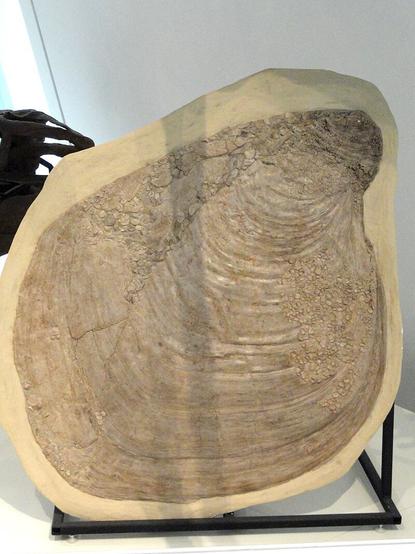
Today for #FlatClamFriday Platyceramus cycloides (prev. P. platinus), the biggest, flattest clams that ever lived. During the Cretaceous these meter-wide XXXL pizzas of the sea thrived in in a variety of habitats, particularly at the bottom of the Cretaceous Interior Seaway that covered much of N. America. Exceptional specimens have been found approaching 3 m in size! They hosted vibrant collections of symbiotic fish, bivalves, shrimp and other creatures in their shells! #clamFacts
Another #FlatClamFriday
I've written about Placuna placenta, the windowpane oyster. They're so flat you can literally see through their shell! There aren't many good pictures of them alive. As with other flat clams, they use their shape to raft on the soft substrate. But in some regions, they live in a "mud-sticker" orientation instead, with their rear embedded in the mud, all wedged in closely like dominoes. No one knows why they live so differently in different environments! #clamFacts
New hashtag: #FlatClamFriday
For the first, there is a group referred to as "flat clams" because they were indeed, very flat. They lived in the Triassic in deep water, anoxic areas, where they likely had a "reclining" lifestyle (resting on the sediment). They had to adapt to living on very fine muds, which would be like quicksand for most clams. They adapted by literally growing into snowshoes! Their large surface area allowed them to stay suspended on the surface of the mud! #clamFacts