 Suzanne ter Huurne
Wenkkrab vrouwtje | Fiddler Crab female
#dierentuin #burgerszoo #wenkkrab #fiddlercrab #zooanimals #crab #animalphotography
#dierentuin #burgerszoo #wenkkrab #fiddlercrab #zooanimals #crab #animalphotography

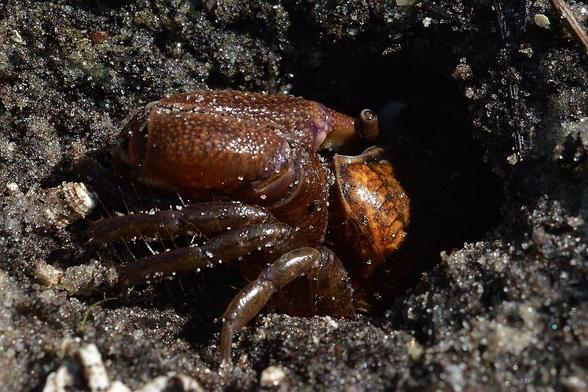
Male fiddler crabs don’t just wave—they vibrate. Oxford researchers uncovered rhythmic love songs hidden beneath the sand. #AnimalBehavior #FiddlerCrab #OxfordResearch
https://geekoo.news/fiddler-crabs-compose-love-songs-with-burrow-vibrations/
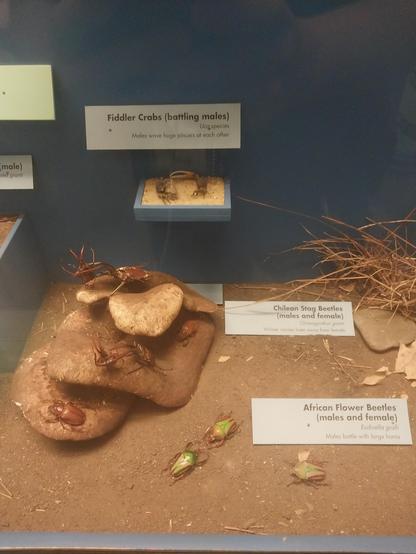
A recent post on regeneration of the large claw in fiddler crabs got me thinking about the rare double-handed males, i.e., males with two large claws. These have been reported in the scientific literature for about a dozen species, usually when a stray individual is found in nature, but occasionally from lab-reared studies. #FiddlerCrab
Here is a good example of one on iNaturalist: https://www.inaturalist.org/observations/171933073
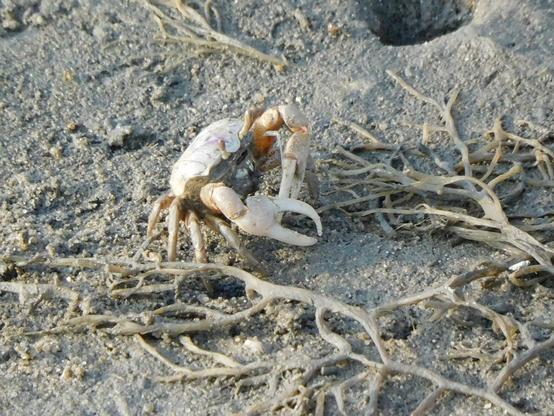
I've finally made progress on something I've wanted to do for a long time: field guides for fiddler crabs. They are now live at https://www.fiddlercrab.info/field_guides
#FiddlerCrab
I am currently anticipating 52 different guides covering different regions of the world, with about 2/3 complete (or very well drafted) at this initial release.
If there are any errors, issues, suggestions, etc., please let me know.
Our #FiddlerCrabOfTheWeek is the Polished Fiddler Crab, Tubuca polita, found on the northern coast of Australia from Brisbane to NW Western Australia.
It is a medium-sized #FiddlerCrab, reaching more than 2cm wide, with a salmon-red claw with pale pink fingers, and a marbled carapace of black, white, and aqua. This color combination is reasonably distinct within its range.
https://www.fiddlercrab.info/u_polita.html
https://www.inaturalist.org/taxa/739174-Tubuca-polita
Our #FiddlerCrabOfTheWeek is the Thin-fingered Fiddler Crab, Leptuca leptodactyla, found in the western Atlantic from the southern tip of Florida to southern Brazil.
It is a small #FiddlerCrab, slightly more than a cm wide, generally mostly white (sometimes speckled), with a pale yellow claw. It's coloration, combined with the long thin fingers of the claw generally make it easy to identify within its range.
https://www.fiddlercrab.info/u_leptodactyla.html
https://www.inaturalist.org/taxa/739161-Leptuca-leptodactyla
Our #FiddlerCrabOfTheWeek is the Orange-clawed Fiddler Crab, Gelasimus vomeris, found on the eastern coast of Australia and New Caledonia, with scattered reports from New Guinea.
It is a medium #FiddlerCrab, with a carapace about 2.5 cm wide, easy to identify within Australia by the shape and color of the large claw, orange on the bottom and white/pink on top. It is harder to distinguish from G. vocans in the non-Australian parts of its range.
https://www.fiddlercrab.info/u_vomeris.html
https://www.inaturalist.org/taxa/556006-Gelasimus-vomeris
 Ryan Hodnett
 Geekoo
 Charring Auh
 Michael Rosenberg