 Doc Cool
Neues ESP32-Projekt:
ESP32-CYD (Cheap Yellow Display) mit LVGL: 433 MHz On/Off-Timer Funk-Steckdosen-Steuerung
#Espressif #ESP32 #CYD #Arduino #Elektronik #Maker #DIY #Mikrocontroller #433MHz #Funksteckdose #FS1000A #Mikrowelle #LVGL
Neues ESP32-Projekt:
ESP32-CYD (Cheap Yellow Display) mit LVGL: 433 MHz On/Off-Timer Funk-Steckdosen-Steuerung
#Espressif #ESP32 #CYD #Arduino #Elektronik #Maker #DIY #Mikrocontroller #433MHz #Funksteckdose #FS1000A #Mikrowelle #LVGL
Neues ESP32-Projekt:
ESP32-CYD (Cheap Yellow Display) mit LVGL: 433 MHz On/Off-Timer Funk-Steckdosen-Steuerung
#Espressif #ESP32 #CYD #Arduino #Elektronik #Maker #DIY #Mikrocontroller #433MHz #Funksteckdose #FS1000A #Mikrowelle #LVGL
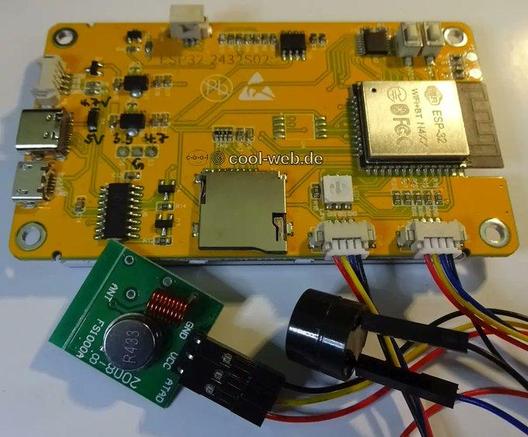
I can honestly say, I have no idea why I bought 10 of these 433Mhz receivers (HC12?), and 5 of these Transmitters (FS1000A).....
They are OOK/ASK. I found them in a box that has been in storage for years. The thing is I already have a bunch of these modules, and I don't use them. So I have no idea why I would buy more.

next #esp32 project is to turn a stupid ceiling fan that can only be controlled by a remote (because the previous homeowner was an idiot) into a "smart" one.
going to try two approaches since I'm seeing projects using both and why not?
Ordered a #FS1000A transmittion/receiver kit that operates at 315MHz, but since the fan remote operates at ~304MHz I also threw in an order of 303.875MHz quartz resonators so I can try out a little desolder/swap/solder on it in order to try out the project here: https://randomnerdtutorials.com/rf-433mhz-transmitter-receiver-module-with-arduino/
Also threw in an order for a #CC1101 module, based off the project here: https://github.com/patrickdk77/hampton-bay-fan-mqtt
The second one seems simpler, but I'm trying to get back into #soldering and when you're drunk on aliexpress it doesn't really hurt to throw $6 toward the communist regime for some electronic doohickeys to play with.

This post aims to be a complete guide for the popular RF 433MHz Transmitter/Receiver module. I’ll explain how it works, show some features and share an Arduino project example with code and schematics that you can take and apply to your own projects.
 LeRoy Miller
 He looks like he's [REDACTED]™