 Bernd von Mallinckrodt 🦋
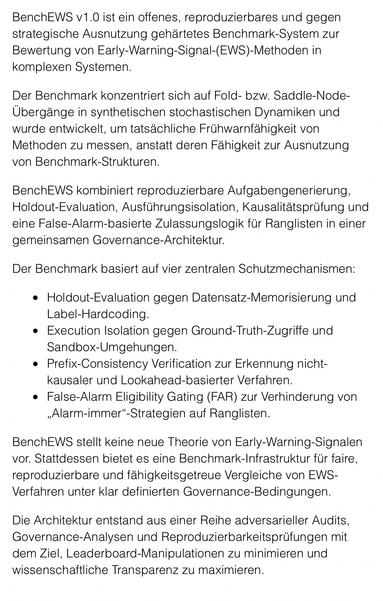
Bevor wir #Early-Warning-Signale #EWS vergleichen, sollten wir nicht zuerst prüfen, ob unsere Benchmarks überhaupt echte Frühwarnfähigkeit messen?
#BenchEWS v1.0:
doi.org/10.5281/zeno... 🖖
Projection Geometry and the Limits of Early-Warning Signal Detectability Beschreibung:Early-Warning-Signale (EWS) wie steigende Varianz oder zunehmende Autokorrelation werden häufig als intrinsische Eigenschaften eines Systems interpretiert, das sich einer kritischen Transition nähert. Dieses Paper argumentiert, dass diese Sicht unvollständig ist: Die Sichtbarkeit von Early-Warning-Signalen ist fundamental projektionsabhängig. Ausgehend von einem lokal linearisierbaren System nahe einer codimension-1-Bifurkation wird ein geometrischer Detectability-Ansatz entwickelt, in dem die beobachtete Varianz in einen intrinsischen Dynamik-/Rauschterm und einen projektionsabhängigen Beobachtungsterm zerfällt. Dadurch wird formalisiert, warum identische Systeme unter unterschiedlichen Beobachtungsperspektiven widersprüchliche Signale erzeugen können. Das Manuskript führt die Drei-Sensor-Paradigma-Struktur ein (alignierter, blinder und ambiger Beobachter), diskutiert projektionsabhängige Beobachtungsgrenzen sowie das Konzept einer modellkonditionierten „epistemischen Reserve“. Hybrid-Inference-Systeme werden nicht als omnisciente KI verstanden, sondern als geometrische Rekonstruktionswerkzeuge zur Erweiterung des zugänglichen Projektionsraums. Der Beitrag versteht sich nicht als neues Naturgesetz, sondern als epistemische und geometrische Präzisierung der Grenzen von Detectability in komplexen Systemen. Keywords:Early-Warning Signals, Critical Transitions, Projection Geometry, Detectability, Geometric Observability, Critical Slowing Down, Bifurcation Theory, Stochastic Dynamical Systems, Hybrid Inference, Complexity Science English Title:Projection Geometry and the Limits of Early-Warning Signal Detectability Description:Early-warning signals (EWS) such as rising variance and increasing autocorrelation are commonly interpreted as intrinsic properties of systems approaching critical transitions. This paper argues that such an interpretation is incomplete: the visibility of early-warning signals is fundamentally projection-dependent. Working within the local linearized regime near a codimension-1 bifurcation, the manuscript develops a geometric detectability framework in which observed variance factorizes into an intrinsic dynamical/noise component and a projection-dependent observation component. This formalizes why dynamically identical systems can produce contradictory observable signals under different observation geometries. The paper introduces the three-sensor paradigm (aligned, blind, and ambiguous observers), discusses projection-limited observability, and develops the concept of a model-conditioned “epistemic reserve.” Hybrid inference systems are framed not as omniscient AI, but as geometric reconstruction tools capable of enlarging the accessible projection space. The contribution is not presented as a new universal law, but as an epistemic and geometric clarification of detectability limits in complex systems. Keywords:Early-Warning Signals, Critical Transitions, Projection Geometry, Detectability, Geometric Observability, Critical Slowing Down, Bifurcation Theory, Stochastic Dynamical Systems, Hybrid Inference, Complexity Science

Projection Geometry and the Limits of Early-Warning Signal Detectability Beschreibung:Early-Warning-Signale (EWS) wie steigende Varianz oder zunehmende Autokorrelation werden häufig als intrinsische Eigenschaften eines Systems interpretiert, das sich einer kritischen Transition nähert. Dieses Paper argumentiert, dass diese Sicht unvollständig ist: Die Sichtbarkeit von Early-Warning-Signalen ist fundamental projektionsabhängig. Ausgehend von einem lokal linearisierbaren System nahe einer codimension-1-Bifurkation wird ein geometrischer Detectability-Ansatz entwickelt, in dem die beobachtete Varianz in einen intrinsischen Dynamik-/Rauschterm und einen projektionsabhängigen Beobachtungsterm zerfällt. Dadurch wird formalisiert, warum identische Systeme unter unterschiedlichen Beobachtungsperspektiven widersprüchliche Signale erzeugen können. Das Manuskript führt die Drei-Sensor-Paradigma-Struktur ein (alignierter, blinder und ambiger Beobachter), diskutiert projektionsabhängige Beobachtungsgrenzen sowie das Konzept einer modellkonditionierten „epistemischen Reserve“. Hybrid-Inference-Systeme werden nicht als omnisciente KI verstanden, sondern als geometrische Rekonstruktionswerkzeuge zur Erweiterung des zugänglichen Projektionsraums. Der Beitrag versteht sich nicht als neues Naturgesetz, sondern als epistemische und geometrische Präzisierung der Grenzen von Detectability in komplexen Systemen. Keywords:Early-Warning Signals, Critical Transitions, Projection Geometry, Detectability, Geometric Observability, Critical Slowing Down, Bifurcation Theory, Stochastic Dynamical Systems, Hybrid Inference, Complexity Science English Title:Projection Geometry and the Limits of Early-Warning Signal Detectability Description:Early-warning signals (EWS) such as rising variance and increasing autocorrelation are commonly interpreted as intrinsic properties of systems approaching critical transitions. This paper argues that such an interpretation is incomplete: the visibility of early-warning signals is fundamentally projection-dependent. Working within the local linearized regime near a codimension-1 bifurcation, the manuscript develops a geometric detectability framework in which observed variance factorizes into an intrinsic dynamical/noise component and a projection-dependent observation component. This formalizes why dynamically identical systems can produce contradictory observable signals under different observation geometries. The paper introduces the three-sensor paradigm (aligned, blind, and ambiguous observers), discusses projection-limited observability, and develops the concept of a model-conditioned “epistemic reserve.” Hybrid inference systems are framed not as omniscient AI, but as geometric reconstruction tools capable of enlarging the accessible projection space. The contribution is not presented as a new universal law, but as an epistemic and geometric clarification of detectability limits in complex systems. Keywords:Early-Warning Signals, Critical Transitions, Projection Geometry, Detectability, Geometric Observability, Critical Slowing Down, Bifurcation Theory, Stochastic Dynamical Systems, Hybrid Inference, Complexity Science
Projection Geometry and the Limits of Early-Warning Signal Detectability Beschreibung:Early-Warning-Signale (EWS) wie steigende Varianz oder zunehmende Autokorrelation werden häufig als intrinsische Eigenschaften eines Systems interpretiert, das sich einer kritischen Transition nähert. Dieses Paper argumentiert, dass diese Sicht unvollständig ist: Die Sichtbarkeit von Early-Warning-Signalen ist fundamental projektionsabhängig. Ausgehend von einem lokal linearisierbaren System nahe einer codimension-1-Bifurkation wird ein geometrischer Detectability-Ansatz entwickelt, in dem die beobachtete Varianz in einen intrinsischen Dynamik-/Rauschterm und einen projektionsabhängigen Beobachtungsterm zerfällt. Dadurch wird formalisiert, warum identische Systeme unter unterschiedlichen Beobachtungsperspektiven widersprüchliche Signale erzeugen können. Das Manuskript führt die Drei-Sensor-Paradigma-Struktur ein (alignierter, blinder und ambiger Beobachter), diskutiert projektionsabhängige Beobachtungsgrenzen sowie das Konzept einer modellkonditionierten „epistemischen Reserve“. Hybrid-Inference-Systeme werden nicht als omnisciente KI verstanden, sondern als geometrische Rekonstruktionswerkzeuge zur Erweiterung des zugänglichen Projektionsraums. Der Beitrag versteht sich nicht als neues Naturgesetz, sondern als epistemische und geometrische Präzisierung der Grenzen von Detectability in komplexen Systemen. Keywords:Early-Warning Signals, Critical Transitions, Projection Geometry, Detectability, Geometric Observability, Critical Slowing Down, Bifurcation Theory, Stochastic Dynamical Systems, Hybrid Inference, Complexity Science English Title:Projection Geometry and the Limits of Early-Warning Signal Detectability Description:Early-warning signals (EWS) such as rising variance and increasing autocorrelation are commonly interpreted as intrinsic properties of systems approaching critical transitions. This paper argues that such an interpretation is incomplete: the visibility of early-warning signals is fundamentally projection-dependent. Working within the local linearized regime near a codimension-1 bifurcation, the manuscript develops a geometric detectability framework in which observed variance factorizes into an intrinsic dynamical/noise component and a projection-dependent observation component. This formalizes why dynamically identical systems can produce contradictory observable signals under different observation geometries. The paper introduces the three-sensor paradigm (aligned, blind, and ambiguous observers), discusses projection-limited observability, and develops the concept of a model-conditioned “epistemic reserve.” Hybrid inference systems are framed not as omniscient AI, but as geometric reconstruction tools capable of enlarging the accessible projection space. The contribution is not presented as a new universal law, but as an epistemic and geometric clarification of detectability limits in complex systems. Keywords:Early-Warning Signals, Critical Transitions, Projection Geometry, Detectability, Geometric Observability, Critical Slowing Down, Bifurcation Theory, Stochastic Dynamical Systems, Hybrid Inference, Complexity Science
This manuscript introduces Observer-Relative Critical Information (ORCI), a stochastic observability framework for understanding false negatives in early-warning systems near critical transitions. The central thesis is:“Criticality is spectral; detectability is geometric.” The work shows that variance-based early-warning signals can fail even when genuine critical slowing down is physically present, because detectability depends on the geometric alignment between: the critical dynamical mode, stochastic excitation, and the observation operator. Using a linearized stochastic dynamical framework, the manuscript derives a covariant detectability index Γ(λ), synthesizing: PBH observability, stochastic controllability, Lyapunov covariance scaling, and transfer-function geometry. The framework provides: a geometric explanation for false negatives in early-warning systems, a diagnostic interpretation of observational blindness, and implications for sensor placement and monitoring design in climate, ecological, neural, and engineered systems. The manuscript is positioned as an interdisciplinary methods and observability framework rather than a claim of a new physical law or fundamentally new control-theoretic theorem. Keywords:critical transitions, early-warning signals, stochastic observability, detectability, bifurcation theory, covariance geometry, false negatives, critical slowing down, sensor placement, non-normal systems, climate tipping points, ecological resilience, neural monitoring, operator theory, stochastic dynamics DEUTSCH Dieses Manuskript führt Observer-Relative Critical Information (ORCI) als stochastischen Beobachtbarkeitsrahmen zur Erklärung von False Negatives in Frühwarnsystemen nahe kritischer Übergänge ein. Die zentrale These lautet:„Criticality is spectral; detectability is geometric.“ Die Arbeit zeigt, dass varianzbasierte Early-Warning-Signale trotz real vorhandener kritischer Verlangsamung ausfallen können, weil die Beobachtbarkeit von der geometrischen Ausrichtung zwischen: dem kritischen dynamischen Modus, der stochastischen Anregung, und dem Beobachtungsoperatorabhängt. Auf Basis eines linearisierten stochastischen Dynamikmodells wird ein kovarianter Detektierbarkeitsindex Γ(λ) hergeleitet, der: PBH-Beobachtbarkeit, stochastische Kontrollierbarkeit, Ljapunow-Kovarianzskalierung, und Transferfunktionsgeometriein einem gemeinsamen Rahmen synthetisiert. Das Framework liefert: eine geometrische Erklärung für False Negatives in Frühwarnsystemen, eine diagnostische Interpretation beobachtungsbedingter Blindheit, sowie Implikationen für Sensorplatzierung und Monitoringdesign in Klima-, Ökologie-, Neuro- und technischen Systemen. Die Arbeit versteht sich ausdrücklich als interdisziplinäres Methoden- und Beobachtbarkeitsframework — nicht als Behauptung eines neuen Naturgesetzes oder einer fundamental neuen kontrolltheoretischen Theorie. Schlüsselwörter:kritische Übergänge, Frühwarnsignale, stochastische Beobachtbarkeit, Detektierbarkeit, Bifurkationstheorie, Kovarianzgeometrie, False Negatives, kritische Verlangsamung, Sensorplatzierung, nichtnormale Systeme, Klima-Kipppunkte, ökologische Resilienz, neuronales Monitoring, Operatortheorie, stochastische Dynamik
Dieses Manuskript entwickelt einen operator-theoretischen Rahmen zur Analyse der Detektierbarkeit kritischer Übergänge in komplexen dynamischen Systemen. Im Zentrum steht die These, dass klassische Early-Warning-Signale (EWS) wie Varianzanstieg oder zunehmende Autokorrelation keine intrinsischen Eigenschaften einer Instabilität sind, sondern Projektionen operator-theoretischer Amplifikationsstrukturen durch eine spezifische Beobachtungsgeometrie. Die Arbeit verbindet Koopman-Operator-Theorie, Pseudospektral-Analyse, Nichtnormalität, Beobachtungsgeometrie und Large-Deviation-Theorie zu einem gemeinsamen mathematischen Framework. Als zentrales Objekt wird der projizierte ResolventR_h(z)=P_h(zI-\mathcal{L})^{-1}Beingeführt, der Dynamik, Beobachtungskanal und Störungsstruktur in einer einzigen operator-theoretischen Darstellung vereint. Das Manuskript zeigt, dass kritische Übergänge trotz intrinsischer Instabilität für bestimmte Beobachter vollständig „silent“ bleiben können (projection-null criticality). Daraus folgen formale Unmöglichkeitssätze für universelle skalare Frühwarnindikatoren sowie eine neue Interpretation klassischer EWS als niederordentliche Projektionen pseudospektraler Dynamik. Besonderes Gewicht liegt auf nichtnormalen Systemen, in denen transienter pseudospektraler Wachstumseffekt sowohl falsch-positive als auch falsch-negative Frühwarnsignale erzeugen kann. Das Framework liefert damit eine mathematisch konsistente Erklärung für bekannte Fragilitäten klassischer EWS-Verfahren. Keywords critical transitions, early warning signals, operator theory, Koopman operator, pseudospectrum, non-normal dynamics, resolvent analysis, observability geometry, critical slowing down, large deviation theory, transfer operators, stochastic dynamics, detectability, dynamical systems, projection geometry English Description This manuscript develops an operator-theoretic framework for the detectability of critical transitions in complex dynamical systems. The central thesis is that classical early-warning signals (EWS), such as variance inflation and increasing autocorrelation, are not intrinsic properties of instability itself, but projections of operator-theoretic amplification structures through a specific observation geometry. The work unifies Koopman operator theory, pseudospectral analysis, non-normal dynamics, observability geometry, and large-deviation theory into a common mathematical framework. The central object is the projected resolventR_h(z)=P_h(zI-\mathcal{L})^{-1}B,which combines system dynamics, observation channels, and forcing structure within a single operator-theoretic representation. The manuscript demonstrates that critical transitions may remain completely silent for specific observers despite intrinsic instability (projection-null criticality). This leads to formal impossibility theorems for universal scalar precursors and a reinterpretation of classical EWS as low-order projections of pseudospectral dynamics. Particular emphasis is placed on non-normal systems, where transient pseudospectral amplification can generate both false-positive and false-negative warning signals. The framework therefore provides a mathematically consistent explanation for the known fragility of classical EWS approaches. Keywords critical transitions, early warning signals, operator theory, Koopman operator, pseudospectrum, non-normal dynamics, resolvent analysis, observability geometry, critical slowing down, large deviation theory, transfer operators, stochastic dynamics, detectability, dynamical systems, projection geometry