
Les drones pourraient « voler indéfiniment » grâce à l’albatros, une avancée qui bouleverse l’industrie aéronautique et menace l’emploi des pilotes - HelloBiz.fr
Les avancées technologiques s'inspirant de la nature ne cessent de révolutionner le monde de l'aviation. Le professeur Sameh Elsa, de l'université de Californie, et son équipe travaillent sur un projet novateur : concevoir des drones inspirés par les techniques de vol des albatros. Ces oiseaux, parmi les plus grands au monde avec une envergure de
Joe Manor's protype glider is successfully ridge soaring.
This prototype is a 'foamy'...very light, very low wing loading. (For the speed record attempt it will be a larger glider, much heavier, much higher wing loading.)
1st Successful Flights Recap
https://youtu.be/yVYNGoMCRk0?t=171
#Aviation #Avgeek #Supersonic #Aerodynamics #Glider #DynamicSoaring #RidgeSoaring

1st Successful Flights Recap
Dynamic soaring - a way for birds, such as the albatross, to fly long times and distances without flapping their wings...and a way for RC gliders to go very, very fast.
https://en.wikipedia.org/wiki/Dynamic_soaring
A new design will attempt new speed records in the coming months. Perhaps go supersonic?
https://www.youtube.com/watch?v=iC1jrMMVxd4
Joe Manor has been doing this for years. Here's a flight from 2013 with a more traditional glider design:
https://www.youtube.com/watch?v=T4OGUYlx_28
#AvGeek #Aviation #ElectricAircraft #ExperimentalAviation #Homebuilt #Glider #DIY #DynamicSoaring #SuperSonic #Aerodynamics
Dynamic soaring - Wikipedia

'Dynamic Soaring' Trick Could Speed Spacecraft Across Interstellar Space
Sailing to the stars on the scale of human lifetimes could be a matter of choosing the right kind of wind.
New research unlocks clues about the iconic flight of the #WanderingAlbatross
https://phys.org/news/2022-11-clues-iconic-flight-albatross.html
Observations and models of across-wind flight speed of the wandering #albatross https://royalsocietypublishing.org/doi/10.1098/rsos.211364
#WanderingAlbatrosses limit their maximum across-wind airspeeds to ~ 20 m/s in higher wind speeds (and greater wind turbulence), probably to keep the aerodynamic force on their wings during #DynamicSoaring well below the mechanically-tolerable limits of wing strength.
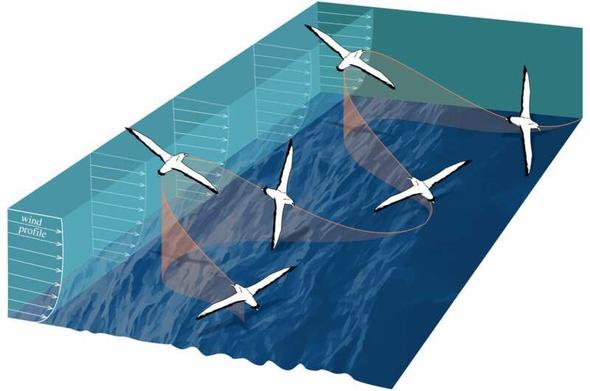

New research unlocks clues about the iconic flight of the wandering albatross
Wandering albatrosses, which are an iconic sight in the Southern Ocean, are highly adapted to long-distance soaring flight. Their wingspan of up to 11 feet is the largest known of any living bird, and yet wandering albatrosses fly while hardly flapping their wings. Instead, they depend on dynamic soaring—which exploits wind shear near the ocean surface to gain energy—in addition to updrafts and turbulence.
Dynamic soaring as a means to exceed the solar wind speed
( surfing the solarsystem heliopause to approach 2% c within two anda half years)
https://www.frontiersin.org/articles/10.3389/frspt.2022.1017442/full
Prior article (PDF file)
https://t.co/BjAWaIeqdN
#AtomicRockets #SpaceShip #SpaceCraft #DynamicSoaring


Dynamic soaring as a means to exceed the solar wind speed
A technique by which a spacecraft can interact with flows of ionized gas in space (the solar wind or interstellar medium) in order to be accelerated to velocities greater than the flow velocity is explored. Inspired by the dynamic soaring maneuvers performed by sea birds and gliders in which differences in wind speed are exploited to gain velocity, in the proposed technique a lift-generating spacecraft circles between regions of the heliosphere that have different wind speeds, gaining energy in the process without the use of propellant and only modest onboard power requirements. In the simplest analysis, the spacecraft motion can be modeled as a series of elastic collisions between regions of the medium moving at different speeds. More detailed models of the spacecraft trajectory are developed to predict the potential velocity gains and the maximum velocity that may be achieved in terms of the lift-to-drag ratio of the vehicle. A lift-generating mechanism is proposed in which power is extracted from the flow over the vehicle in the flight direction and then used to accelerate the surrounding medium in the transverse direction, generating lift (i.e., a force perpendicular to the flow). Large values of lift-to-drag ratio are shown to be possible in the case where a small transverse velocity is imparted over a large area of interaction. The requirement for a large interaction area in the extremely low density of the heliosphere precludes the use of a physical wing, but the us...
 AlcorNews
 TomKrajci 🇺🇦 🏳️🌈 🏳️⚧️
 Winchell Chung ⚛🚀
 Lukas VFN 🇪🇺