Call for contributions to the next curated zine in my “series” aimed at countering this christofascist era:

“The Heart Is a Muscle:
XX Embodiments of Antifascist Grief”

Length: approx. 75 to 250 words
Due: by or before August 4
Email: cbmilstein [at] yahoo [dot] com

Please read my previous post for more details on this zine, including a series of prompts that hopefully will generate contributions coming at the overall theme from varied directions. As another aid—or rather, some inspiration—in nudging you to consider submitting an anecdote, here’s a story I said “yes” to already for inclusion in this zine:

🖤🌹🖤

“Grief is a tightrope I walk. On the one end, there’s the seemingly surreal amount of suffering, loss, death, pain, and hate. On the other, the connections, love, resistance, and refusal of my networks of kin and comrades. For my own well-being, balance is essential. To fall off this tightrope means to enter into crisis. And crises for me are the hopeless places of despair, suicidality, and addiction. I do not want to go back there, for I’ve worked too hard to get out.

“This moment is challenging: it seems incomprehensible, yet demands that we live it. To accept reality yet not consent to its impositions is a difficult proposition. To be awake in a world awash in pain is to risk drowning in it. So I must set boundaries. I limit my intake of news. I make space for play. I reach out to others.

“At my best, all I have done is say, ‘Friend, you don’t need to carry this alone.’ I believe it is through collectively carrying the infinite weight of stolen lives, the weight of loss, injustice, fear, genocide, state terror, and fascism, that we forge collective memory. It is how we fight back against forgetting. And it is how together, we can walk forward, balanced in defiant grief. No one can hold all of this alone. We must all lend a hand to keep one another from falling.”
—Scott Campbell

#RebelliousMourning
#CollectiveWorkOfGrief

(photo: “Revolutionary love” tag, red on a concrete barrier, seen in Montreal, July 2025—because we only grieve what we love, and by mourning our losses, we put our love into “direct action” to fight for the living)

Call for contributions to the next curated zine in my “series” aimed at countering this christofascist era:

“The Heart Is a Muscle:
XX Embodiments of Antifascist Grief”

Length: approx. 75 to 250 words
Due: by or before August 4
Email: cbmilstein [at] yahoo [dot] com

This next collection of (your) voices revolves around the rivers of rage and seas of sorrow that are distinctive to this moment. It aims to both name the myriad and specific types of grief we feel in light of neofascisms taking hold across this imperiled earth, and share stories of how grief fuels our resolve and generates new ways to struggle against fascism.

As prompts to help shape your contributions:

1. What’s particular about the form(s) grief and losses that you’re experiencing at present? How does grief feel different and even surprising? What is it bringing up for you? What novel or surprising losses are you suddenly facing?

2. How do you embody that grief? Where do you see and feel it?

3. Where are your feelings of grief over fascism leading you? What are they generating? What are they compelling you to do, want to do, or not do? And with whom? Or where? Or how?

4. In what ways has your antifascist grief showed up—especially publicly, politically, and/or collectively—as practices of “rebellious mourning”?

5. What example from your own life, circles, or communities can you share that embody a “direct action of the grieving”? How have our shared patterns of losses and griefs under fascism fueled rituals of resistance, community self-defense, collective care, and/or solidarity?

Please only send me pieces that speak to grief and mourning that explicitly arise from an anarchistic as well as antifascist impulse, and center on “antifascist grief,” not timeless or decontextualed grief (crucial as that is too).

#RebelliousMourning
#CollectiveWorkOfGrief

(photo: “mourn the dead & fight like hell for the living” sticker, Pittsburgh, 2025)

Call for contributions to the next curated zine in my “series” to counter this christofascist era:

“The Heart Is a Muscle:
XX Embodiments of Antifascist Grief”

Length: approx. 75 to 250 words
Due: by or before August 1
Email: cbmilstein [at] yahoo [dot] com

Of late—or rather, for many months—it feels sadly routine to get one or several texts daily in which a friend, old or new, says: “I’m struggling.” Those two words are like clockwork in their regularity, as if counting out how the days, hours, or seconds of these sadistic times tear at our very souls. They are followed, invariably, by more detail of why that particular person is struggling, and how much it’s breaking their body, heart, and spirit. And while each “I’m struggling” is an individual story, there are patterns among these tales that transcend a lone experience, revealing a collective impact that can be summarized, I’d argue, in one word.

Grief.

“Grief” is shorthand for the impossible-to-summarize mountains of our losses, which in turn carve out rivers of rage and seas of sorrow. It’s healthy, given all of this, to know one is struggling. It means you still have a heart and are busily exercising that muscle. And by sending off a *simple* text or leaving a voicemail or penning a letter or posting on social media that you’re having a rough go of it, you’re showing others that you still have a heart, and you’re being met in turn by those who still have a heart too, and together, our grief is held by our love.

For we only grieve what we love, and despite the slogan “grief is love with no place to go,” it does take us places; it does have a place to go.

Through grief-as-love, we can find each other, naming the dimensions of how we embody antifascist mourning, so we can share and cope with it. We can take better care of each other, whether via communal rituals, social solidarity, or community self-defense. Grief can fuel our resolve and generate new ways to struggle against fascism.

Long story short: I’m seeking your musings on how you’re embodying your antifascist grief—what it feels like, where it leads you, with whom, and/or how.

For previous (free and downloadable!) zines in this series, see:

https://itsgoingdown.org/author/cindy-milstein/

#RebelliousMourning
#CollectiveWorkOfGrief
#DirectActionOfTheAggrieved

(photo: circle A heart, tag, Montreal, 2025)

Sparks of rebellious inspiration have a funny way of not staying put in one time or space. They traverse borders. They congregate without permission in all sorts of unexpected places. They defy the logics of commodification, freely sharing with and borrowing from each other, while also defying the logics of colonialism and states, offering life-giving solidarity to weather and contest their death machinery.

We never know, when we release tiny sparks into the enormous darkness of this social order, where they will end up, if they manage to stay alighted at all. Or who will see them, or where or when, much less what they will make of those sparks. Most often, we never know, and don’t really need to.

Yet we do need to remember that each and every one of us who aspires to kindle the flames of a new world does indeed put out sparks into the night via all our many gifts. And just as we find inspiration in those random sparks that we stumble on and run with, others will likely do the same with what we release into the wind to stir up social transformation.

But occasionally, we get to see and feel the fruits of reciprocal inspiration—proof positive that our liberatory strivings can soar above walls and fences to magnify resistance. Or simply to supply each other with the further inspiration to keep fighting and dreaming.

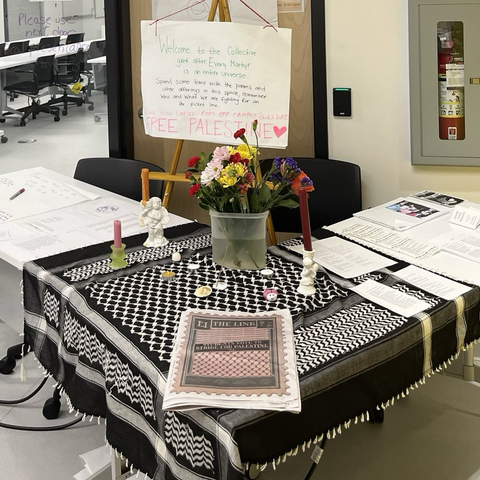
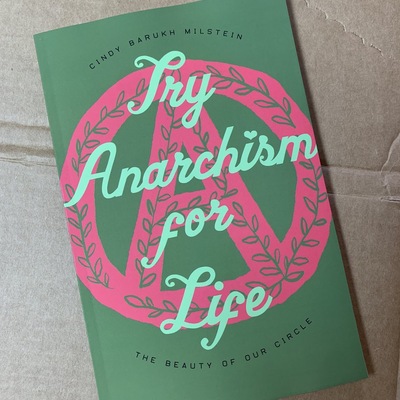
The past two days in Montreal, some 85,000 students went on strike in solidarity with Palestinians, timed to coincide with NATO meetings in that city. This student strike, in turn, finds echoes of inspiration in years of powerful student and social strikes in Montreal. And just as I was feeling FOMO that I couldn’t be there for this strike, a Concordia student texted me these photos (used with consent) of an altar they’d set up as both a blockade in their classroom and collective space of grief, inspired by the stories in my edited anthology #RebelliousMourning (@akpressdistro, with striking design by @eff_charm).

May our arts of inspiration, resistance, and remembrance burst into rebel bonfires, illuminating our ancestors there alongside us and honoring them as we journey toward freedom.

#CollectiveWorkOfGrief
#SolidarityIsOurBestWeapon

Grief lands us in unexpected places. And it’s how we create collective room for processing it that allows us to journey through our grief in ways that make it more bearable, especially related to unnecessary losses.

Yet it still felt surprising to see my edited anthology “Rebellious Mourning: The Collective Work of Grief” (AK Press, with poignant design by @eff_charm, including cover art honoring David Ware, a Black man murdered on January 23, 2007, by police in Ypsilanti, Michigan) in a literal room in a museum—a respite room, to be exact.

The term “respite” refers to offering temporary care in the form of a period of rest and relief. Meaning it’s only an interval in the grinding violence of, in this case, anti-Black racism.

Such respite feels crucial in the context of this museum exhibition, “An Archaeology of Silence,” being held now at the @deyoungmuseum. The exhibit is described thusly: “Artist Kehinde Wiley’s new body of paintings and sculptures confronts the silence surrounding systemic violence against Black people through the visual language of the fallen figure. … [Deaths] are transformed into a powerful elegy of resistance. The resulting paintings of figures struck down, wounded, or dead, referencing iconic paintings of mythical heroes, martyrs, and saints, offer a haunting meditation on the legacies of colonialism and systemic racism.”

Mourning and honoring the systemic loss of Black life should include some comfort, some relief. But how could this not be temporary given the lengthy, genocidal history of anti-Blackness along with the ongoing brutality of white supremacy, policing and prison systems, and increasingly outright fascism?

The choice of “respite” for a room filled with grief-related books and, I imagine, some breathing space from the heaviness of this exhibition feels appropriate: there can be no real, sustained relief in this world. How we mourn, though, has an intimate, inseparable relation to how we go about fighting for social transformation—or it should. Our ancestors, so many of them still existing as “unquiet ghosts” far from being at peace, demand no less.

#RebelliousMourning
#NoMoreStolenLives
#CollectiveWorkOfGrief

https://www.akpress.org/rebellious-mourning.html

(Thanks to Steve Rhodes for sending me this photo)

Rebellious Mourning

The intimate yet tenacious writing in this volume shows that mourning can pry open spaces of contestation and reconstruction, empathy and solidarity. With contributions from Claudia Rankine, Sarah Schulman, David Wojnarowicz, Leanne Betasamosake Simpson, David Gilbert, and nineteen others.

“How’s your covid grief these days?”

Those words, which traveled across an ocean and many borders as a DM, supplied a recognition that’s too rare in this so-called post-pandemic world: someone else feels stuck in mourning.

For without collective reckoning of what humanity has gone and is still going through …

Without collective processing of the innumerable losses as our sacred shared duty …

Without public do-it-ourselves altars, memorials, and other pandemic grief spaces woven into the public landscape, acknowledging the immensity of the collective and individual trauma and myriad absences …

Without honoring our dead and actively fighting for the living …

Without collective care for those who are sick, disabled, grappling with long covid, or dying …

Without people routinely inquiring into each other’s losses in this world where there’s so much to mourn and grieving demands its own good, communal time …

Without masks and other visible gestures of everyday forms of looking out for the well-being of all …

Without regard for how some people are being cut off from living fully and in community because they are at risk while so much of social and work life is “back to normal” …

Without those in our own anarchist(ic) circles steadfastly, reciprocally, and without question always including and lovingly abiding by covid and other harm reduction as practices in all our spaces …

How can one not be stuck?

How can one not feel dead inside? A hollow shell? Alone?

Grieving needs the company of others, not merely to hold the profundity of any loss and make it more bearable, but to witness, believe, and remember the loss, and thus integrate it into how we want to move forward.

Without that, especially in the face of the human-made catastrophe of a global pandemic, most of humanity has shifted backward into a delusional normal that denies both death and qualitative life, thereby ensuring the hum of a murderous social system.

A few, too few, take time to ask each other and really listen to the reply, “How’s your grief?”

With that small act, mourning rebelliously finds some ground for us to get unstuck.

#CollectiveCare
#RebelliousMourning
#CollectiveWorkOfGrief

(photo: black-and-white etching-style image of skull wheat pasted on a white-painted brick wall, with the edge of the forehead peeling off a bit, as seen in Tio’tia:ke/Montreal, winter 2023)