We are offering a 2-year postdoctoral position at CIMCyC (Granada, Spain) to work on the psychology of dis(mis)information.
Apply before 26th September. Nice city, great environment ☺️
Please share! 🔃
cimcyc.ugr.es/en/informati...
#socialpsychology
#cogpsyc
#PsychSciSky
#PsychJob
#PhDJobJob Offer: Postdoctoral Resear...
Job Offer: Postdoctoral Researcher in Disinformation
As part of the strategic plan linked to the María de Maeztu Seal of Excellence award, the CIMCYC is recruiting a postdoctoral researcher with experience in the field of the psychology of disinformation. This person will be responsible for working with researchers at the center to develop a new line of research focused on this topic, applied to the center's various areas of research where disinformation exists among the non-expert public.
Reminder (now with hashtags):
We are offering a 2-year postdoctoral position at CIMCyC (Granada, Spain) to work on the psychology of dis(mis)information.
Nice environment, great city!
Apply before 26th September.
Please share! 🔃
#socialpsychology
#cogpsyc
#PsychSciSky
#PsychJob
#PhDJob
RE: https://bsky.app/profile/did:plc:3d7uboipn2kpfyb6gyhu3wit/post/3lyhsarjnm22cPostdoctoral job offer:
Do you want to join us to conduct research on the psychology of dis(mis)information in Granada, Spain? You will also have the opportunity to participate in popularization activities.
📆Apply before Sept 26th!
#socialpsyc
#cogpsyc
#PsychSciSky
#polipsy
RE: https://bsky.app/profile/did:plc:3d7uboipn2kpfyb6gyhu3wit/post/3lyhsarjnm22cLOL
https://medicalnewsbulletin.com/are-men-better-at-reading-maps/do men refuse to ask for directions because they think their female navigator is just bad at maps? more fool them!
#CogPsyc #devpsychsky #feministsky 🧪

Are men better at reading maps? | Medical News Bulletin
A study investigating differences in spatial cognition between men and women seeks to answer the age-old question, are men better at ...

redsolver (@redsolver.dev)
Developer, working on content-addressed storage/routing networks (https://sfive.net), custom feeds for Bluesky (@skyfeed.app) and other cool open-source stuff!
Matrix: @red:y4y.me
Email: [email protected]
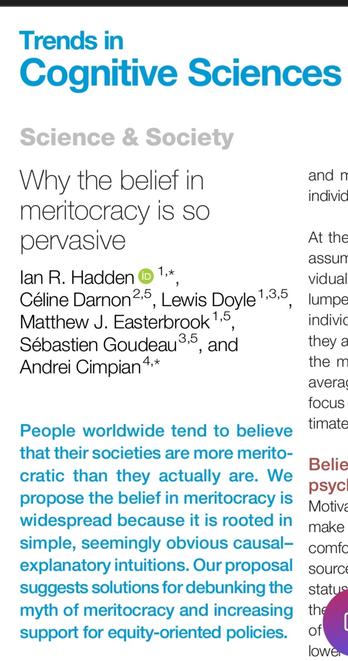
Why is the belief in meritocracy so pervasive?
New article argues that the dose–response schema for causes and effects may encourage us to believe that what we get out of life depends on what we put in:
"More effort = more success!"
doi.org/10.1016/j.ti...
#SocialPsyc #CogPsyc #AcademicSky 🧪
redsolver (@redsolver.dev)
Developer, working on content-addressed storage/routing networks (https://sfive.net), custom feeds for Bluesky (@skyfeed.app) and other cool open-source stuff!
Matrix: @red:y4y.me
Email: [email protected]
And here's a list of psychology-related starter packs including experts in fields such as:
#SocialPsyc
#CogPsyc
#DevPsyc
#PolPsych
Vision Science
Culture & Evolution
#MentalHealth
Body-brain interactions
Gender research
Relationship science
#Autism
Click here and scroll up...
RE:
https://bsky.app/profile/did:plc:4jb3re5tvklsvhuc3lkerj5q/post/3lamtukltbs2o"We have advanced a pragmatic, problem-centric account of theoretical virtues, which draws on the cognitive sciences and theory development in those fields."
doi.org/10.1007/s421...
BSky authors:
@anids.bsky.social
@neurostats.org
@freekoudemaatman.bsky.social
#PhilSci #CogPsyc 🧪
“Cognitive Science needs (theoretical) problem-finding as much as (empirical) problem-solving.”
doi.org/10.1007/s421...
BSky author:
@fedeadolfi.bsky.social
#PhilSci #CogPsyc #MetaSci 🧪


From Empirical Problem-Solving to Theoretical Problem-Finding Perspectives on the Cognitive Sciences - Computational Brain & Behavior
Meta-theoretical perspectives on the research problems and activities of (cognitive) scientists often emphasize empirical problems and problem-solving as the main aspects that account for scientific progress. While certainly useful to shed light on issues of theory-observation relationships, these conceptual analyses typically begin when empirical problems are already there for researchers to solve. As a result, the role of theoretical problems and problem-finding remain comparatively obscure. How do the scientific problems of Cognitive Science arise, and what do they comprise, empirically and theoretically? Here, we attempt to understand the research activities that lead to adequate explanations through a broader conception of the problems researchers must attend to and how they come about. To this end, we bring theoretical problems and problem-finding out of obscurity to paint a more integrative picture of how these complement empirical problems and problem-solving to advance cognitive science.
 Fernando Blanco 🦋 🏳️🌈 🏳️⚧️
 Jo at Medical News Bulletin
 Mark Rubin