
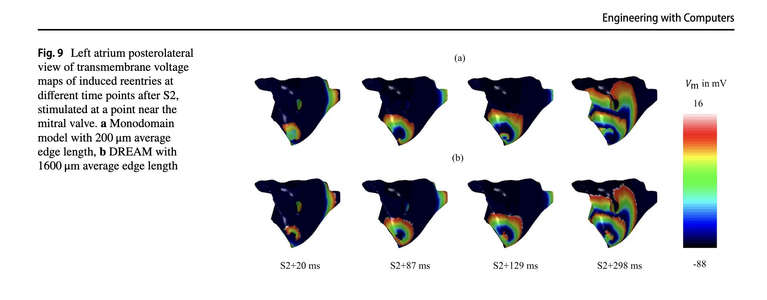
Our use case partner Axel Loewe has published "A cyclical fast iterative method for simulating reentries in cardiac electrophysiology using an eikonal-based model": The DREAM model, which incorporates conduction velocity restitution and an approximated reaction-diffusion component, significantly accelerates the simulation of complex cardiac arrhythmias compared to traditional models.

https://zenodo.org/records/14906903

#openCARP #CardiacModeling #EikonalModel #digitalization #ditrare @fiz_karlsruhe
A cyclical fast iterative method for simulating reentries in cardiac electrophysiology using an eikonal-based model

Computer models for simulating cardiac electrophysiology are valuable tools for research and clinical applications. Traditional reaction–diffusion (RD) models used for these purposes are computationally expensive. While eikonal models offer a faster alternative, they are not well-suited to study cardiac arrhythmias driven by reentrant activity. The present work extends the diffusion–reaction eikonal alternant model (DREAM), incorporating conduction velocity (CV) restitution for simulating complex cardiac arrhythmias. The DREAM modifies the fast iterative method to model cyclical behavior, dynamic boundary conditions, and frequency-dependent anisotropic CV. Additionally, the model alternates with an approximated RD model, using a detailed ionic model for the reaction term and a triple-Gaussian to approximate the diffusion term. The DREAM and monodomain models were compared, simulating reentries in 2D manifolds with different resolutions. The DREAM produced similar results across all resolutions, while experiments with the monodomain model failed at lower resolutions. CV restitution curves obtained using the DREAM closely approximated those produced by the monodomain simulations. Reentry in 2D sheets yielded similar results in vulnerable window and mean reentry duration for low CV in both models. In the left atrium, most inducing points identified by the DREAM were also present in the high-resolution monodomain model. DREAM’s reentry simulations on meshes with an average edge length of 1600µm were 87x faster than monodomain simulations at 20µm . This work establishes the mathematical foundation for using the accelerated DREAM simulation method for cardiac electrophysiology. Cardiac research applications are enabled by a publicly available implementation in the openCARP simulator.  
Zenodo

New paper from our colleague Axel Loewe from Institute of Biomedical Engineering on investigating the long-overlooked role of the right atrium in atrial fibrillation using patient-specific computer models:

Martínez Díaz, P., Sánchez, J., Fitzen, N., Ravens, U., Dössel, O., Loewe, A.: The right atrium affects in silico arrhythmia vulnerability in both atria. Heart Rhythm 2024;-:1–7
https://zenodo.org/records/11187364

@fiz_karlsruhe @AnnaJacyszyn #Cardiology #HeartHealth #CardiacModeling

The right atrium affects in silico arrhythmia vulnerability in both atria

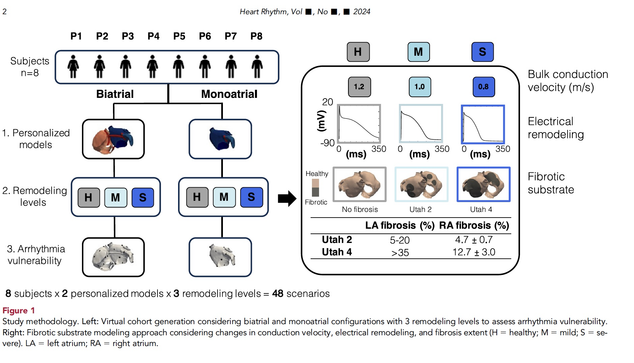
The role of the right atrium (RA) in atrial fibrillation (AF) has long been overlooked. Multiple studies have examined clinical conditions associated with AF, such as atrial enlargement, fibrosis extent, electrical remodeling, and wall thickening, but have been mainly concentrated on the left atrium (LA). AF research predominantly focuses on the LA because of 2 key paradigms. First, the well-established view that AF onset is primarily triggered by activity originating in the pulmonary veins of the LA.1 Second, comorbidities linked to AF, such as hypertension, valvular disease, and heart failure, primarily impact the left side of the heart, contributing to increased mortality and reduced quality of life. Thus, AF research continues to focus mostly on the LA, and, as a consequence, the role of the RA in AF is barely understood. With the advent of personalized medicine, patient-specific computer models of the atria are enhancing our understanding of intricate interactions during AF and have already been used to identify ablation targets, tailor ablation strategies, and predict recurrence in AF patients.2–5 Nevertheless, those methodologies did not specifically focus on the role of the RA, with some excluding RA tissue and others neglecting the assessment of AF induction or maintenance from RA sources. Computer models of the atria can aid in assessing how the RA influences arrhythmia vulnerability and in studying the role of RA drivers in the induction of AF, both aspects difficult to assess clinically and experimentally. This work assesses the “Creative Concept” of incorporating the RA in computational arrhythmia studies based on 1398 virtual pacing sequences in  8 biatrial and 8 monoatrial patient-specific models under 3 different substrate conditions, resulting in a total of 48 distinct model configurations.

Zenodo

http://sciencedirect.com/science/articl…

A new paper with @[email protected] and twitter-less Michele Torre and Simone Morganti @[email protected]. Another key step in bringing the computational efficiency of #isogeometricanalysis (#IGA) to #CardiacModeling

https://www.sciencedirect.com/science/article/pii/S004578252200812X?dgcid=coauthor

A new paper with @[email protected] and twitter-less Michele Conti and Simone Morganti @[email protected]. Another key step in bringing the computational efficiency of #isogeometricanalysis (#IGA) to #CardiacModeling
