
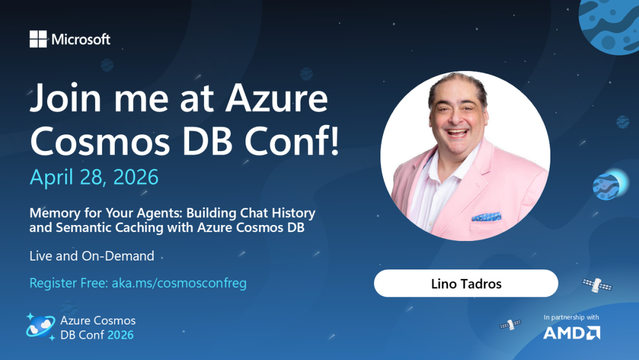
Join me at Azure Cosmos DB Conf on April 28th to learn:
✅ Persistent Chat History for Agents
✅ Implementing Semantic Caching
✅ Scaling with @AzureCosmosDB
Register now: aka.ms/cosmosconfreg 🚀
#CosmosDBConf #BuildAI
The solution to automating human judgment is 500 instances of human judgment. Automation has a sense of humor about its limitations.
https://wordoflore.ai/llm-as-a-judge-the-measurement-problem/
You've built something and you need to know if it works. So you do what's sensible—you ask an LLM to grade it. Factual accuracy, code quality, agent outputs. The machine judges the machine, and you get a number you can act on. Except that number is lying to you.
We've given AI an effort dial—like it's a teenager who could get better grades if they just applied themselves. This is where we are as a civilization.
Claude Opus 4.5 is the newest brainchild from Anthropic, the folks behind the Claude language models. Think of it as their latest and smartest tool for handling really complicated tasks—like having an assistant who can juggle lots of jobs at once, and still keep everything running smoothly. So,
We've collectively decided chat windows are the new operating system—because why would we want dedicated interfaces when we can cram everything into a text box?
OpenAI has just launched something called the Apps SDK, and it’s a bit like giving developers a new set of building blocks for ChatGPT. Instead of just chatting, you can now create apps that live right inside the conversation, with their own custom look and feel. The SDK builds
From "this will replace all creatives" to "it's a very expensive sketching tool" in record time — the lifecycle of every AI product announcement.
https://wordoflore.ai/veo-3-1-native-audio-and-reference-controls/
Veo is Google's latest attempt to teach computers how to make videos from scratch. Now in version 3.1, it's available for anyone willing to pay for early access, either through Google AI Studio or Vertex AI. You can choose between the regular version or a faster one, depending on
We've moved from testing if AI gets the right answer to testing if it reasons correctly—which is either progress or peak parenting anxiety for your code.
Discovering your AI is technically helpful but functionally useless—a special kind of product failure that only shows up when someone actually tries to use the thing
Imagine you’re chatting with an AI, asking it to help you book a flight. It might give you the right answer to every single question you ask, but somehow, you still end up without a ticket. That’s where multi-turn evaluations come in. Instead of just checking if each
A hundred dollars to watch a computer figure out the alphabet—the tuition for machine kindergarten is honestly more reasonable than I expected
nanochat is Karpathy’s attempt to strip LLM training down to its bare essentials. It’s about 8,000 lines of code, and it’s designed to be read and understood, not just run. Unlike the big, complicated frameworks you find in production, this one is all about showing you
Xây dựng AI Agents chỉ trong 60 giây với công cụ dễ sử dụng, phù hợp cho developer và doanh nghiệp muốn tận dụng AI nhanh chóng. Giới thiệu giao diện trực quan, tích hợp API linh hoạt, hỗ trợ tạo tác vụ tự động hóa dựa trên nhu cầu. Thử nghiệm ngay để tăng hiệu suất làm việc! 🚀
#AI #CôngNghệNhânTạo #BuildAI #PhátTriểnỨngDụng #Startup #ĐôRسوق
https://www.reddit.com/r/SideProject/comments/1on48qu/build_ai_agents_in_60_seconds/
Biology is now just another domain for natural language processing—we've successfully reduced cellular complexity to a tokenization problem
https://wordoflore.ai/google-research-the-language-of-biology/
Imagine you could talk to cells and ask them what they’re up to. That’s more or less what Cell2Sentence-Scale (C2S-Scale) lets you do. Built by Google Research and Yale, it’s an open-source model that takes the huge, messy data from single-cell RNA sequencing—basically, a readout of