 The Open Buddhist University
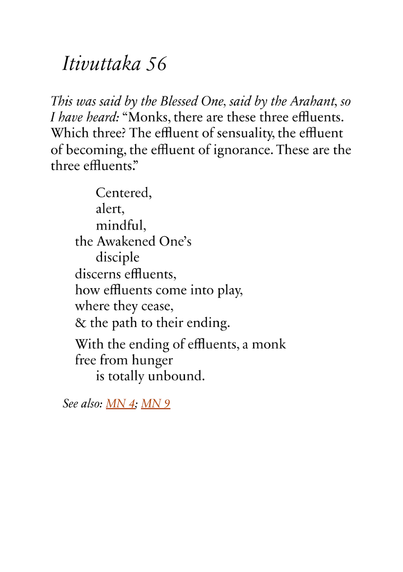
☸️ The First Saying on the Defilements (A free, 1-page sutta translation from 2001)
Tags: #Enlightenment #BuddhaQuotes
https://buddhistuniversity.net/content/canon/iti56
☸️ The First Saying on the Defilements (A free, 1-page sutta translation from 2001)
Tags: #Enlightenment #BuddhaQuotes
https://buddhistuniversity.net/content/canon/iti56
☸️ AN 2.67 Sukha Vagga (4) (A free, 1-page sutta translation from 2018)
Tags: #BuddhaQuotes #Feeling
https://buddhistuniversity.net/content/canon/an2.67
☸️ A Heap of the Unwholesome (A free, 1-page sutta translation from 2012)
Tags: #Wisdom #BuddhaQuotes #Motivation
https://buddhistuniversity.net/content/canon/an5.52
☸️ Corruptions (A free, 2-page sutta translation from 2018)
Tags: #BuddhaQuotes #Monk #Dialogue
https://buddhistuniversity.net/content/canon/an4.50
The mind is everything. What you think, you become. - Buddha
#MindsetIsEverything #BuddhaQuotes #LawOfAttraction #PositiveThinking #Mindfulness #Consciousness #YouBecomeWhatYouThink #Quotes #ShareInspireQuotes

📰 On the Ekottarikāgama 增壹阿含經 T 125 as a Work of Zhú Fóniàn 竺佛念 (A free, 31-page article from 2017)
Tags: #BuddhaQuotes
https://buddhistuniversity.net/content/articles/ea-zhu-fonian_radich-michael

On the basis of a large set of diverse stylistic markers, this paper argues that the Ekottarikāgama T 125 was translated by Zhu Fonian, and not by Saṃghadeva. The paper also considers implications of its findings for the broader corpus of texts ascribed to Zhu Fonian, and for methods in assessing ascriptions of Chinese Buddhist texts on the basis of internal evidence.
📰 The Two Versions of the *Other Translation of Saṃyuktāgama* (A free, 32-page article from 2008)
Tags: #BuddhaQuotes
https://buddhistuniversity.net/content/articles/two-versions-of-other-sa-translation_bucknell

The Other Translation of Saṃyuktāgama 別譯雜阿含經 exists in two versions. The version preserved as text no. 100 in the Taishō edition of the Chinese canon is divided into sixteen fascicles, a format carried over from the Korean edition on which the compilers of the Taishō mainly relied. The other version, found in most editions produced in China itself, is instead divided into twenty fascicles. These two versions contain almost the same collection of sūtras, but differ in their arrangement. As regards the grouping into Saṃyuktas, the twenty-fascicle version is in good order while the sixteen-fascicle version is in disarray. This article examines the proposition by Anesaki (1908) that the sixteen-fascicle version resulted from accidental disarrangement of a text that closely resembled the twenty-fascicle version, and seeks to identify how and when this could have come about.
☸️ With Mahāli (A free, 2-page sutta translation from 2018)
Tags: #Vipassana #Feeling #Origination #BuddhaQuotes
https://buddhistuniversity.net/content/canon/sn22.60

But because consciousness is painful—soaked and steeped in pain and not steeped in pleasure—sentient beings do grow disillusioned with it. Being disillusioned, desire fades away. When desire fades away they are purified. This is a cause and reason for the purification of sentient beings.
☸️ Seclusion (A free, 1-page sutta translation from 2018)
Tags: #BuddhaQuotes #Ethics #Monk
https://buddhistuniversity.net/content/canon/an3.93
📰 The Role of Brahmā in Pāli Discourses (A free, 10-page article from 2003)
Tags: #God #BuddhaQuotes #Dialogue #Philosophy
https://buddhistuniversity.net/content/articles/brahma-in-pali-discourses_analayo


 Share Inspire Quotes
