Why study hammerhead shark development? How are these rare shark embryos collected? 🦈

Find out by reading this #behindthepaper story from Gareth:
https://thenode.biologists.com/behind-the-paper-rarely-seen-development-of-a-viviparous-shark-emergence-of-the-hammerhead/highlights/

#EvoDevo #DevBio

Behind the paper: Rarely seen development of a viviparous shark – emergence of the hammerhead. - the Node

In this Developmental Dynamics paper, Steven Byrum, Gareth Fraser and colleagues present the first comprehensive embryonic staging series for the Bonnethead, a viviparous hammerhead shark. In this post, Gareth and Steven tell us more about studying these hard-to-access shark embryos and the importance of unconventional model organisms.
the Node

Ancient origin of the vertebrate sympathetic nervous system

Read this new #BehindthePaper story from Brittany Edens and Marianne Bronner, about an unexpected finding from the sea lamprey! 👇
https://thenode.biologists.com/ancient-origin-of-the-vertebrate-sympathetic-nervous-system/

#EvoDevo #DevBio

 Ancient origin of the vertebrate sympathetic nervous system - the Node

A recent paper “Neural crest origin of sympathetic neurons at the dawn of vertebrates” challenges the prevailing dogma that the sympathetic ganglia arose

the Node

Our latest #BehindThePaper post is now live on the #PLOSBiology Biologue.

Check out the original research here: https://plos.io/3MxsAYH

https://plos.io/44bracN

Shortcomings of reusing species interaction networks created by different sets of researchers

Researchers commonly reuse previously published species interaction networks to infer community structure and dynamics. This study reveals that these reused networks are very topologically diverse and, without proper attention to their unwanted heterogeneities, are unlikely to yield valid conclusions about ecological processes.

📢New #BehindthePaper story🌱

Qingqing Wang from the Gendron lab tells the story of finding out how plants can measure different light durations to independently control seasonal flowering and growth:
https://thenode.biologists.com/a-journey-of-understanding-the-distinct-molecular-mechanisms-underlying-plant-photoperiodism/

A journey of understanding the distinct molecular mechanisms underlying plant photoperiodism - the Node

In a new study, Joshua Gendron and colleagues find that plants can measure two different photoperiods to independently control seasonal flowering and

the Node

Exploring Mammary Gland Development and Evolution with Organoid Technology

Read this #BehindthePaper story from Gat Rauner about generating mammary gland #organoids from 8 eutherian species and a marsupial, the gray short-tailed opossum:

https://thenode.biologists.com/exploring-mammary-gland-development-and-evolution-with-organoid-technology/highlights/

Exploring Mammary Gland Development and Evolution with Organoid Technology - the Node

What is the set of instructions that directs cells as they form a tissue, and how did this set of instructions evolve throughout species evolution? In a new study, we generated organoids from a variety of species that can be utilized to answer these questions and more. What is the set of instructions that directs cells as they form a tissue, and how did this set of instructions evolve throughout species evolution? In a new study, we generated organoids from a variety of species that can be utilized to answer these questions and more.

the Node

New #BehindThePaper post up on the PLOS #Biologue.

@OlgaPonomarova discusses how testing many diverse hypothesis brought them to find the relationship between apparently unrelated #metabolic pathways.

Check out the paper here: https://plos.io/41r41k4

https://plos.io/3S1QT3k

A D-2-hydroxyglutarate dehydrogenase mutant reveals a critical role for ketone body metabolism in Caenorhabditis elegans development

In humans, mutations in D-2-hydroxyglutarate dehydrogenase (D2HGDH) cause delayed development, seizures and ataxia. This study shows that in the nematode Caenorhabditis elegans, D2HGDH sustains ketone body production to support embryonic viability; its loss results in mitochondrial defects and embryonic lethality,

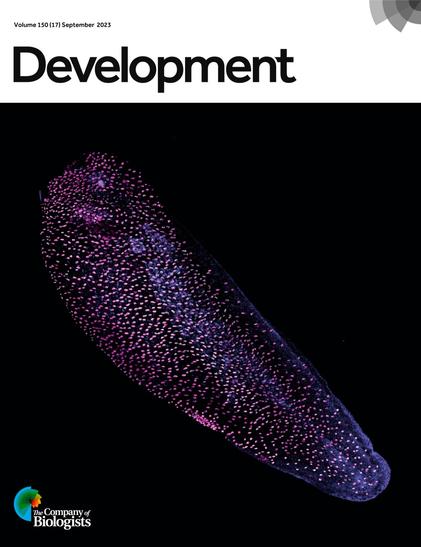
Issue 17 is complete!

On the cover: a stage 38 Xenopus tadpole with TgTub-MemRFP (magenta), cilia marker acetylated tubulin (white) and actin marker phalloidin (purple). See Ventrella et al.: https://journals.biologists.com/dev/article/150/17/dev201612/326627/

Also in Issue 17:
▪6 Research Highlights on mole ovotestes, optogenetics, gastruloids & more
▪Stem cell-based embryo models 'In preprints'
▪PI Fellow interviews & #BehindThePaper interview
▪Human male germline development Review

https://journals.biologists.com/dev/issue/150/17

Bidirectional multiciliated cell extrusion is controlled by Notch-driven basal extrusion and Piezo1-driven apical extrusion

Summary: Notch-driven basal extrusion and Piezo1-mediated apical extrusion work in concert to ensure that all multiciliated cells are lost from the epithelium by stage 48 of Xenopus embryonic development.

The Company of Biologists

📢New #BehindthePaper story on the Node

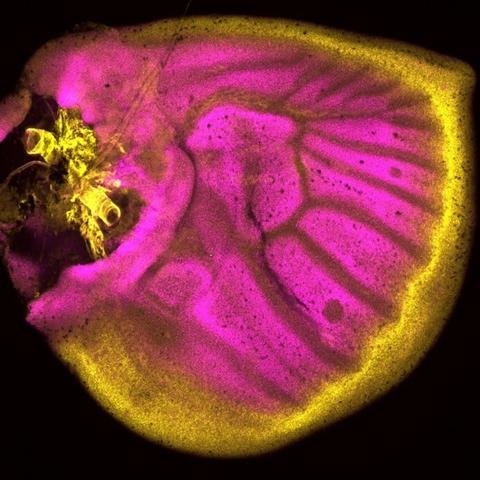
Tirtha Das Banerjee and Antόnia Monteiro tell the story behind their paper exploring the expression and function of Wnt signaling pathway members in setting up butterfly wing patterns 🦋

https://thenode.biologists.com/patterning-the-butterfly-wing-through-wnt-signaling/research/

Patterning the butterfly wing through Wnt signaling - the Node

Read the story behind the paper from Tirtha Das Banerjee and Antόnia Monteiro about Wnt signaling in setting up butterfly wing patterns.

the Node

The **Behind the paper** series at the #PLOSBiologue blog at #plosbiology @PLOSBiology is always inspiring and interesting. The newest is about findings in extramedullary hematopoiesis in tumors and tells about how Derek Barisas (MD/PhD student at WashU School of Medicine) nurtured the project through the pandemic—the lab shut down 3 months after he started.

https://biologue.plos.org/2023/07/05/tumors-produce-factors-that-promote-extramedullary-hematopoiesis/

Paper: https://journals.plos.org/plosbiology/article?id=10.1371/journal.pbio.3001746

#cancerbiology
#behindthepaper
#scienceblogging

1/2

Behind the paper: Tumors produce factors that promote extramedullary hematopoiesis - PLOS Biologue

In this ‘behind the paper’ post, Derek Barisas discusses how analyzing some old data shaped a hypothesis and led them to find the factors derived from tumors that promote extramedullary hematopoiesis.

PLOS Biologue

Living up to your cnidarian potential

Read this #BehindthePaper story by Aine Varley from Uri Frank's lab, detailing the trials and tribulations of developing a technique to transplant a single i-cell in #Hydractinia, and the search for pluripotency of these #stemcells:

https://thenode.biologists.com/living-up-to-your-cnidarian-potential/research/

Living up to your cnidarian potential - the Node

Áine Varley tells the story behind the paper “Pluripotent, germ cell competent adult stem cells underlie cnidarian regenerative ability and clonal growth”.

the Node