The First RELHIC? Cloud-9 is a Starless Gas Cloud
The First RELHIC? Cloud-9 is a Starless Gas Cloud* , Anand, Gagandeep S., Benítez-Llambay, Alejandro, Beaton, Rachael, Fox, Andrew J., Navarro, Julio F., D’Onghia, Elena
Does the solar magnetic field migrate towards the poles faster than expected? Results using data from #ESA ’s #SolarOrbiter spacecraft are published today in #ApJL: https://iopscience.iop.org/article/10.3847/2041-8213/ae10a3
More infos here: https://www.mps.mpg.de/sun-first-glimpse-of-polar-magnetic-field-in-motion
#Sun
Radware Bot Manager Captcha
Does the solar magnetic field migrate towards the poles faster than expected? Results using the data from
#ESA ’s
#SolarOrbiter are published today in
#ApJL. More infos here:
www.mps.mpg.de/sun-first-gl...
@science.esa.int @ioppublishing.bsky.socialSun: First Glimpse of Polar Ma...
Sun: First Glimpse of Polar Magnetic Field in Motion
In March, ESA's spacecraft Solar Orbiter had its first clear view of the Sun’s south pole. A first analysis has now been published.
Huge cells of hot plasma cover the Sun and create the large-scale, net-like structure of the magnetic field on its surface. Researchers have now for the first time determined their properties in the polar region.
The plasma cells and along with them the magnetic field drift toward the pole—at higher speeds than expected.
Further observations are needed to understand how the processes at the poles contribute to building up the Sun's global magnetic field over the course of a solar cycle.
“Hawkins & Garcia-Bellido post contained a number of scientific misrepresentations of our 20-yr long OGLE photometric monitoring.”
#arXiv #ApJL Limits on planetary-mass primordial black holes from the OGLE high-cadence survey of the Magellanic Clouds
https://arxiv.org/abs/2410.06251
Limits on planetary-mass primordial black holes from the OGLE high-cadence survey of the Magellanic Clouds
Observations of the Galactic bulge revealed an excess of short-timescale gravitational microlensing events that are generally attributed to a large population of free-floating or wide-orbit exoplanets. However, in recent years, some authors suggested that planetary-mass primordial black holes (PBHs) comprising a substantial fraction (1%-10%) of the dark matter in the Milky Way may be responsible for these events. If that was the case, a large number of short-timescale microlensing events should also be seen toward the Magellanic Clouds. Here, we report the results of a high-cadence survey of the Magellanic Clouds carried out from 2022 October through 2024 May as part of the Optical Gravitational Lensing Experiment. We observed almost 35 million source stars located in the central regions of the Large and Small Magellanic Clouds and found only one long-timescale microlensing event candidate. No short-timescale events were detected despite high sensitivity to such events. That allows us to infer the strongest available limits on the frequency of planetary-mass PBHs in dark matter. We find that PBHs and other compact objects with masses from $1.4 \times 10^{-8}\,M_{\odot}$ (half of the Moon mass) to $0.013\,M_{\odot}$ (planet/brown dwarf boundary) may comprise at most 1% of dark matter. That rules out the PBH origin hypothesis for the short-timescale events detected toward the Galactic bulge and indicates they are caused by the population of free-floating or wide-orbit planets.
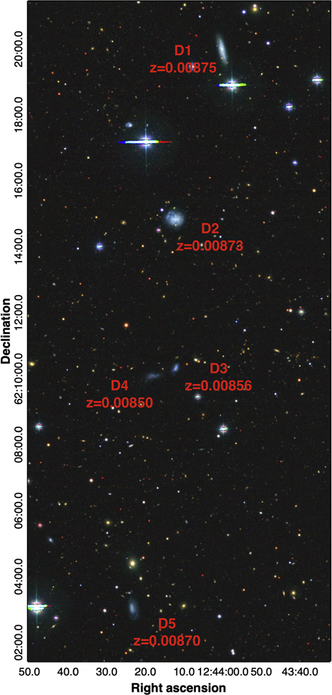
#ApJL Discovery of a Rare Group of Dwarf Galaxies in the Local Universe
https://iopscience.iop.org/article/10.3847/2041-8213/ad8f3c "a nearby association of five dwarf galaxies form a gravitationally bound group. Two of them are interacting with each other, with visible tidal tails, in the early stages of merging."
Radware Bot Manager Captcha
 Boud
Boud MPS Göttingen
 Max Planck Institute for Solar System Research
 Francisco R. Villatoro