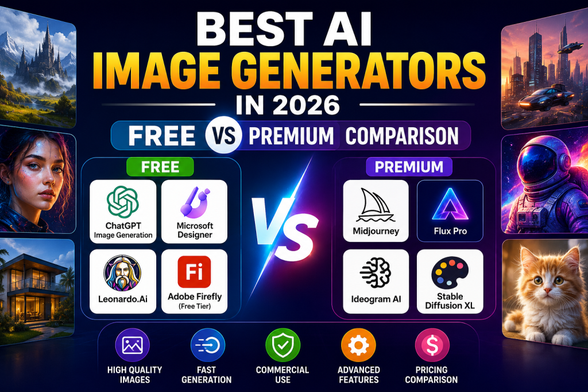
Best AI Image Generators in 2026: Free vs Premium Comparison

Artificial Intelligence has completely transformed digital creativity. Whether you’re a blogger, YouTuber,
marketer, graphic designer, or social media creator, AI image generators can create stunning visuals within
seconds.
In 2026, these tools are smarter, faster, and more realistic than ever before. But with so many options
available, choosing between free and premium AI image generators can be confusing.
This guide compares the top AI image generators of 2026, highlighting their features, pricing, advantages,
and ideal use cases

What is an AI Image Generator?

An AI image generator uses machine learning models to convert text prompts into digital artwork,
illustrations, realistic photos, logos, anime, product mockups, and much more.
Simply describe what you want, and the AI creates an image in seconds.

Best Free AI Image Generators (2026)

1. ChatGPT Image Generation

Best For:

  • Social media graphics
  • Blog images
  • Marketing creatives
  • Concept art
    Pros
    ✔ Easy to use
    ✔ Excellent prompt understanding
    ✔ High-quality results
    ✔ Great for beginners
    Cons
  • Limited image generation for free users
  • Advanced editing requires paid plans

2. Microsoft Designer

Microsoft Designer remains one of the best completely free AI design tools.


Features

  • AI image generation
  • Social media templates
  • Poster creator
  • Logo generation

  • Pros
  • Beginner-friendly
  • Fast image generation
  • Integrated editing tools

3. Leonardo AI (Free Plan)

Leonardo AI has become one of the most popular AI art generators

Best For

  • Game assets
  • Fantasy artwork
  • Character design
  • Product mockups

Free Features

  • Daily image credits
  • Multiple AI models
  • Prompt enhancement

Adobe Firefly (Free Tier)

Adobe Firefly is ideal for professional creators.

Features

  • Commercial-safe image generation
  • Text effects
  • Background replacement
  • Generative fill
    Perfect for content creators already using Adobe Creative Cloud.

Best Premium AI Image Generators (2026)

1. Midjourney

Starting Price
Around $10/month

Best For

  • Ultra-realistic artwork
  • Digital paintings
  • Concept art
  • Cinematic visuals

Advantages

  • Industry-leading quality
  • Artistic styles
  • Exceptional lighting
  • Professional results

Drawbacks

  • Subscription required
  • Learning curve for prompts

2. Flux Pro

Flux has become one of the strongest competitors to Midjourney.

Best For

  • Realistic portraits
  • Product photography
  • Marketing creatives

Highlights

  • Excellent typography
  • Better prompt accuracy
  • Fast generation speed

3. Ideogram AI Pro

Ideogram excels at generating text inside images.

Perfect For

  • Posters
  • Advertisements
  • Logos
  • Thumbnails

Why People Love It

  • Accurate text rendering
  • High-resolution exports
  • Commercial usage

4. Stable Diffusion XL

Ideal for users who want complete customization.

Features

  • Open-source
  • Local installation
  • Custom models
  • Unlimited creativity

Best For
Developers, designers, and AI enthusiasts.

Free vs Premium AI Image Generators

FeaturesFree ToolsPremium ToolsImage QualityGoodExcellentSpeedModerateVery FastCommercial useLimitedUsually AllowedDaily LimitsYesNoResolutionStandardHigh ResolutionEditing FeaturesBasicAdvancedCustomer SupportLimitedPriorityWatermarksSometimesUsually None

Which AI Image Generator is Best?

For Beginners

  • ChatGPT Image Generation
  • Microsoft Designer

For YouTubers

  • Midjourney
  • Ideogram
  • Adobe Firefly

For Bloggers

  • ChatGPT Image Generation
  • Adobe Firefly

For Graphic Designers

  • Midjourney
  • Flux Pro
  • Stable Diffusion XL

For Businesses

  • Adobe Firefly
  • Ideogram Pro

Tips for Better AI Image Results

  • Write detailed prompts.
  • Specify lighting and camera angles.
  • Mention art style (realistic, anime, watercolor, etc.).
  • Include aspect ratio (16:9, 1:1, 9:16).
  • Use negative prompts where supported.
  • Generate multiple variations and choose the best one
  • Should You Choose Free or Premium?

    If you’re just getting started, free AI image generators are more than capable of creating attractive graphics
    for blogs and social media.
    However, if you’re creating content professionally or need commercial-quality visuals, investing in a premium
    AI image generator is worthwhile. The improved image quality, faster processing, higher resolutions, and
    commercial licensing can save significant time and improve your content’s overall quality.

    Final Verdict

    AI image generation has reached an incredible level in 2026. Free tools are now powerful enough for casual
    users and hobbyists, while premium platforms offer unmatched realism, creative control, and professional
    workflows.

    Choose a tool based on your budget and creative needs:

    • Best Free Overall: ChatGPT Image Generation
    • Best for Design: Adobe Firefly
    • Best Artistic Images: Midjourney
    • Best Realistic Images: Flux Pro
    • Best for Text in Images: Ideogram AI
    • Best Open-Source Option: Stable Diffusion XL

    No matter which platform you choose, AI image generators can dramatically speed up content creation and
    help you produce stunning visuals with minimal effort.

    Frequently Asked Questions (FAQs)

    1. Which AI image generator is the best in 2026?


    Midjourney is widely regarded as the best for artistic quality, while ChatGPT Image Generation offers an
    excellent balance of ease of use and quality.


    2. Are free AI image generators good enough?


    Yes. Free tools are ideal for bloggers, students, and casual creators, though they often have generation limits
    and fewer advanced features.


    3. Which AI image generator is best for YouTube thumbnails?


    Ideogram AI, ChatGPT Image Generation, and Midjourney are excellent choices because they produce highquality visuals, with Ideogram particularly strong at rendering readable text.


    Can I use AI-generated images commercially?


    It depends on the platform’s licensing terms. Always review the commercial usage policy of the specific AI
    image generator before using images for business or client work.

  • What is an AI Image Generator?
  • Best Free AI Image Generators (2026)
  • 1. ChatGPT Image Generation
  • 2. Microsoft Designer
  • 3. Leonardo AI (Free Plan)
  • Adobe Firefly (Free Tier)
  • Best Premium AI Image Generators (2026)
  • 1. Midjourney
  • 2. Flux Pro
  • 3. Ideogram AI Pro
  • 4. Stable Diffusion XL
  • Free vs Premium AI Image Generators
  • Which AI Image Generator is Best?
  • For Beginners
  • For YouTubers
  • For Bloggers
  • For Graphic Designers
  • For Businesses
  • Tips for Better AI Image Results
  • Should You Choose Free or Premium?
  • Final Verdict
  • Frequently Asked Questions (FAQs)
  • 1. Which AI image generator is the best in 2026?
  • 2. Are free AI image generators good enough?
  • 3. Which AI image generator is best for YouTube thumbnails?
  • Can I use AI-generated images commercially?
  • Related Posts:

    Best AI Image Generators in 2026: Free vs Premium Comparison

    by Sajawal MalikJune 28, 2026

    Ways to Earn Money Online Using AI Tools in 2026

    by Sajawal MalikJune 27, 2026

    How to Start a Blog Using AI (Step-by-Step Guide 2026).

    by Sajawal MalikJune 26, 2026
    Most businesses are still using chatbots. AI agents are 10x more powerful.

    Here's how they work:
    1️⃣ Gather data from systems & users
    2️⃣ Analyze context & make decisions
    3️⃣ Execute multi-step tasks automatically
    4️⃣ Learn & improve over time

    💡 Replace your rule-based bots with goal-oriented AI agents.

    Read more:
    🔗 https://increativeweb.com/blog/ai-agent-development-a-complete-guide-to-building-intelligent-business-agents

    #AIAgents #AIAgentDevelopment #BuildAIAgents #BusinessAutomation #AIForBusiness #LearnAI #AIForBeginners #Automation #MachineLearning #NLP #LLM #TechTrends2026

    AI Agent Development: A Complete Guide to Building Intelligent Business Agents - InCreativeWeb

    Discover what AI agent development is, how AI agents work, and why businesses are investing in them. A complete step-by-step guide to building intelligent, autonomous business agents.

    InCreativeWeb

    AI Agents for Beginners: Everything You Need to Know

    Artificial Intelligence is changing the world faster than ever, and one of the biggest innovations today is AI Agents. From automating tasks to making intelligent decisions, AI agents are becoming powerful digital assistants for businesses and individuals.

    If you are new to AI, this beginner-friendly guide will help you understand:

    • What AI agents are
    • How they work
    • Real-world use cases
    • Popular AI agent tools
    • Benefits and challenges
    • Future of AI agents

    Let’s dive in.

    What Are AI Agents?

    AI agents are intelligent software systems that can:

    • Understand instructions
    • Analyze information
    • Make decisions
    • Perform tasks automatically
    • Interact with users and systems

    Unlike traditional software programs that follow fixed rules, AI agents can adapt based on context and user requests.

    Think of an AI agent as a smart assistant capable of handling tasks with minimal human intervention.

    Examples include:

    • AI chatbots
    • Coding assistants
    • Virtual customer support agents
    • Autonomous workflow systems

    Simple Example of an AI Agent

    Imagine you ask an AI agent:

    “Create a sales report from yesterday’s data and email it to the manager.”

    The AI agent can:

  • Access the database
  • Retrieve sales data
  • Generate the report
  • Create charts
  • Send the email automatically
  • All of this can happen without manual work.

    How AI Agents Work

    AI agents usually follow these steps:

    1. Receive Input

    The user gives instructions through text, voice, or APIs.

    2. Understand the Request

    The AI processes the request using Large Language Models (LLMs).

    3. Plan Actions

    The agent decides what steps are needed to complete the task.

    4. Use Tools

    AI agents may connect to:

    • Databases
    • APIs
    • Cloud services
    • Applications
    • Search engines

    5. Execute Tasks

    The agent performs the required actions.

    6. Return Results

    The final output is delivered to the user.

    Types of AI Agents

    Reactive AI Agents

    These respond instantly to inputs but do not remember past interactions.

    Example:

    • Basic chatbots

    Memory-Based AI Agents

    These remember previous conversations and improve responses.

    Example:

    • Advanced AI assistants

    Goal-Based AI Agents

    These work toward achieving specific goals.

    Example:

    • Automated workflow systems

    Autonomous AI Agents

    These can independently perform multi-step tasks with minimal supervision.

    Example:

    • AI-powered research assistants

    Real-World Use Cases of AI Agents

    Customer Support

    AI agents can:

    • Answer FAQs
    • Resolve customer issues
    • Handle tickets 24/7

    Software Development

    AI coding agents help developers:

    • Generate code
    • Debug applications
    • Create documentation
    • Write SQL queries

    Data Engineering

    AI agents can:

    • Monitor ETL pipelines
    • Detect data quality issues
    • Generate reports
    • Automate validations

    Healthcare

    AI agents assist with:

    • Appointment scheduling
    • Medical documentation
    • Patient support systems

    Finance

    AI agents are used for:

    • Fraud detection
    • Risk analysis
    • Automated reporting

    Benefits of AI Agents

    Increased Productivity

    AI agents automate repetitive tasks and save time.

    Faster Decision Making

    They analyze huge amounts of data quickly.

    24/7 Availability

    AI agents can work continuously without breaks.

    Reduced Costs

    Businesses can reduce operational expenses.

    Improved Accuracy

    Automation reduces manual errors.

    Popular AI Agent Frameworks

    Many developers use frameworks to build AI agents.

    LangChain

    Popular for building AI workflows using LLMs.

    CrewAI

    Helps create collaborative AI agents.

    AutoGen

    Designed for multi-agent conversations and automation.

    Semantic Kernel

    Microsoft framework for AI orchestration.

    OpenAI Agents

    Used for building advanced AI-powered assistants.

    AI Agents vs Traditional Automation

    Traditional AutomationAI AgentsRule-basedIntelligent decision-makingFixed workflowsDynamic workflowsLimited flexibilityAdaptive behaviorManual configurationNatural language interactionRequires coding changesLearns from context

    Challenges of AI Agents

    While AI agents are powerful, they also have challenges.

    Security Risks

    AI systems must be protected from unauthorized access.

    Hallucinations

    Sometimes AI may generate incorrect information.

    Data Privacy

    Sensitive data must be handled carefully.

    High Infrastructure Costs

    Advanced AI systems may require expensive compute resources.

    Governance

    Organizations need proper monitoring and compliance policies.

    Future of AI Agents

    AI agents are expected to become digital coworkers in many industries.

    Future AI agents may:

    • Manage projects autonomously
    • Coordinate with other AI agents
    • Perform complex business operations
    • Automate end-to-end workflows

    Businesses adopting AI agents early may gain significant competitive advantages.

    Should Beginners Learn AI Agents?

    Absolutely.

    AI agents are becoming one of the most important technologies in:

    • Artificial Intelligence
    • Data Engineering
    • Software Development
    • Cloud Computing
    • Business Automation

    Learning AI agents now can open exciting career opportunities in the future.

    Final Thoughts

    AI agents are transforming how businesses and individuals work. They combine automation, intelligence, and decision-making into powerful digital systems.

    Whether you are a beginner, developer, or business professional, understanding AI agents is becoming increasingly valuable in today’s AI-driven world.

    The future of automation is intelligent — and AI agents are leading that transformation.

    #AIAgents #AIForBeginners #ArtificialIntelligence #Automation #generativeAI

    People assume learning AI requires months of technical training.

    Truth: You can start using AI tools productively in just a few hours.

    Most AI tools are designed for regular people, not programmers.

    What's one task you do weekly that AI could help with?

    #ArtificialIntelligence #AIForBeginners

    AI Term of the Day: CONTEXT WINDOW

    How much the AI can "remember" in one conversation.

    Think of it like short-term memory. Once you hit the limit, it starts forgetting what you said earlier.

    Claude: ~200k tokens
    ChatGPT-4: ~128k tokens

    1 token ≈ 4 characters

    #ArtificialIntelligence #AIForBeginners #TechExplained

    AI Term of the Day: LLM (Large Language Model)

    The brain behind ChatGPT, Claude, and Gemini.

    An LLM is trained on billions of words from the internet. It learned patterns in language so well that it can write, answer questions, and hold conversations.

    Not magic. Just very good pattern matching.

    #ArtificialIntelligence #LLM #AIForBeginners

    AI Term of the Day: HALLUCINATION

    When AI confidently makes up facts that aren't true.

    Ask ChatGPT about a fake book title. It might describe the plot, author, and reviews for a book that doesn't exist.

    Always fact-check important info. AI can be wrong with a straight face.

    #ArtificialIntelligence #AIForBeginners #AILiteracy

    AI Term of the Day: PROMPT

    A prompt is the instruction you give an AI. Think of it like a text message to a very smart assistant.

    "Write a poem" = vague prompt
    "Write a 4-line poem about coffee for Instagram" = good prompt

    The clearer your message, the better the response.

    #ArtificialIntelligence #AIForBeginners #LearnAI