✨#32 of #85 Things About DIAS

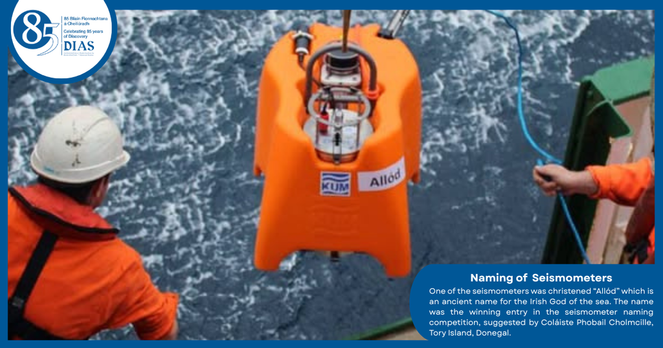
Naming of Seismometers

One of the seismometers was christened "Allód" an ancient name of the Irish God of the sea. Allód was a winning entry in the seismometer naming competition, suggested by Coláiste Phobail Cholmicille in Donegal.
#85ThingsAboutDIAS #DIAS85

✨#31 of #85 Things About DIAS

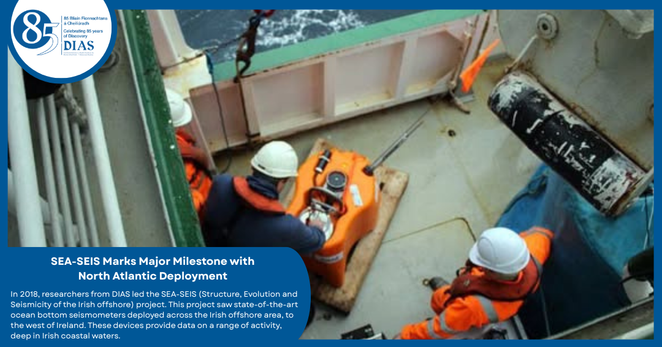
SEA-SEIS Deployment

In 2018, researchers from the DIAS Geophysics Section led the SEA-SEIS (Structure, Evolution and Seismicity of the Irish offshore) project.

This Project saw state-of-the-art ocean bottom seismometers deployed across the Irish offshore area, to the west of Ireland which provide data on a range of activity deep in Irish coastal waters.

#85ThingsAboutDIAS #DIASdiscovers #geophysics

✨#30 of #85 Things About DIAS

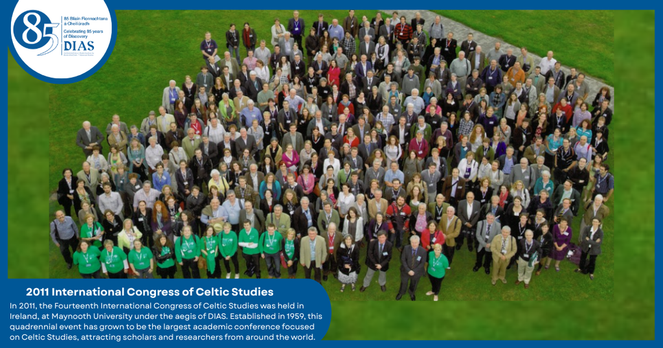
2011 International Congress of Celtic Studies.

In 2011, the Fourteenth International Congress of Celtic Studies was held in Ireland, at Maynooth University under the aegis of DIAS. Established in 1959, this quadrennial event has grown to be the largest academic conference focused on Celtic Studies, attracting scholars and researchers from around the worlds.

#85ThingsAboutDIAS #DIASDiscovers

✨#29 of #85 Things About DIAS
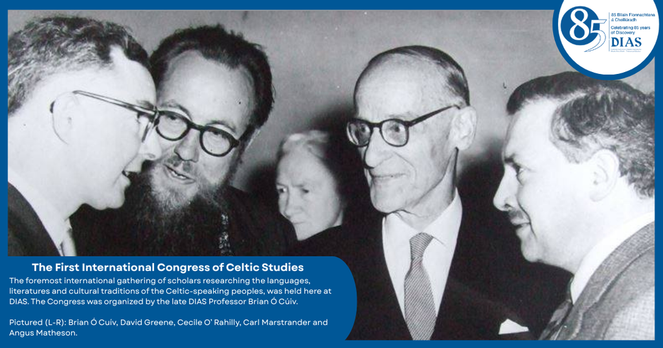
The First International Congress of Celtic Studies.

The foremost international gathering of scholars researching the languages, literature and cultural traditions of the Celtic-speaking people, was held at DIAS.
The Congress was organized by the late DIAS Professor Brian Ó Cúiv.

Pictured (L-R): Brian Ó Cúiv, David Greene, Cecile O'Rahilly, Carl Marstrander and Angus Matheson.

#DIASdiscovers #85ThingsAboutDIAS

✨#28 of #85 Things About DIAS

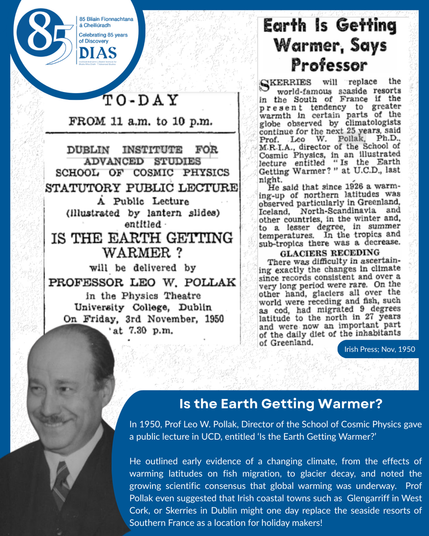
In 1950, Prof Leo W. Pollak, Director of the School of Cosmic Physics gave a public lecture in UCD, entitled ‘Is the Earth Getting Warmer?’

He outlined early evidence of a changing climate, from the effects of warming latitudes on fish migration, to glacier decay, and noted the growing scientific consensus that global warming was underway.

#DIAS85 #85ThingsAboutDIAS #DIASdiscovers

✨#26 of #85 Things About DIAS

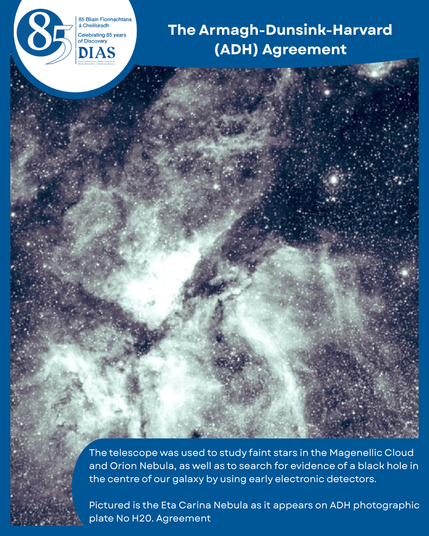
The ADH telescope was used to study faint stars in the Magenellic Cloud & Orion Nebula, as well as search for evidence of a black hole in the centre of our galaxy using early electronic detectors.
Image: the Eta Carina Nebula as it appears on photographic plate No.H20

#DIASdiscovers #DIAS85 #85ThingsAboutDIAS

✨#24 of #85 Things About DIAS

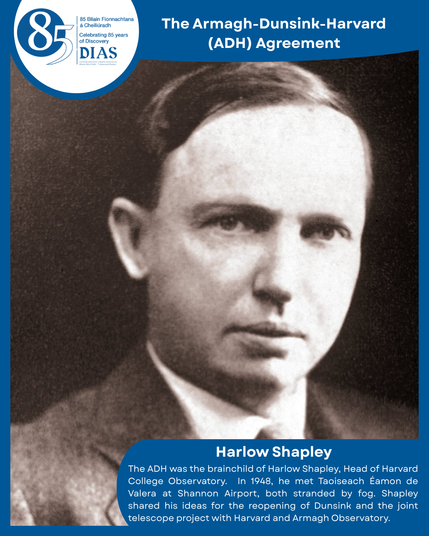
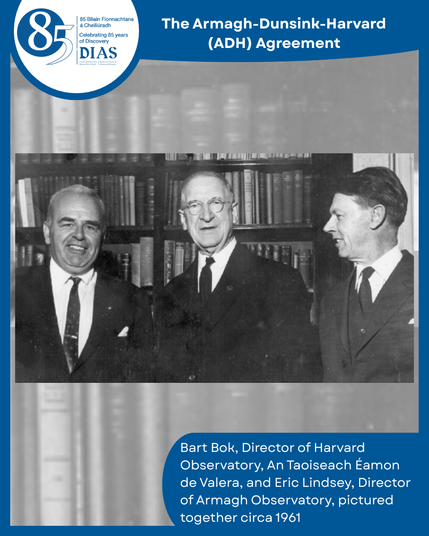
The ADH was the brainchild of Harvard Observatory Director, Harlow Shapley who fortuitously met Taoiseach Eamon de Valera at Shannon Airport in 1948, whilst marooned due to fog. Shapley introduced himself and proceeded to discuss ideas for the reopening of Dunsink and the joint telescope project with Harvard and Armagh Observatory.

#DIASdiscovers #DIAS85 #85thingsaboutdias

✨#24 of #85ThingsAboutDIAS

The ADH Telescope

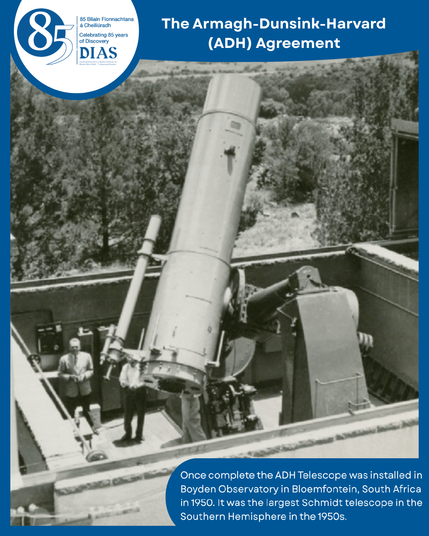
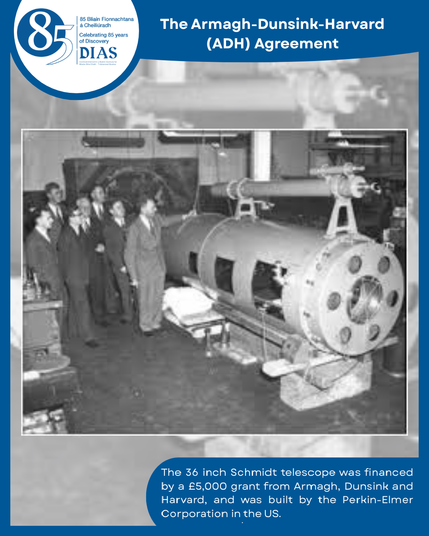
In 1950 the ADH Telescope was installed in Boyden Observatory in Bloemfontein, South Africa. It was the largest Schmidt telescope in the Southern Hemisphere in the 1950s. The 36 inch Schmidt telescope was built by the Perkin-Elmer Corporation in the US, financed by a £5,000 grant from each Armagh, Dunsink and Harvard

#DIAS85 #DIASdiscovers

✨#23 of #85ThingsAboutDIAS

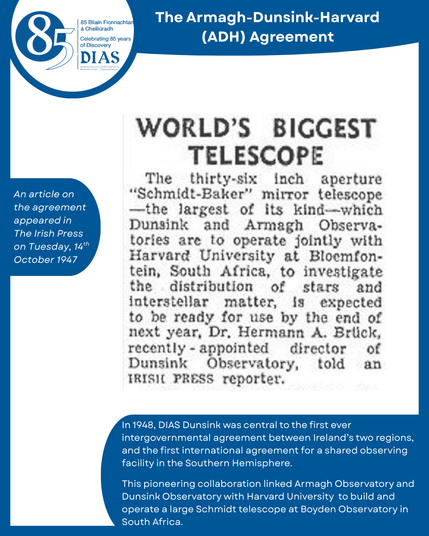
The Armagh-Dunsink-Harvard Agreement

In 1948 DIAS Dunsink was central to the first ever inter-governmental agreement between the two parts of Ireland, and the first international agreement to operate a shared observing facility in the southern hemisphere. This pioneering collaboration linked Armagh and Dunsink Observatory with Harvard University under an agreement to build and operate a large Schmidt telescope at the Boyden Observatory in South Africa.

#DIAS85

✨#22 of #85 Things About DIAS

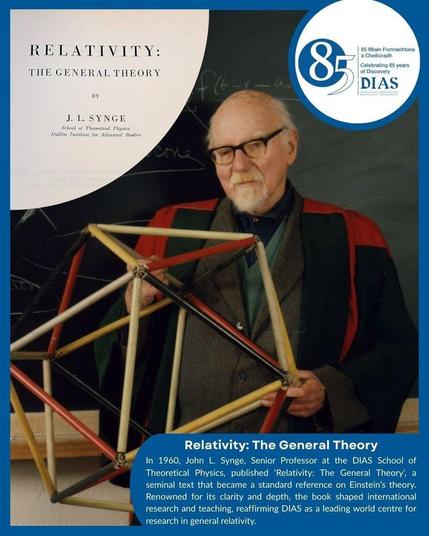
In 1960, John L. Synge, Senior Professor at the DIAS School of Theoretical Physics, published ‘Relativity: The General Theory’, a seminal text that became a standard reference on Einstein’s theory. Renowned for its clarity and depth, the book shaped international research and teaching, reaffirming DIAS as a leading world centre for research in general relativity.
#DIAS85 #DIASdiscovers #85ThingsAboutDIAS