🚨 Say that I were to give a talk to EU policy makers and OSS communities at a very big conference tomorrow..

and that I want to spend half of my talk on how Google is locking down #Android through:
1. Device attestation
2. Developer registration
3. Age/identity verification

What should I absolutely include? đź‘€

Input is welcome, sorry for the short notice. Plain language + realistic calls to action pls.

@fdroidorg @GrapheneOS @postmarketOS @Fairphone @appfair @fsfe @murena @volla @IzzyOnDroid
Boosting and tagging is appreciated, DM's are welcome too.

I really want to get this right, so please only use verified information. And yes, I'll be mentioning https://keepandroidopen.org/ extensively.

(And yes I will also mention Apple and the role of the DMA, but only briefly. More info: https://mastodon.social/@kirschner/116440678455335985)

Keep Android Open

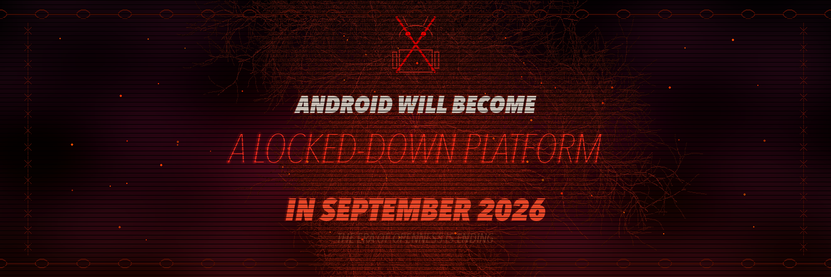
Your phone is about to stop being yours. In September 2026, Google will block every Android app whose developer hasn't registered with them.

I'll start with the #opensource strategy and EU tech sovereignty package, and good things happening and alternatives being build etc.

Then mention how the mobile ecosystem is one of the last frontiers left critically assessed.

I'll share how Google is closing down Android (input welcome!). 

And that we need to promote, fund, regulate and perhaps even build open (EU) alternatives in the mobile ecosystem if we don't want to increasingly become captured by 2 US big tech companies.

@Gina I would appreciate the not-everything-needs-an-app angle and focussing more on the web as a true open platform. Good luck with it all 🫶🙌🤞
@janl I really like apps though. They just need to be open source and not reliant on Google's Play Integrity API.
@Gina My angle is certain necessities of life requiring an app (banking, medical, parking, etc) all of that should be possible without an app. That’s not saying no-apps, just apps-not-mandatory.

@Gina 100% agree with @janl.

I'm a prolific open source maintainer and I very deliberately don't have a smart phone (story for another day). Don't exclude me from society, just because you like apps...

@jrf_nl @Gina @janl

I think all app functionality can also be achieved via Progressive Web Apps ( #PWA ). A PWA should be able to run on an open browser engine (beware of Chrome #lockin), and hence on open standards, independent of a specific platform like Android or iOS.

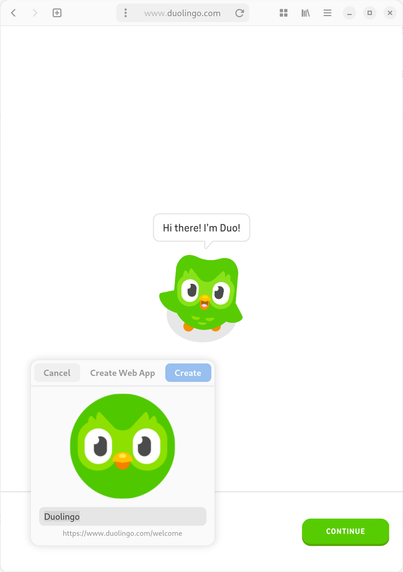
With GNOME Web, you can install a website as a Web App.

https://developer.mozilla.org/en-US/docs/Web/Progressive_web_apps/Guides/What_is_a_progressive_web_app

@janvlug @jrf_nl @Gina @janl

You're missing the real story here: APPLE is the enemy of PWAs and an open, powerful web. Not Google.

So much more here:

https://open-web-advocacy.org/
https://infrequently.org/series/browser-choice-must-matter/

Open Web Advocacy

A group of software engineers from all over the world who have come together to advocate for the future of the open web

Open Web Advocacy

@nickchomey @jrf_nl @Gina @janl

The point I tried to make is that there is a good alternative for apps: PWA's.

I was reacting on the phrase: "I really like apps though".

My statement about Chromium is because I sometimes see sites that do not work well with LibreWolf. PWA's should not use proprietary parts of browsers.

@janvlug @jrf_nl @Gina @janl

Agreed. PWAs are the way forward. But your comment about librewolf compatibility is misguided - this is a discussion about policy, not individual developer decisions about which apis to build upon.

Also, Firefox has failed to implement some important pwa apis, so I have to figure librewolf suffers from that as well.

@nickchomey

Thanks for the correction. I guessed that LibreWolf (Firefox) would be standards compliant. The key message should be: based on open standard api's (and do not let the open standards be hijacked by monopolists).

@jrf_nl @Gina @janl

@nickchomey

To add to "do not let open standards be hijacked by monopolist", I just read a blog stating:

"Euro-Office defaults to the fully proprietary OOXML document format, developed and controlled solely by Microsoft. This makes it a de facto ally of Microsoft in its content lock-in strategy, with control remaining firmly in Redmond and far from Europe."

https://blog.documentfoundation.org/blog/2026/06/08/an-open-letter/

@jrf_nl @Gina @janl

An open letter to office suite users, just before the Euro-Office announcement - TDF Community Blog

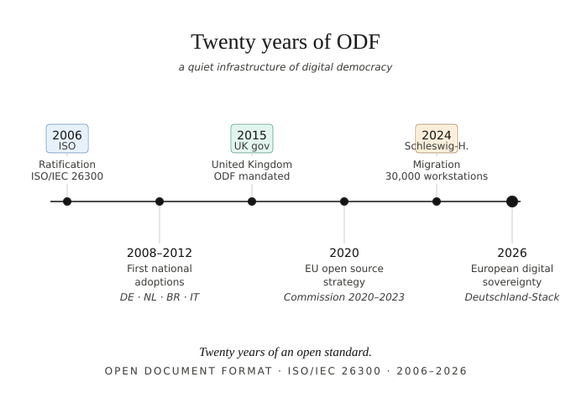
Dear office suite users, In recent days you will have read various articles announcing the arrival of Euro-Office, which is being “marketed” as the first open-source office suite developed in Europe. We feel compelled — reluctantly, since open source should rest on transparency, not deception — to correct this claim. The first open-source office suite developed in Europe was OpenOffice.org in 2001, based on StarOffice’s source code, followed by LibreOffice from 2010. These are two genuine open-source office suites, built from source code that originated in Europe. They are not a freeware clone of MS Office whose code provenance is undisclosed, nor a product that has rebranded itself out of pure opportunism to ride today’s wave of Digital Sovereignty. It is worth remembering that many of those who champion Digital Sovereignty today were silent back in 2006, when the open ISO/IEC ODF standard — the pillar of Digital Sovereignty — was announced: not only did they not listen to us during all these years, but in some cases they greeted us with a condescending smile. If we can speak of Digital Sovereignty in Europe today, it is thanks to The Document Foundation and LibreOffice community members at large, who kept

TDF Community Blog

@jrf_nl @Gina @janl

Exactly! I *do not want* a smartphone and no one should be required to have one or install apps just to do normal things like park a car and other routine activities of daily life!

publishing apps as free software, and not making them mandatory by offering alternate access to services, would go a long way in weakening the dominance and lock-in of the mobile operating system duopoly

governments should go a step further and actively promote the adoption of a sovereign platform, instead of further entrenching the dependency on this duopoly

CC: @[email protected]
you may also argue that it is absolutely unreasonable for foreign companies to be entitled to decide who can or cannot get government services, by allowing or refusing accounts that enable the installation of the apps required to get those services, or even to get information about the services. promoting and favoring platforms that enable foreign companies to decide who gets to be a full citizen, and who gets marginalized, and to set the terms and conditions for the enjoyment of digital citizenship, is a disservice to the citizenship, and an unacceptable subjugation.

CC: @[email protected] @[email protected]
@janl @Gina Agreed. But that would mean having to log into each webapp every single time, possibility using MFA, which requires another device. Not impossible, but we have to think about how.