 Peter
Peterhad dinner last night with a couple of kids from Texas and their assessment is that the education system is completely fucked. it's all teachers using ChatGPT to make lessons that kids complete using ChatGPT and then teachers grade the work using ChatGPT. you couldn't undermine a society more effectively if you set out to do it on purpose.
i'm so angry at what the billionaires have done to us because of their psychotic greed and lust for power. the harm to the public is incalculable. Nuremberg trials for the AI financiers and then public executions.
 Aria <3
@peter No public executions.
Making a show of executing your enemies when you've already won is meaningless violence. Get above that, it's the 21st century in case you haven't noticed.
 David
DavidI disagree.
Those public executions will show other billionaires, CEOS, entrepreneurs and smoke sellers what happens when you mess up with society.
Therefore they must be public and excruciatingly painful.
 Azarilhⓥ
@DBG3D @ariarhythmic @peter Definitely would not get out of hand against other people. Lmao
Tribalism will never solve our problems.
Tribalism will never solve our problems.
@Azarilh @ariarhythmic @peter
After Mussolini was hanged up, it changed Franco's mind and near his dead he decided to name King Juan Carlos to put Spain into democracy (kind of, the system we got was for the Borbons to keep stealing).
So, yes, it works. I'm sure there are many other examples.
 HeliosPi
@DBG3D
@Azarilh @ariarhythmic @peter
For an anarchist perspective against state terror and public executions i suggest the essay:
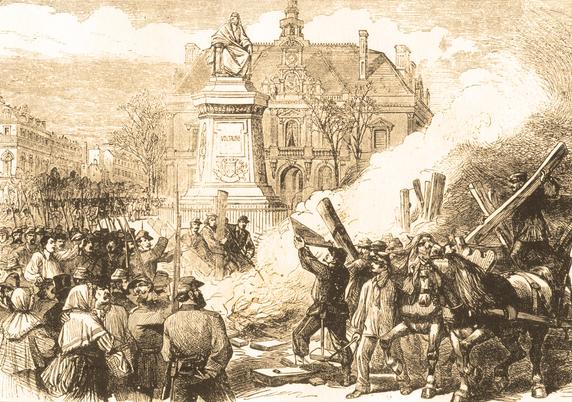
"Against the Logic of the Guillotine
Why the Paris Commune Burned the Guillotine—and We Should Too"
https://crimethinc.com/2019/04/08/against-the-logic-of-the-guillotine-why-the-paris-commune-burned-the-guillotine-and-we-should-too
Also tiqqun's book The Imaginary Party theorizes the pitfalls of people's courts, if the goal is legit freedom and revolution.
"Foucault, too, made a decisive contribution to the theory of the Imaginary Party: his interviews dealing with the plebs. Foucault evokes the theme for the first time in a “Discussion with Maoists” on “popular justice” in 1972. Criticizing the Maoist practice of popular courts, he reminds us that all popular revolts since the Middles Ages have been anti-judicial, that the constitution of people’s courts during the French Revolution occurred at precisely the moment when the bourgeoisie regained control, and, finally, that the tribunal form, by reintroducing a neutral authority between the people and its enemies, reincorporated the principle of the state in the struggle against the state. “When we talk about courts we’re talking about a place where the struggle between contending forces is willy-nilly suspended.” According to Foucault, the function of justice following the Middles Ages was to separate the proletarianized plebs-the plebs integrated as a proletariat, included by way of their exclusion-from the non-proletarianized plebs, from the plebs proper. By isolating within the mass of the poor the “criminals,” the “violent,” the “insane,” the “vagrants,” the “perverted,” the “gangsters,” the “underworld,” THEY would not only remove what was for power the most dangerous segment of the population, that which was always ready for armed, Insurrectionary action, THEY would also enable themselves to turn the people’s most offensive elements against the people themselves. This would be the permanent threat of “either you go to prison or you join the army,” “either you go to prison or you leave for the colonies,” “either you go to prison or you join the police,” etc. All the effort of the workers’ movement to distinguish between honest, strike-ready workers from “agitators,” “rioters,” and other “uncontrollable elements” is an extension of this opposition between the plebs and the proletariat. The same logic is at work today when gangsters become security guards: in order to neutralize the Imaginary Party by playing one of its parts off the others."
https://theanarchistlibrary.org/library/tiqqun-this-is-not-a-program
In other words, destroy the apparatuses, not the people.
@HeliosPi @Azarilh @ariarhythmic @peter
I found the essay more palatable than the quotation of the book.
There is no longer bourgeoisie or middle class, only politicians and officials at the service of a few millionaires. So few that they are outnumbered by a ratio of 99 to 1.
It is naive to think that in the current political and war moment, it will be possible to destroy the apparatus and the institutions that support it, without first destroying its sources of financing. The billionaires.
@DBG3D @Azarilh @ariarhythmic @peter
Glad to read the feedback about the form of my communicating. The important part imho, is the bit about the French Revolution, how eventually the struggle was reincorporating "the principle of the state in the struggle against the state", by judicial executions.
Anyways, the term bourgeoisie still kinda mystifies me, and if that terminology isn't clarifying anymore then... ... So I imagine it meaning apparatusses like center-right Parties of electoral politics.
In the current moment its not possible really. This opens up another can of worms about ideas (and practices) of dual power and/or living outside the zones of control of a State. Such as among the hills, deep forests, mountains, and swamps of the world, until technology of all-terrain-vehicles and roads (such as in 1950s SE Asia), and like actually draining a swamp (such as in Iraq by Sudein). But we live in an era of a grand scope of control by the institutions of dominations reaching seemingly all of the Globe*, at a time when the backloop of the Anthropocene is occuring, during this ongoing great sixth extinction event on Earth that we're living through now.
* A global conception symbolized by maps and a defined finiteness on Earth, pushing the conceptual boundaries of infinity out into the universe, from what is sensually experienced by gazing out at the infinite horizons of the Oceans.
