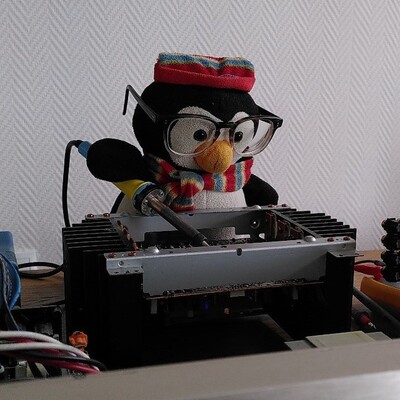
2 weeks ago, girlfriend and me took a #nighttrain from Berlin Südkreuz to Budapest (EN 40457). On paper a 12 hour ride (20:25 - 08:29), in reality we arrived after 10 in the morning, since the train just stood around in Bratislava for at least an hour ("something with the rails" according to the conductor) and we started out with a >30minutes delay from Berlin.

I requested compensation through the #ÖBB -bot (which worked very well actually) and got a reply later on: denied, system says no, you arrived with less than an hour of delay.

What I noticed during our ride, is that somewhere after Břeclav (Czechia), our train state in the DB app stopped updating and it didn't take our Bratislava-delay into account anymore.
#crossBorderRail

@quin_antarctic I also often notice the same thing where delays are not properly tracked across borders. Train operators generally only see delay within their "home" country but default to "on time" once abroad.

In my opinion, this is why the upcoming EU regulation on passenger rights should include mandatory tracking of delays across Europe in an open data manner. There cannot be effective compensation if operators pretend delays don't happen. cc @erpu @jon @stefanlindbohm @bovine3dom

@cycling_on_rails @quin_antarctic @erpu @jon @stefanlindbohm @bovine3dom
as I understand it, the February 2026 publication of Telematics TSI does not mandate the tracking of delay information, but rather the open publication of all train service tracking and timetable data.
Whether a train service is delayed, or heavens forfend, on-time, is the left as an exercise for the reader.
I also note that, although this is now in law, there is still an implementation period which has yet to elapse.

@wnd @cycling_on_rails @erpu @jon @stefanlindbohm @bovine3dom I can imagine that you don't want to track delay information as a separate field per se, but I'd assume you do want to be able to track the actual train arrival/departure times. Or is that what's included with "all train service tracking and timetable data"?

I'd assume the planned arrival/departures are known, so any differences are pretty easily calculated.

Also seems very relevant information anyhow and I assume (again), that this information is available to the operators/planners anyway..

@quin_antarctic @cycling_on_rails @erpu @jon @stefanlindbohm @bovine3dom yes, this is what I meant by "all train service tracking and timetable data".

Determining whether or the cause of a delay or otherwise is more a performance analysis activity. About which the TEL TSI has very little to say.

@wnd My interpretation in practical terms is that all the (raw) data should by law be available by 2029, but law says nothing about who needs to build a UI to show it.

Realtime data is by definition split at borders (infrastructure managers change + different NAP’s for the data), so there’s nothing saying any particular app would add these data sources just because they exist.

@quin_antarctic @cycling_on_rails @erpu @jon @bovine3dom

@wnd However, there is a UIC-led project for state railways (mostly) to share data in a proprietary manner ahead of the legislated stuff. So certain countries’ state railways should get better at this stuff soon.

@quin_antarctic @cycling_on_rails @erpu @jon @bovine3dom

@stefanlindbohm @wnd @quin_antarctic @erpu @jon @bovine3dom Ah, looks like UIC needs to find a way to justify their hefty MERITS fee ahead of mandatory open data! Which confirms that yes, mandatory open data is a good incentive to kick their b*tts and improve the data sharing. 👍