 Joanna Masel
Our new paper on long-term genetic threats to small populations finds that #MutationalMeltdown (bad mutations fixing) is less of a problem than "mutational drought" (too few good new mutations) @wmawass @uliseshmc @jdmatheson https://royalsocietypublishing.org/rspb/article/293/2072/20260600/481996/Extinction-vortices-are-driven-more-by-a-shortage #ConservationGenetics #EvolutionaryRescue #PopulationGenetics #EvolGenPaper 1/5
Small populations produce fewer of the new mutations that are eventually required to keep up with environmental change. Small populations also allow more deleterious mutations to fix. In both cases, lower fitness then creates a vicious cycle or “extinction vortex”. 2/5
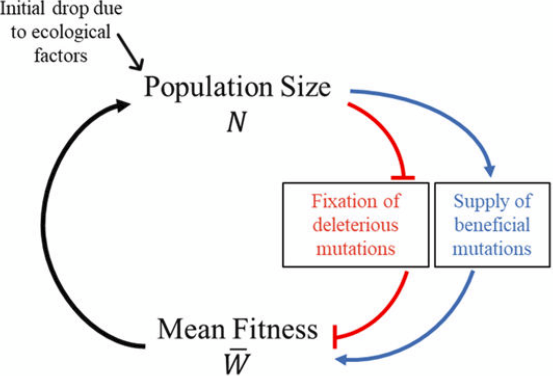
These are both long-term dangers. A shortage of standing genetic variation is more urgent than a shortage of new beneficial mutations, and a rise in inbreeding depression is more urgent than deleterious fixations. 3/5
New beneficial mutations are eventually needed not only to counter environmental change, but also to compensate for fixed deleterious mutations. Mutational drought exceeds mutational meltdown even in the conservative case where the latter kind of fitness loss exceeds the former. 4/5
Meltdown only becomes more important when beneficial mutations are not so rare compared to deleterious mutations. So population genetics should never ignore beneficials over long timescales: either they are common, or their limiting nature is critical. 5/5