 Nick East (Indie Writer)
Virtue signaling, guilt trips, and wage theft is what corporations do best, that's how they become a big company... 😒
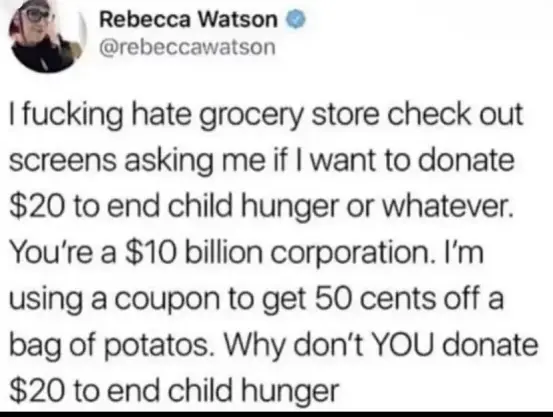
Virtue signaling, guilt trips, and wage theft is what corporations do best, that's how they become a big company... 😒
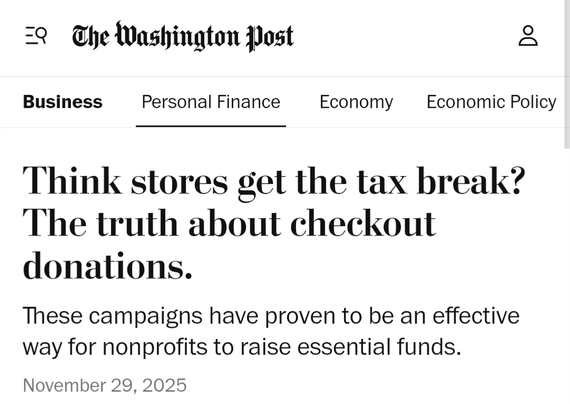
@khleedril @fluffgar @NickEast_IndieWriter Actually, these campaigns are very effective for the nonprofits that benefit from them. 100% of the donations go to the cause you're asked if you want to support, like your local food bank.
https://www.washingtonpost.com/business/2025/11/29/charity-round-up-checkout-tax-deduction
@rhywun @fluffgar @NickEast_IndieWriter No they don't. But even if they did, I wouldn't care. The nonprofits are massively benefitting from grocery stores connecting them with small donors, and they get 100% of the donations.
Sometimes the Corporations Bad reflex isn't reality, and besides, it's just your grocery store, not Exxon Mobil.
https://www.washingtonpost.com/business/2025/11/29/charity-round-up-checkout-tax-deduction
@NickEast_IndieWriter Why would I need a corporation to act as intermediary when I can donate directly to causes I care about? Our local Lidl ended the practice of having their chip and pin machines ask for a donation before every transaction, because so many customers complained.
This is a working class housing estate where folks are choosey about where their hard-earned money goes. 🤷🏻♂️
@ApostateEnglishman @NickEast_IndieWriter Maybe you don't need it, but these nonprofits massively benefitting from the opportunity to reach so many small donors. 100% of that dollar your round your bill up to at checkout goes directly to the nonprofit you're asked if you want to support, and the grocery stores don't profit. The people shopping at your Lidl took away a great opportunity from your local nonprofits because they didn't feel like just selecting 'no'.
https://www.washingtonpost.com/business/2025/11/29/charity-round-up-checkout-tax-deduction
@Retepkce @ApostateEnglishman @NickEast_IndieWriter I'm not sure I understand you. Are you asking what's to stop a US-based grocery store from claiming a tax break in Europe? If so, it's the fact that they don't pay taxes in Europe. US, UK, and EU laws all prohibit companies from claiming a tax deduction on money that was never theirs.
Go ahead and give that dollar to your local food bank, fam. It's not going to hurt anyone and you will help feed a hungry person.
@Retepkce @ApostateEnglishman @NickEast_IndieWriter Large-scale fraud happens where money is easily hidden—like shell companies or offshore accounts—not at a cash register under a heavy paper trail.
For Lidl to pull this off, they would have to coordinate fraud across thousands of stores, trick global auditing firms, and fool national tax authorities, all for a minor tax break that mathematically equals zero anyway. Corporate fraud exists, but this specific rumor is a myth.
@NickEast_IndieWriter they collect your change today. They deposit it into their accounts. They receive interest from your abandoned coins. Then make a small charitable donation in December so they don't have to pay taxes on the money you have them to invest.
It's not charity, it's late stage capitalism
@bebadefabo @NickEast_IndieWriter It's totally charity, and you are the donor with the right to write it off on your taxes, not the store, and no they don't make interest on it. 100% of your donation goes directly to the nonprofit you're asked if you want to support. These nonprofits are massively benefitting from this opportunity to reach so many small donors. But if you don't feel like giving a dollar by adding it at checkout, you'll find an excuse for yourself.
https://www.washingtonpost.com/business/2025/11/29/charity-round-up-checkout-tax-deduction
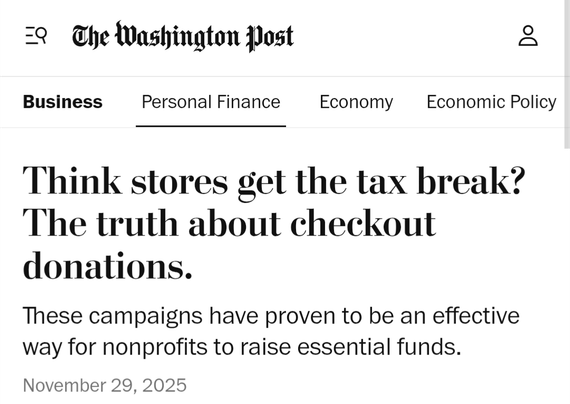
@lobstermane @NickEast_IndieWriter Uh, no. The grocery stores are not getting anything from this. 100% of your donation goes to the nonprofit you're asked if you want to support, like your local food bank. These nonprofits are massively benefitting from this opportunity to reach so many small donors. This is just an all around good thing. And stealing from your grocery store just makes prices go up for your neighbors.
https://www.washingtonpost.com/business/2025/11/29/charity-round-up-checkout-tax-deduction
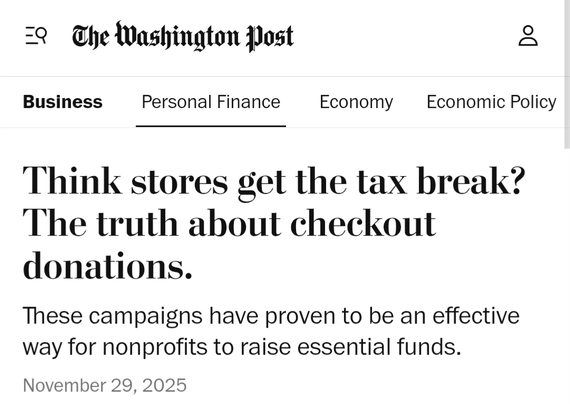
@transitionalaspect @NickEast_IndieWriter No, they don't. 100% of your donation goes to the nonprofit you're asked if you want to support, and the nonprofits are massively benefitting from the opportunity to reach out to so many small donors.
https://www.washingtonpost.com/business/2025/11/29/charity-round-up-checkout-tax-deduction
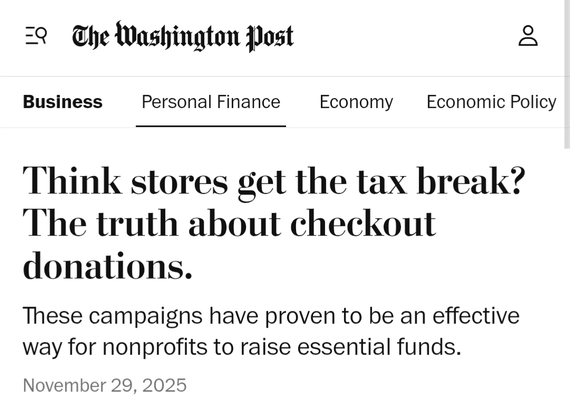
@vince @transitionalaspect probably because at first glance it looks like you’re spamming the same thing over and over with the wapo link (and the same/similar text).
This is probably unrelated, but your wording made me think you were talking about something other than the tax break because it seems feasible that “100% of your money” could go to the charity while the corporation is still getting a tax break for “donating” the money that you gave to them for that purpose - BUT the rules say they can’t claim your money as their donation and get a tax break for it.
That’s probably why the conversion keeps going back and forth without advancing past “yes they can” and “no they can’t”.
@shadows @transitionalaspect Admittedly, I replied to everyone propagating the false notion that we shouldn't add a dollar at checkout to feed hungry people because Corporation Bad. I have a passion for the truth. And I like to cite my sources.
The argument is that the evil grocery store might write off your dollar given to the food bank for a tax break, so you should not donate at checkout. But most people don't donate to food banks except at checkout, so we shouldn't discourage them from it.
@infoseclogger @NickEast_IndieWriter No they don't, but even if they did, who cares? Your local grocery store gets a small tax break for funneling 100% of donations to nonprofits?
These campaigns are very effective for the nonprofits that benefit from them. 100% of the donations go to the cause you're asked if you want to support, like your local food bank.
https://www.washingtonpost.com/business/2025/11/29/charity-round-up-checkout-tax-deduction
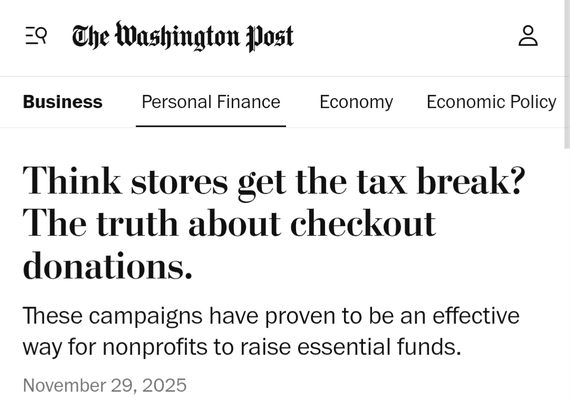
"Corporations cannot take tax deductions for charitable contributions made by their customers. This would be illegal under U.S. tax law, according to Renu Zaretsky, a writer and editor for the Urban-Brookings Tax Policy Center."
And the punishment fine for taking the deduction is less than the money made from the deduction, I'll bet.
Be mindful and donate directly. That way it goes to good and reputable charities.
In MKE, there are to major charities battling hunger, one of whom advertises so much more than the other. I did IT work for the big one. They shouldn't get a dime. But, fast food and grocery stores solicit donations for this wasteful org overpaying their top executives.
Just because it sounds good, like a food bank, doesn't make it good.
In the current environment with the current administration? They won't even get the fine. Per your article:
"In other words, if the business is acting lawfully"
If is doing a Mr. Olympia level amount of lifting.
My argument is not to donate through the store. Donate directly. And I fail to see the fault in my logic of donating directly, donating thoughtfully.
@infoseclogger @NickEast_IndieWriter I mean, if you have some irrational fear complex that your local grocery store is risking their business to illegally get a negligible tax break when you give a dollar to your local food bank, then you might be a little too paranoid. But there's no way for them to claim the dollar that goes from your credit card to your food bank is their donation.
Most people don't directly donate to their food bank, except at the checkout, so you shouldn't discourage them.
@NickEast_IndieWriter I always get these prompts when I'm paying, but it's always asking for a dollar, not twenty.
This tweet seems disingenuous in that they're lying about being asked for twenty dollars, complaining about how much they hate corporations, and then demanding that corporation to do charity on their behalf.
I'm sorry you can't afford a dollar.
@NickEast_IndieWriter If you donate $10 to charity, the charity gets $10 (less whatever they pay the people who send the (e)mail(ers)) as soon as they receive your donation.
If you pay $10 to charity through some retailer, they hang onto it for an unknown amount of time, earning interest or inflating their balance sheet, and get a massive tax write-off when they finally send out the aggregated donations.
@linuxandyarn @NickEast_IndieWriter So the charity still gets the 10 dollars then. Great. I'm sure they're happy about the opportunity to reach so many potential donors. I don't know if your claim that the grocery store makes interest is true, but who cares if they do? The nonprofits are massively benefitting from this.
https://www.washingtonpost.com/business/2025/11/29/charity-round-up-checkout-tax-deduction
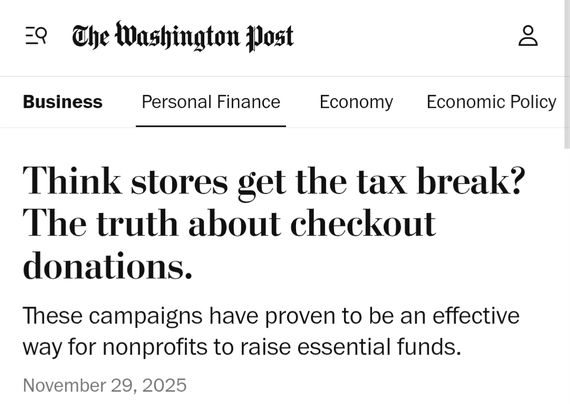
@stuartb @NickEast_IndieWriter This is direct donation. And they can't legally write it off on taxes. You are the donor and you have the right to write it off on your taxes. The big bad grocery store doesn't financially benefit from this at all. The nonprofits are massively benefitting from the opportunity to reach so many small donors, and 100% of that dollar you add to your bill goes to that nonprofit, like your local food bank.
https://www.washingtonpost.com/business/2025/11/29/charity-round-up-checkout-tax-deduction
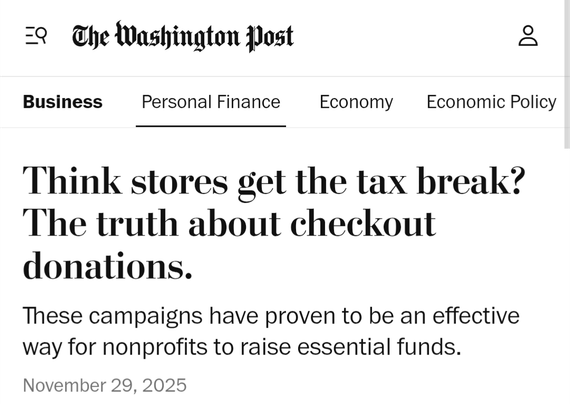
@vince @NickEast_IndieWriter Just because legally they can't use it as a tax writeoff doesnt mean they don't do it anyway - just look at the stuff these companies do on a regular basis that isn't legal, or only barely legal, and it would soon become obvious that they would at least try it.
These are companies that aren't known for doing anything socially reponsible, but run these donation-washing schemes to try and look as if they are.
You say that it is the customers rightvto aim the tax writeoff for themselves, but... how does the IRS know who donated that money?
The ony name attached to the combined donations is the retailer.
But the main reason I'm suspicious of this...
It's rife here in the UK, and anyone who thinks the kings of the grift (US corpporations) aren't doing these things on a bigger scale is deluding themselves.
And, on a semi-related note, giving directly to charities here in the UK has another, massive advantage.
Gift Aid.
Here, tax law isn't set up so that individuals can claim a tax write-off for charitable donations, instead, the charity can claim Basic Rate Tax (25%) back from the government, if the donating person signs a declaration.
Gift Aid may be available to businesses, in addition to reducing their tax bill, but not always.
Most excellent comeback..
 Fluffgar 🏴 🏳️🌈
 Khleedril
 Vince
Vince Greg L
 WienTanzGal1
 The Sleight Doctor 🃏🍉
 Retepkce 🐈
 Bebadefabo
 Lobster
 Olga Lovick (she/her)
 shadows
 Eddie.
 Rachel Rawlings
 mathew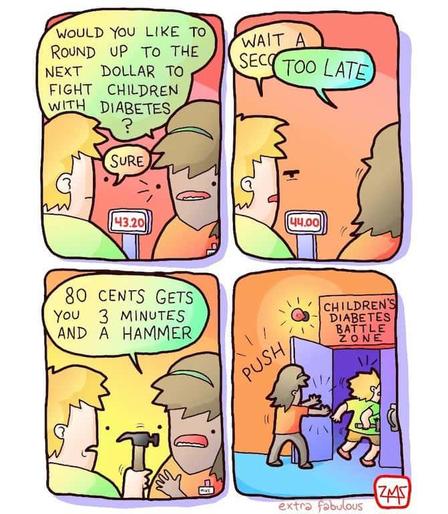
 Now @
Now @ Maddad ☑️
 flere-imsaho 🇺🇦
 kelleynnn