Yet another bomb is coming from the EU: #GMO deregulation. It includes getting rid of labelling, safety checks, monitoring and more.

It completely ignores science, but is exactly what lobbyists and patent holders want. Because most of us want to know what we eat and have freedom of choice.

This is the final vote. Scheduled to 1&2 June in ENVI and 15 June in EP.

*Let’s let MEPs know that we don’t agree with this.*

https://www.mujmalysvet.cz/stitek/gmo/
(in Czech, but with many links to resources in English)

@xHire

"GMO deregulation" can be misleading to the reader, and unnecessarily alarming: old GMOs will remain regulated as they are now.

The new law being discussed covers products that are modified using so-called New Genomic Techniques (NGT), such as CRISPR/Cas9, which produce tiny changes in the DNA that resemble those occurring in nature. Only a subset of these new products will be "deregulated".

@emmecola That’s what lobbyists say, yes. However, science shows a different reality.

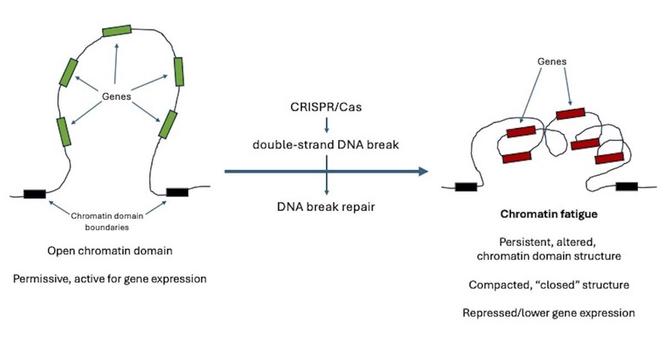
For example, the image from a research shows the state of a DNA after GM – this doesn’t happen in nature. The equivalency claims of NGT and natural processes/breeding aren’t based on science at all.

Based on an analysis by BfN, the deregulation is expected to affect 94% of new GMOs.

I have yet to see science supporting the deregulation. I ask the yes-voting MEPs for links to research, too. So far no answers.

@xHire Can you please point me to the specific research from which you took the illustration? Thanks

@emmecola Sure! https://www.science.org/doi/abs/10.1126/science.adk6662

Of course this isn’t the only unintended damage caused to the #DNA by #NGT. Caution and careful examination of GMOs with proper techniques is absolutely appropriate.

It also shows that this research area is still very young, there is a lot we don’t know yet. It’s too early to deregulate it.

> Potential adverse effects shall not be discounted on the basis that they are unlikely to occur.

(A quote from the current #GMO directive: https://eur-lex.europa.eu/legal-content/EN/TXT/?uri=CELEX:02001L0018-20210327)

@emmecola Perhaps one thing to clarify: the illustration I posted isn’t directly from the paper, but was made by Michael Antoniou (a professor in molecular genetics at King’s College London) who reported on the paper.