
Is #mastodon becoming an echo chamber? This post from @carnage4life has me questioning our community. The Mastodon team is finally getting some traction, the product improvements are increasing, The #UX is improving, yet people posting on multiple platforms are making comments like this. It's confusing.

I *know* people here don't want this to be a classic social media-clone but we'd *like* journalists to be here right? They aren't coming with examples like this!
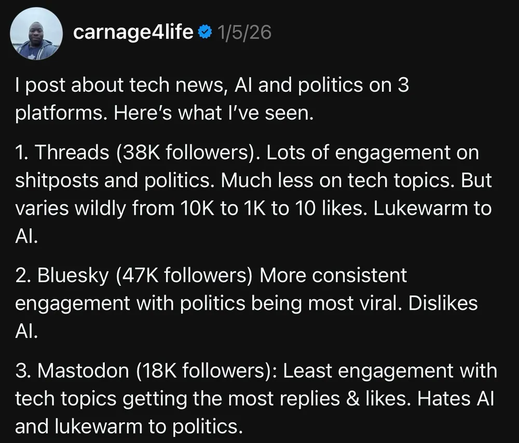

@scottjenson so, I find this discussion disappointing for a few reasons.

The biggest one is this: all three platforms that @carnage4life calls out are connected via ActivityPub. They are on one inter-network.

In theory, he should not need three different accounts, with three different follower groups. He should have one account, and all 103k followers (minus duplicates!) could be part of the same conversation, on whatever server platform they use.

In practice, few people do this today.

@scottjenson

As technologists we need to do more to smooth those junctures and make them less of a barrier. I hope in a few years when @carnage4life looks at his network, it feels more integrated and less separated.

@scottjenson @carnage4life on the topic of AI, I find the abusive conversations on the Fediverse pretty dispiriting. People I like and respect have worked themselves into the position that use of AI is an inexcusable sin, and that anyone who uses AI merits harassment and abuse. Given that 85% of developers use or plan to use AI (Stack Overflow poll), that means a huge number of tech people getting brigaded by our anti-AI squad.

@evan @scottjenson @carnage4life I agree. I would rather talk about how we can improve LLMs and their applications than post anti-AI memes and shame people who use LLMs.

For example, let's use more voluntary training data, let's make smaller, more efficient models, let's do more quality control with the output, let's protect authors and artists from having their work stolen, let's not over-rely on LLMs or use them for things they are bad at. These are actionable steps we can take to improve the world with LLMs in it.

I do not believe that the "LLMs are categorically evil" approach is going to have any good results. The genie is out of the bottle, people find this technology very useful in certain ways. We might as well try to reduce the harms and improve the outcomes of using LLMs rather than chase after a cultural or legal prohibition which will never really be effective.

@earth_walker @scottjenson @carnage4life

One thing we don't talk about, when we talk about AI, is that, for hackers, AI-assisted software development threatens our livelihoods and lifestyle. It undermines the special position that we hold in the social and economic order.

No amount of lowering power consumption, careful training data provenance, or decentralised deployment will help with that.

@earth_walker @scottjenson @carnage4life

It would be interesting to have the discussion of how, if we don't manage to abolish all LLM-assisted software development entirely, we can maintain hacker culture and a positive influence on the world's use of technology.

@evan @scottjenson @carnage4life I would argue that the history of technology is defined by working with increasing levels of abstraction. First you were plugging in wires, then you had simple instruction sets, then low level languages, then high level languages, and now we can use natural language to write software. Every time this happened, we found new sources of inspiration and made cool and useful new things. I see LLMs as part of that story and not fundamentally different. In my opinion, hackers are ultimately people who trade in ideas, the technology is more the means to actualize the ideas. If you get too attached to specific technologies you'll have a problem when the world changes and the focus shifts to new technologies. So I see the cultural side of the issue as something that people can potentially adapt to.

That said, yes LLMs being pushed by capitalist entities are definitely reducing the economic value of information-based labor. But that's unfortunately also the latest iteration of a long story of industrialization and automation. I believe we should fight against the devaluation of labor by capitalists, but I think that we should be more focused on policy than technology in that fight.