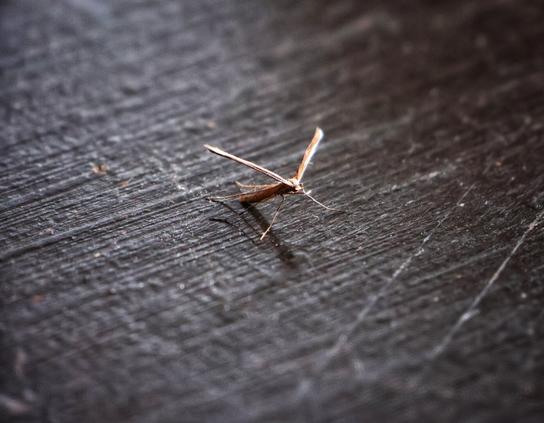
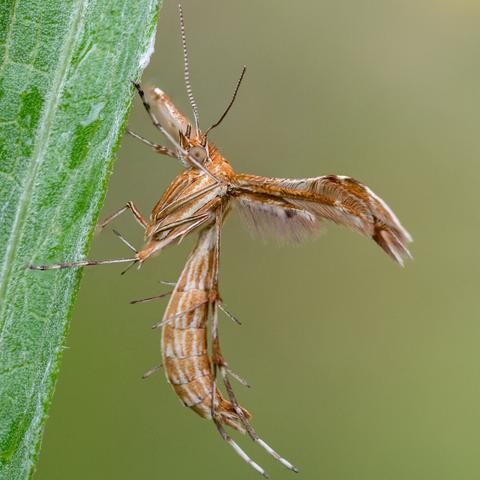
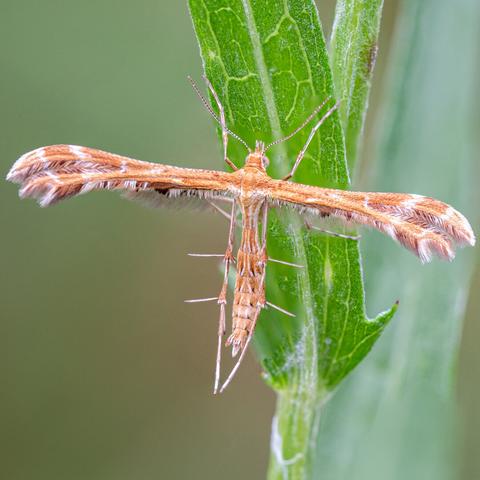
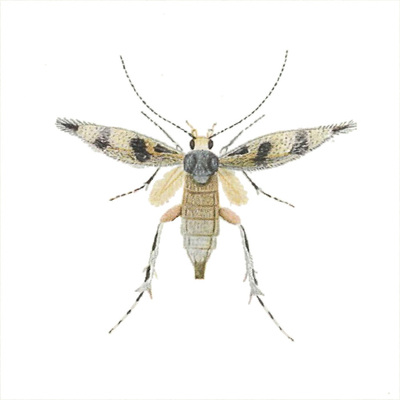
I've been going through around 5000 #iNaturalist plume #moth records in #Australia that are not yet research grade and for which I'd not yet added identifications. Almost all the species here can be identified well from a good photo.

The most interesting discovery today was a handful of #caterpillar observations that clearly represent the first photos of the #larva of the common species Stangeia xerodes. See the explanation here:

https://inaturalist.ala.org.au/observations/190890238

#entomology #Lepidoptera #Pterophoridae

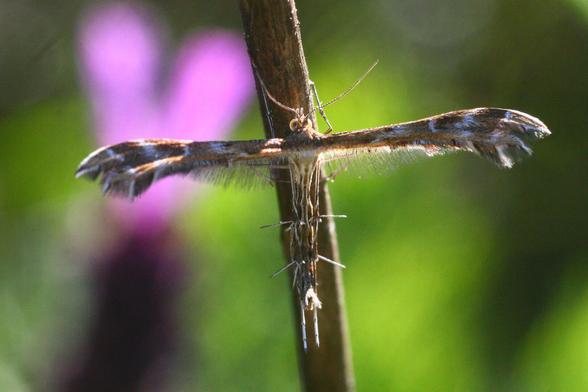
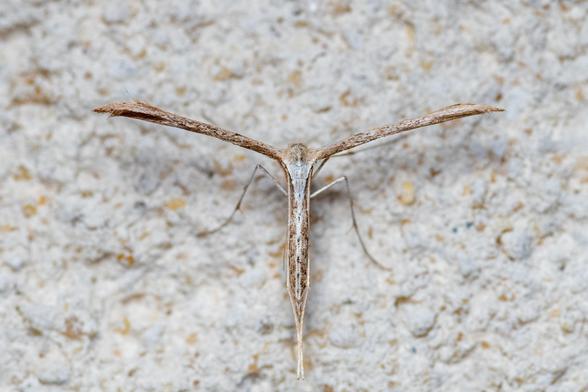
Otra polilla portuguesa, cuyo nombre horrible no hace justicia a lo bonita que es: Crombrugghia distans (familia Pterophoridae).
Las polillas de esta familia se caracterizan por esas alas tan estrechas adornadas con "flecos". Me caen simpatiquísimas. Si buscáis fotos en internet, veréis que las hay realmente preciosas y llamativas.
#polilla #moth #pterophoridae #macrophotography #macro

This #PlumeMoth species was previously last recorded in the ACT (as far as I know) back in 1950. I'd been thinking of planning visits to #Namadgi to look for it next summer, but I just found one in #NatureMapr identified (then) as Platyptilia celidotus. I added the identification and it's been accepted by others, so this record can now flow correctly into the #AtlasOfLivingAustralia and then @gbif

Stenoptilia leuconephes

https://canberra.naturemapr.org/sightings/4535301

#Lepidoptera #Pterophoridae #entomology

Stenoptilia leuconephes at Namadgi National Park

Canberra & Southern Tablelands - NatureMapr

@pirarucu

This one's one of the many rather similar American Hellinsia species.

If you consider #moths (and insects more widely), many seem to have evolved to look like anything other than an edible insect.

Many resemble bird droppings, broken twigs, dead leaves or something mouldy:

https://inaturalist.ala.org.au/taxa/205156-Cilix-glaucata
https://inaturalist.ala.org.au/taxa/55361-Phalera-bucephala
https://inaturalist.ala.org.au/taxa/345746-Falcaria-lacertinaria
https://inaturalist.ala.org.au/taxa/123022-Thyatira-batis

Others have transparent or trompe-l'oeil sections in their wings:

https://inaturalist.ala.org.au/taxa/257013-Psychophasma-erosa
https://inaturalist.ala.org.au/observations/1133796

Others mimic something dangerous:

https://inaturalist.ala.org.au/taxa/1648557-Musotima-instrumentalis
https://inaturalist.ala.org.au/taxa/354819-Sesia-apiformis

In other words, you can expect moths to resemble pretty much anything that hides their mothness.

For plume moths (#Pterophoridae), the posture and the (frequently) rolled wings make them look more like plant matter than an insect, but even these moths can sometimes be quite spectacular:

https://inaturalist.ala.org.au/observations/319357256

#Entomology #Lepidoptera #camouflage
Chinese Character (Cilix glaucata)

The Chinese Character (Cilix glaucata) is a moth of the family Drepanidae. It is found in Europe, Asia Minor and North Africa. (Source: Wikipedia, '', http://en.wikipedia.org/wiki/Cilix_glaucata, CC BY-SA 3.0 . Photo: (c) Michał Brzeziński, some rights reserved (CC BY-NC), uploaded by Michał Brzeziński)

iNaturalist Australia
The plume moth prooves that aliens live among us.

Die Federmotte ist der Beweis, dass Außerirdische unter uns weilen.

#plumeMoth
#Federmotte
#Oxyptilus
#Pterophoridae

I just saw this record in #iNaturalist:

https://inaturalist.ala.org.au/observations/200710267

It's the first in iNat for the plume #moth species Deuterocopus honoratus. Neither the #AtlasOfLivingAustralia nor @gbif currently has any records for the species. It may well be that this is the first record of the species since the type specimen was collected around Brisbane in March 1897. That specimen is in the Natural History Museum in London and clearly not one of those they have so far databased.

https://en.wikipedia.org/wiki/Deuterocopus_honoratus

https://www.biodiversitylibrary.org/page/9808840

https://bie.ala.org.au/species/https://biodiversity.org.au/afd/taxa/1b05e2a2-25fa-46bd-9b6f-ea18413b0cf3#overview

https://www.gbif.org/species/1858944

#Lepidoptera #Pterophoridae #PlumeMoth #entomology

Subfamily Deuterocopinae

Deuterocopinae from Witta QLD 4552, Australia on February 28, 2024 at 01:19 PM by Larney Grenfell

iNaturalist Australia

Catalogue of the Alucitoidea of the World updated.

New combination and generic placement for many-plume species in China and Russia

https://doi.org/10.25221/fee.517.2

Includes a few new distribution records too.

This feeds into #CatalogueOfLife and @gbif.

Latest version available on #ChecklistBank:

https://www.checklistbank.org/dataset/2207/about

#Lepidoptera #Pterophoridae #taxonomy #entomology #NewSpecies #BiodiversityInformatics @dhobern

New data on poorly-known species of many-plumes moth (Lepidoptera: Alucitidae) from China and Russia - Far Eastern Entomologist

Catalogue of the Pterophoroidea of the World updated.

New #PlumeMoth species from #SouthAfrica, Agistis zagulajevi:

https://doi.org/10.1134/S0013873824040080

Changes to synonymy and new distribution records from #Georgia:

https://doi.org/10.5281/zenodo.14720696

This feeds into #CatalogueOfLife and @gbif.

Latest version available on #ChecklistBank:

https://www.checklistbank.org/dataset/1199/about

#Lepidoptera #Pterophoridae #taxonomy #entomology #NewSpecies #BiodiversityInformatics @dhobern