#CMSPAS: Search for Z' bosons decaying into charginos in final states with two oppositely charged leptons and missing transverse momentum (CMS-PAS-SUS-23-006) https://cds.cern.ch/record/2929803 #Moriond #SuperSymmetry
Search for Z' bosons decaying into charginos in final states with two oppositely charged leptons and missing transverse momentum

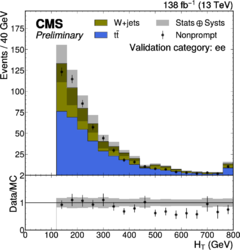
A search for massive leptophobic Z' bosons decaying into a pair of charginos at the CERN LHC with the CMS detector is presented. The final state consists of two oppositely charged leptons and missing transverse momentum. The analysis is based on proton-proton collision data collected at a center-of-mass energy of $13~\mathrm{TeV}$, corresponding to an integrated luminosity of $138~\mathrm{fb}^{-1}$. A parametrized neural network is employed for signal extraction. The data are found to be consistent with the standard model, and upper limits are set on the Z' boson production cross section versus Z' and chargino masses. The analysis is sensitive to Z' boson masses up to about $3.5~\mathrm{TeV}$, assuming a $100\%$ branching fraction to charginos.

CERN Document Server
#CMSPAS: Spin and symmetry properties of all-charm tetraquarks (CMS-PAS-BPH-24-002) https://cds.cern.ch/record/2929695 #Moriond #BPhysics
Spin and symmetry properties of all-charm tetraquarks

The traditional quark model accounts for the existence of baryons, like protons and neutrons, which consist of three quarks, as well as mesons, composed of a quark and antiquark pair. Only recently has substantial evidence started to accumulate for exotic states composed of four or five quarks or antiquarks. In this study, the CMS Collaboration investigates the recently discovered family of three tetraquark candidates composed of four charm quarks and antiquarks. The exact nature of their internal structure remains uncertain. They could either be tightly bound states of true tetraquarks, similar to quarks bound within protons and neutrons, or molecules composed of two familiar mesons, loosely bound like protons and neutrons in a nucleus, with other potential configurations still being considered. Angular analysis techniques for decay products, developed for the discovery and characterization of the Higgs boson, are now being applied to the new exotic states. The quantum numbers for parity $P$ and charge conjugation $C$ symmetries are found to be +1. The spin $J$ of these exotic states is most consistent with $J=2\hbar$, a value that is uncommon for such particles, while the $J=0\hbar$ and $1\hbar$ are excluded at 95\% and 99\% confidence level, respectively. The $J^{PC}=2^{++}$ quantum numbers match the expected values for tetraquarks with specific configurations of spin and angular momenta of its components, which helps in narrowing down the tetraquark's internal structure.

CERN Document Server
#CMSPAS: Observation of X(6900) and evidence of X(7100) in the psi(2S)Jpsi to 4mu mass spectrum in pp collisions at CMS (CMS-PAS-BPH-22-004) https://cds.cern.ch/record/2929529 #Moriond #BPhysics
Observation of X(6900) and evidence of X(7100) in the psi(2S)Jpsi to 4mu mass spectrum in pp collisions at CMS

A search is performed for structures near threshold in the $J/\psi\psi(2S) \rightarrow \mu^{+} \mu^{-} \mu^{+} \mu^{-}$ channel using a sample of proton-proton collisions at $\sqrt{s} = 13.0~\mathrm{TeV}$ and $13.6~\mathrm{TeV}$ recorded by the CMS detector at the CERN LHC. The data correspond to an integrated luminosity of about $314~\mathrm{fb}^{-1}$. A threshold structure is observed near $6900~\mathrm{MeV}$ with a significance in excess of five standard deviations ($>$5$\sigma$), and there is also evidence (4.0$\sigma$) for a second peak, in a model where the structures mutually interfere. The mass and width of the two peaks are measured to be $6876^{+46\,+110}_{-29\,-110}$, $253^{+290\,+120}_{-100\,-120}~\mathrm{MeV}$ and $7169^{+26\,+74}_{-52\,-70}$, $154^{+110\,+140}_{-82\,-160}~\mathrm{MeV}$, which are consistent to within one standard deviation of the X(6900) and X(7100) structures previously observed in the $J/\psi$$J/\psi$ spectrum.

CERN Document Server
#CMSPAS: Search for compressed electroweakinos with low-momentum isolated tracks (CMS-PAS-SUS-24-012) https://cds.cern.ch/record/2929520 #Moriond #SuperSymmetry
Search for compressed electroweakinos with low-momentum isolated tracks

A search is presented for higgsino dark matter (DM) in final states with a low momentum (soft), isolated track and large missing transverse momentum. In the minimal supersymmetric standard model (MSSM), charginos are most often produced in association with a nearly mass-degenerate neutralino or another chargino, and predominantly decay into the lightest neutralino (DM candidate) and a soft pion. For a mass difference $\Delta m^{\pm}$ less than $1$ $\mathrm{GeV}$, a discernible displacement of the pion's track with respect to the primary vertex can arise, reaching up to about $1$ $\mathrm{cm}$ for the smallest allowed $\Delta m^{\pm}$. A parameterized multivariate classifier is employed to distinguish the signal track from background tracks, optimally targeting a range of $\Delta m^{\pm}$ by exploiting the track transverse momentum, impact parameter, and event topology to varying degrees depending on the assumed $\Delta m^{\pm}$. The analyzed data correspond to an integrated luminosity of $138$ $\mathrm{fb}^{-1}$ collected by the CMS experiment in proton-proton collisions at $\sqrt{s}=13\, \mathrm{TeV}$. No evidence of new physics is observed, and limits are set at the $95\%$ confidence level in the mass plane of the model. Assuming MSSM cross sections, values of $\Delta m^{\pm}$ between $0.28$ and $1.15$ $\mathrm{GeV}$ are excluded for a $100$ $\mathrm{GeV}$ mass chargino, and chargino masses up to $185$ $\mathrm{GeV}$ are excluded for $\Delta m^{\pm}$ of $0.55$ $\mathrm{GeV}$.

CERN Document Server
#CMSPAS: Model-independent measurement of the Higgs boson differential production cross section in association with two jets in the WW decay channel (CMS-PAS-HIG-24-004) https://cds.cern.ch/record/2929512 #Moriond #HiggsBoson
Model-independent measurement of the Higgs boson differential production cross section in association with two jets in the WW decay channel

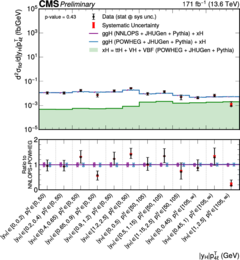
A model-independent measurement is presented of the differential production cross section of the Higgs boson decaying into a pair of W bosons, with a final state including two jets. The analysis selects events where the decay products of the two W bosons consist of an electron, a muon, and two neutrinos. The study is based on proton-proton collision data collected by the CMS detector from 2016 to 2018, corresponding to an integrated luminosity of $138~\mathrm{fb}^{-1}$. The production cross sections are measured as a function of the difference in azimuthal angle between the two jets. The differential cross section measurements are further used to constrain Higgs boson couplings within the SM effective field theory framework.

CERN Document Server
#CMSPAS: Observation of a family of all-charm tetraquark candidates at the LHC (CMS-PAS-BPH-24-003) https://cds.cern.ch/record/2929472 #Moriond #BPhysics
Observation of a family of all-charm tetraquark candidates at the LHC

Three structures, $X(6600)$, $X(6900)$, and $X(7100)$, have been reported in the $J/\psi$$J/\psi$ channel. These are prime candidates for all-charm tetraquarks. We extend our earlier study of these structures in proton-proton collisions using the CMS detector at the LHC, with 3.6 times more $J/\psi$$J/\psi$ pairs ($315~\mathrm{fb}^{-1}$ of total integrated luminosity). The statistical uncertainties on the masses and widths are reduced by about a factor of three, and the systematic uncertainties are also substantially reduced. For the first time all three structures are established with a significance well above five standard deviations ($5\sigma$). Good descriptions of the $J/\psi$$J/\psi$ spectrum were based on quantum interference among structures, which is now validated with significances of more than $5\sigma$ relative to the fit with no interference---implying all structures have the same $J^{PC}$ quantum numbers, and suggests a family of states.

CERN Document Server
#CMSPAS: Energy-energy correlation in Z boson tagged PbPb and pp collisions at sqrt(sNN) = 5.02 TeV (CMS-PAS-HIN-24-019) https://cds.cern.ch/record/2929460 #Moriond #HeavyIons
Energy-energy correlation in Z boson tagged PbPb and pp collisions at sqrt(sNN) = 5.02 TeV

The first measurement of a Z boson tagged energy-energy correlator (EEC) using charged particle tracks in PbPb collisions at $\sqrt{s_{_\mathrm{NN}}} = 5.02$ TeV is presented. This study utilizes PbPb collision data recorded in 2018 with an integrated luminosity of $1.67 \pm 0.03$ nb$^{-1}$, as well as pp collision data acquired in 2017 with an integrated luminosity of $301 \pm 6$ pb$^{-1}$. The energy-energy correlator of charged hadrons associated with the Z boson, which is predicted to be sensitive to modifications of in-medium parton showers and medium recoils, is measured in bins of event centrality for the first time in PbPb collisions. Significant modification of the EEC is observed in central PbPb collisions compared to pp reference data. The effect disappears in the more peripheral events. The results provide new insight into the jet quenching mechanism and the inner workings of the quark-gluon plasma.

CERN Document Server
#CMSPAS: Search for a new scalar resonance decaying to a Higgs boson and a new scalar with two bottom quarks and two photons in the final state in proton-proton collisions at √s = 13 TeV (CMS-PAS-B2G-24-001) https://cds.cern.ch/record/2929445 #Moriond #NewPhysics
Search for a new scalar resonance decaying to a Higgs boson and a new scalar with two bottom quarks and two photons in the final state in proton-proton collisions at $\sqrt{s}=13\,\mathrm{TeV}$

A search for a new scalar resonance, X, decaying to a standard model Higgs boson and a new scalar particle, Y, is presented. The Higgs boson further decays to a pair of b quarks, while the Y particle decays to a pair of photons. The search is performed in the mass range $240-1000\,\mathrm{GeV}$ for the resonance X, and in the mass range $70-800\,\mathrm{GeV}$ for the particle Y, using proton-proton collision data collected by the CMS experiment at $\sqrt{s}=13\,\mathrm{TeV}$, corresponding to an integrated luminosity of $132\,\mathrm{fb}^{-1}$. Observed (expected) upper limits on the product of the production cross section and the relevant branching fraction at the $95\%$ confidence level are extracted for the $\text{X}\to\text{Y}\text{H}$ process, and are found to be within the range of $0.05-2.69\,(0.08-1.94)\,\mathrm{fb}$ depending on $m_\text{X}$. The most significant deviation from the background-only hypothesis is observed for X and Y masses of $300$ and $77\,\mathrm{GeV}$, respectively, with a local (global) significance of $3.33\,(0.65)$ standard deviations.

CERN Document Server
#CMSPAS: Search for Higgs boson decay to a charm quark-antiquark pair via ttH production (CMS-PAS-HIG-24-018) https://cds.cern.ch/record/2929444 #Moriond #HiggsBoson
Search for Higgs boson decay to a charm quark-antiquark pair via ttH production

A search for the standard model Higgs boson decaying to a charm quark-antiquark pair, $\mathrm{H\!\to\!c\overline{c}}$, produced in association with a top quark-antiquark pair ($\mathrm{t\overline{t}H}$) is presented. The search is performed with proton-proton collisions at ${\sqrt{s}=13}$ TeV collected by the CMS experiment, corresponding to an integrated luminosity of 138 $\mathrm{fb}^{-1}$. Advanced machine learning techniques are employed for jet flavor identification and event classification. The Higgs boson decay to a bottom quark-antiquark pair is measured simultaneously and the observed $\mathrm{t\overline{t}H(H\!\to\!b\overline{b})}$ event rate relative to the standard model expectation is $0.91^{+0.26}_{-0.22}$. The observed (expected) upper limit on $\sigma(\mathrm{t\overline{t}H})\mathcal{B}(\mathrm{H\!\to\!c\overline{c}})$ is 0.11 ($0.13^{+0.06}_{-0.04}$) pb at $95\%$ confidence level (CL), corresponding to 7.8 ($8.7^{+4.0}_{-2.6}$) times the standard model prediction. When combined with the previous search for $\mathrm{H\!\to\!c\overline{c}}$ via associated production with a W or Z boson, the observed (expected) $95\%$ CL interval on the Higgs-charm Yukawa coupling modifier, $\kappa_\mathrm{c}$, is ${|\kappa_\mathrm{c}|<3.5}$ (${|\kappa_\mathrm{c}|<2.7}$), the most stringent constraint to date.

CERN Document Server
#CMSPAS: Azimuthal anisotropy of prompt Ds mesons at sqrt(sNN) = 5.02 TeV with CMS experiment (CMS-PAS-HIN-24-006) https://cds.cern.ch/record/2929442 #Moriond #HeavyIons
Azimuthal anisotropy of prompt Ds mesons at sqrt(sNN) = 5.02 TeV with CMS experiment

The azimuthal anisotropy of prompt $\mathrm{D}_\mathrm{s}^{\pm}$ mesons in lead-lead collisions at a nucleon-nucleon center-of-mass energy of 5.02 TeV is measured using data obtained with the CMS detector. The dataset corresponds to an integrated luminosity of 0.58 $\mathrm{nb}^{-1}$. The $v_2$ and $v_3$ Fourier coefficients are studied as a function of the $\mathrm{D}_\mathrm{s}^{\pm}$ transverse momentum ($p_\mathrm{T}$). The $v_2$ coefficient is determined in the range $4 < p_\mathrm{T} < 40$ GeV/c for three event centrality ranges, while the $v_3$ coefficient is measured in the range $4 < p_\mathrm{T} < 20$ GeV/c for one event centrality range. The results align with those observed for $\mathrm{D}^{0}$ mesons, suggesting that the inclusion of a strange quark in the $\mathrm{D}_\mathrm{s}^{\pm}$ meson has a minimal impact on the flow coefficients when these are compared to the non-strange $\mathrm{D}^{0}$ meson within the measured $p_\mathrm{T}$ range of the analysis.

CERN Document Server