New study finds exposition to
#microplastic adversely affects growth and chlorophyll content of aquatic plant Lemna minuta (least duckweed) with respect to both MP concentrations & exposure times and highlights longer-term effects.
https://www.mdpi.com/2047026 #mdpiplants @
[email protected]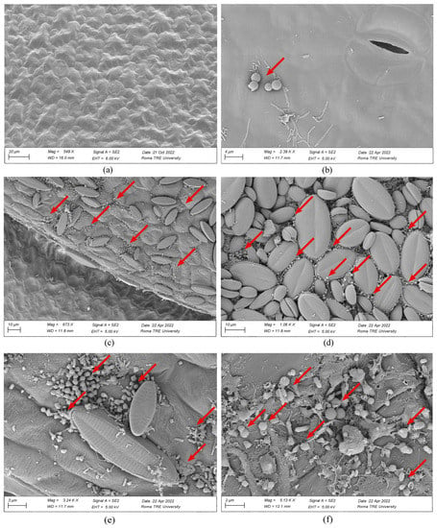

Effects of Microplastic Contamination on the Aquatic Plant Lemna minuta (Least Duckweed)
Microplastics are widely spread in aquatic environments. Although they are considered among the most alarming contaminants, toxic effects on organisms are unclear, particularly on freshwater plants. In this study, the duckweed Lemna minuta was grown on different concentrations (50, 100 mg/L) of poly(styrene-co-methyl methacrylate) microplastics (MP) and exposure times (T0, T7, T14, T28 days). The phytotoxic effects of MP were investigated by analyzing several plant morphological and biochemical parameters (frond and root size, plant growth, chlorophyll, and malondialdehyde content). Observations by scanning electron microscope revealed MP adsorption on plant surfaces. Exposition to MP adversely affected plant growth and chlorophyll content with respect to both MP concentrations and exposure times. Conversely, malondialdehyde measurements did not indicate an alteration of oxidative lipid damage in plant tissue. The presence of MP induced root elongation when compared to the control plants. The effects of MP on L. minuta plants were more evident at T28. These results contribute to a better understanding of MP’s impact on aquatic plants and highlight that MP contamination manifests with chronic-type effects, which are thus detectable at longer exposure times of 7 days than those traditionally used in phytotoxicology tests on duckweeds.
By @ASchwember and B. Carrasco: Meta-QTL Analysis for Yield Components in Common Bean (
#Phaseolus vulgaris L.)
https://www.mdpi.com/2030986 #mdpiplants via @Plants_MDPI

Meta-QTL Analysis for Yield Components in Common Bean (Phaseolus vulgaris L.)
Common bean is one of the most important legumes produced and consumed worldwide because it is a highly valuable food for the human diet. However, its production is mainly carried out by small farmers, who obtain average grain yields below the potential yield of the species. In this sense, numerous mapping studies have been conducted to identify quantitative trait loci (QTL) associated with yield components in common bean. Meta-QTL (MQTL) analysis is a useful approach to combine data sets and for creating consensus positions for the QTL detected in independent studies. Consequently, the objective of this study was to perform a MQTL analysis to identify the most reliable and stable genomic regions associated with yield-related traits of common bean. A total of 667 QTL associated with yield-related traits reported in 21 different studies were collected. A total of 42 MQTL associated with yield-related traits were identified, in which the average confidence interval (CI) of the MQTL was 3.41 times lower than the CIs of the original QTL. Most of the MQTL (28) identified in this study contain QTL associated with yield and phenological traits; therefore, these MQTL can be useful in common bean breeding programs. Finally, a total of 18 candidate genes were identified and associated with grain yield within these MQTL, with functions related to ubiquitin ligase complex, response to auxin, and translation elongation factor activity.
By @
[email protected] and B. Carrasco: Meta-QTL Analysis for Yield Components in Common Bean (
#Phaseolus vulgaris L.)
https://www.mdpi.com/2030986 #mdpiplants via @
[email protected]Meta-QTL Analysis for Yield Components in Common Bean (Phaseolus vulgaris L.)
Common bean is one of the most important legumes produced and consumed worldwide because it is a highly valuable food for the human diet. However, its production is mainly carried out by small farmers, who obtain average grain yields below the potential yield of the species. In this sense, numerous mapping studies have been conducted to identify quantitative trait loci (QTL) associated with yield components in common bean. Meta-QTL (MQTL) analysis is a useful approach to combine data sets and for creating consensus positions for the QTL detected in independent studies. Consequently, the objective of this study was to perform a MQTL analysis to identify the most reliable and stable genomic regions associated with yield-related traits of common bean. A total of 667 QTL associated with yield-related traits reported in 21 different studies were collected. A total of 42 MQTL associated with yield-related traits were identified, in which the average confidence interval (CI) of the MQTL was 3.41 times lower than the CIs of the original QTL. Most of the MQTL (28) identified in this study contain QTL associated with yield and phenological traits; therefore, these MQTL can be useful in common bean breeding programs. Finally, a total of 18 candidate genes were identified and associated with grain yield within these MQTL, with functions related to ubiquitin ligase complex, response to auxin, and translation elongation factor activity.
 Dr. Melanie Bergmann
 plgepts