 WE AND THE COLOR
Human Art Is Becoming More Valuable in the Age of AI—Here’s Why. https://weandthecolor.com/human-art-is-becoming-more-valuable-in-the-age-of-ai-heres-why/209840
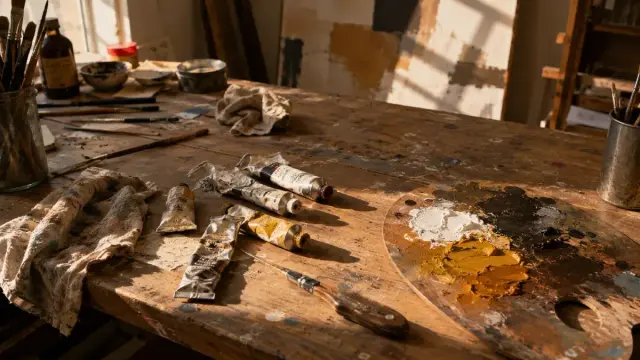
Human Art Is Becoming More Valuable in the Age of AI—Here’s Why. https://weandthecolor.com/human-art-is-becoming-more-valuable-in-the-age-of-ai-heres-why/209840
Human Art Is Becoming More Valuable in the Age of AI—Here’s Why
Machines generate millions of images per day. Anyone with a browser can produce a technically flawless illustration in under ten seconds. And yet, at the same time, human-made art is commanding higher attention, deeper emotional investment, and increasingly serious collector interest. That tension is not a contradiction. It’s an economic and cultural signal worth paying close attention to.
The value of human art in the age of AI isn’t shrinking. It’s restructuring. And the restructuring follows a logic that feels almost inevitable once you see it clearly.
Think about what happened to handmade furniture after the Industrial Revolution. Factories could produce chairs faster and cheaper than any craftsperson. But instead of eliminating the value of handmade work, mass production elevated it. Hand-carved tables became luxury objects. Craft became a premium signal, not a nostalgic footnote. The AI moment in art follows the same pattern—only faster, and at a much larger scale.
Does AI Make Human Art More Valuable or Less?
This is the question most people in the creative industry are asking right now. The honest answer is: it depends entirely on which layer of the market you’re looking at.
At the commercial, functional layer—stock imagery, social media visuals, and marketing templates—AI is replacing human labor rapidly. That work was never really about human expression anyway. It was about efficient visual production. AI does that better, faster, and cheaper.
But at the expressive, culturally meaningful layer? The picture looks completely different. Human-made art is gaining a new kind of symbolic weight. The origin of a work—who made it, with what hands, under what circumstances—has become a value signal in itself.
Consider what researchers call the “source attribution effect.” Studies consistently show that audiences devalue art once they learn it was generated by AI, even when they cannot visually distinguish it from human-made work. The aesthetic experience and the perceived value are not the same thing. People aren’t just buying images. They’re buying contact with another human consciousness.
That distinction is becoming the defining fault line of the contemporary art market.
The Scarcity Inversion: Why Abundance Creates New Premium
Here’s the core mechanism driving the shift. When something becomes infinitely abundant, the scarce version of it becomes exponentially more valuable. The internet made information free—and immediately created a premium market for expertise, curation, and original perspective. Streaming made music instantly accessible—and vinyl record sales hit a 36-year high. Digital photography flooded every phone—and analog film photography became a collector’s medium with serious investment potential.
AI is doing the same thing to images. And eventually, to all creative output.
When you can generate a thousand “masterpiece-style” paintings before lunch, the paintings that carry genuine human intent, material process, and irreproducible gesture become genuinely rare. Rarity, in markets, creates value. This isn’t wishful thinking. It’s basic economics applied to cultural production.
I call this the Scarcity Inversion Principle: the more a technology floods a creative category with synthetic output, the higher the premium attached to verifiably human work in that same category. It’s not linear. It’s asymmetric. The faster AI scales, the faster the human premium grows in the tier above it.
What the Numbers Already Show
I did a brief bit of research. Here’s what I found: The AI art market reached approximately $3.2 billion in 2024. That growth is real and significant. But it tells an incomplete story. At Christie’s first dedicated AI art auction in early 2025, total sales came in at $728,784—impressive for a debut, but a fraction of what a single significant human-made work commands at the same house.
Meanwhile, 70% of artists believe AI cannot produce work carrying the same emotional depth as human-made art. And 76% of the general public still does not consider AI-generated output to be art in a culturally meaningful sense. That cultural resistance is not ignorance. It’s a taste signal. Markets follow taste, with a delay.
Human Art in the Age of AI: Three Emerging Value Layers
The art market is not collapsing into a single pool. It’s stratifying. I see three distinct layers forming, each with its own logic and audience.
Layer One: Functional AI Imagery
This is the commodity tier. Fast, abundant, and technically capable. AI-generated visuals for marketing, editorial illustration, and commercial production fit here. The value proposition is efficiency. The cultural signal is close to zero. This layer will grow massively, but it doesn’t compete with the layers above it—it defines them by contrast.
Layer Two: Human-AI Hybrid Work
Artists who use AI as a tool—directing, editing, curating, and contextualizing machine output—occupy the experimental middle ground. This is genuinely interesting creative territory. But it carries an ambiguity problem. Provenance is murky. The human contribution is hard to quantify. Collectors and institutions are still figuring out how to value it.
Layer Three: Verifiably Human-Made Art
This is the premium tier, and it is strengthening. Human art that emerges from lived experience, material process, and irreproducible gesture carries something no AI output can carry: contact. Contact with a specific human being, a specific moment, a specific consciousness navigating the world. That contact is not a soft, sentimental idea. It’s a hard cultural and economic differentiator.
Collectors, institutions, and serious audiences increasingly organize their attention—and their spending—around this layer. Not because they’re nostalgic. Because they understand what they’re actually paying for.
The Contact Value Framework: A New Way to Think About Human Creativity
Most discussions about human art and AI frame the question in terms of quality or skill. Can AI draw as well as a human? Can it compose music at the same level? These are the wrong questions. They treat art as a performance metric, not a relational experience.
I want to propose a different framework: Contact Value. Contact Value is the degree to which a work carries evidence of a specific human consciousness—its choices, constraints, vulnerabilities, and intentions. It’s the thing you feel when you stand in front of a Francis Bacon painting and understand, viscerally, that another human being made this. That it came from somewhere real. That someone was there.
AI has no Contact Value. It has aesthetic value and often impressive technical value. But there is no person behind it. No one was there. The image emerged from statistical patterns, not from a life being lived.
Contact Value is precisely what becomes rare and therefore precious as AI output scales. The more synthetic images flood the cultural environment, the more acutely audiences feel the difference when something human-made crosses their path.
Why Contact Value Is Not the Same as Nostalgia
A common misreading of this argument is that it’s simply nostalgia dressed up in theory. It isn’t. Nostalgia is about preferring the past. Contact Value is about recognizing a specific kind of meaning-making that only humans can perform.
A painting from 1847 has Contact Value not because it’s old, but because a specific human being chose every mark. A painting made today by a human working in oil has the same Contact Value. The date is irrelevant. The human presence is the point.
This distinction matters because it means the premium on human art isn’t temporary or transitional. It’s structural. It will persist as long as human consciousness is different from algorithmic output—which, despite every claim about “emergent AI creativity,” remains fundamentally true.
What the Vinyl Revival Tells Us About Human Art’s Future
The vinyl record is one of the most instructive analogies available. Streaming platforms offer instant access to virtually every piece of recorded music ever made. Convenience, quality, and breadth are all maximized. And yet vinyl sales in the United States outsold CDs for the second consecutive year, with over 43 million units sold. Younger audiences—not audiophiles—are driving this.
Why? Not primarily because vinyl sounds better (it often doesn’t). But because it creates a different kind of relationship with music. It demands ritual: removing the record from its sleeve, placing it on the turntable, and dropping the needle. It creates friction, and friction creates attention. Attention creates meaning.
Human art operates on the same logic. In a world of instant, frictionless, infinite visual generation, the work that requires real time, real skill, real commitment, and real human judgment becomes the thing that feels worth stopping for. The friction is the point. The human effort is the value proposition.
Analog film photography offers a parallel signal. Despite billions of smartphone images captured daily, 35mm film photography is growing rapidly among younger creators. Nearly 99 million posts related to film photography exist on TikTok alone. Leica sold 5,000 M6 film cameras in one recent year—ten times the figure from a decade earlier. Scarcity, materiality, and process are driving that interest. And AI is accelerating it by making the opposite—frictionless, instant image generation—the default.
The Authenticity Economy and Human Art Value
There’s a broader cultural shift that the human art conversation sits inside. Call it the Authenticity Economy: a market reorganization in which verified human origin becomes a premium signal across creative, intellectual, and material categories.
It’s already happening in writing. In food, with the resurgence of small-batch, artisan production. In fashion, with the growth of independent makers and visible craft. The “handmade” label, once just a description, is now a differentiator carrying a real price premium.
Human art will follow—or rather, it’s already following—the same trajectory. The question is how quickly cultural institutions, collectors, and platforms will develop the frameworks to verify and communicate human origin with credibility. Provenance documentation, process transparency, and creative biography are becoming part of the value stack, not optional additions to it.
This is not a marginal or specialist concern. It’s a structural shift in how creative work is valued across the market. And it’s happening faster than most institutions are prepared for.
The Copyright Asymmetry
There’s a legal dimension reinforcing this shift. The U.S. Copyright Office has ruled that only human-created artwork—or verifiably human contributions to hybrid work—can be copyrighted. AI-generated output exists in a legal gray zone. It cannot be owned in the same way. This gives human-made work a structural legal advantage that will deepen as intellectual property becomes more contested in the creative economy.
Brands, publishers, and institutions that care about owning their creative assets will increasingly pay more for work they can actually protect. Human origin isn’t just culturally meaningful. It’s legally defensible.
Will Human Artists Lose Their Livelihoods or Gain a Premium Market?
This is the anxiety underneath most discussions about AI and creative work. It’s worth addressing directly and honestly.
Some human artists will lose work. Specifically, those operating at the functional, commodity tier—producing images that AI can now replicate at negligible cost. That displacement is real and should not be minimized.
But the premise that all creative work is equally vulnerable is wrong. The artists most at risk are those whose work is primarily valued for its technical execution of generic visual categories. The artists least at risk—and potentially most advantaged—are those whose work carries irreplaceable human specificity: a perspective, a biography, a material process, or a cultural position that cannot be averaged or synthesized.
The uncomfortable truth is that AI is forcing a clarifying question that the art world has always avoided: what exactly is the human element in this work, and why does it matter? Artists who can answer that question clearly—whose work embodies a genuinely human answer—are entering the strongest market position they’ve ever occupied.
Those who cannot answer it are in the most vulnerable position, not because of AI, but because of what AI reveals about the nature of their work.
The Origin Premium: How Human Art Becomes a Luxury Signal
Luxury markets are instructive here. A handmade watch costs more than a factory-produced one not primarily because it keeps better time—often it doesn’t—but because of what the handmade origin communicates: attention, commitment, irreproducible craft, and the mark of a specific human being’s skill. The premium is for the human story embedded in the object.
Human-made art is moving toward this luxury positioning across the market. And it’s doing so in response to exactly the same dynamic that luxury goods markets have always used: artificial abundance at the commodity tier creates genuine scarcity at the top.
I’m willing to make a specific prediction here: Within the next decade, “verified human-made” will function as a recognized art market category with its own certification infrastructure, premium pricing norms, and collector culture—similar to how “certified organic” functions in food markets. The category exists implicitly already. It will become explicit as verification technology (both documentary and AI-detection-based) matures.
This is the Origin Premium Thesis: as AI-generated creative output becomes the default mode of visual production, human origin transforms from a baseline assumption into a certified, premium attribute with documented economic value.
What This Means for Artists Working Right Now
If you’re a practicing artist, the strategic implication is clear: lean into the human elements of your work with more intention, not less. Document your process. Communicate your biography. Make your material choices visible. The things that used to feel secondary—the studio practice, the constraints you work within, the failures and revisions—are becoming primary value signals.
The artists who will thrive are not those who compete with AI on its own terms—speed, volume, stylistic versatility. They’re those who make the human specificity of their work legible and unmistakable.
Collectors and institutions are increasingly looking for exactly that. The market for authentic human-made art in the age of AI is not shrinking. It is clarifying, stratifying, and, in its most significant tier, growing.
The question is whether the art world—its galleries, critics, educators, and platforms—will develop the frameworks fast enough to support that growth with the rigor it deserves. That institutional response is still catching up. But the market signal is already there.
Frequently Asked Questions About Human Art Value in the Age of AI
Does AI-generated art devalue human-made artwork?
At the commodity tier of image production, AI creates competitive pressure on human creators. However, at the expressive and collectible tier, AI-generated abundance actually increases the perceived scarcity and cultural value of verifiably human-made work. The two markets are increasingly distinct, not in direct competition.
Why does human art become more valuable when AI can generate images for free?
The Scarcity Inversion Principle explains this: when a category becomes infinitely abundant through technology, the scarce, verifiably human version commands a higher premium. The same pattern occurred with handmade furniture after industrialization, with vinyl records after streaming, and with analog photography after digital cameras. Scarcity in a sea of abundance is a powerful value driver.
What makes human-made art different from AI-generated art?
Beyond aesthetic differences, human art carries what this article terms “Contact Value”—evidence of a specific human consciousness, with its choices, constraints, and lived experience. AI output has no person behind it. That distinction has deep cultural, psychological, and increasingly legal significance. The U.S. Copyright Office, for instance, recognizes copyright only in human-created or human-contributed works.
Will human artists lose their jobs to AI?
Artists working at the functional, commodity tier face real displacement pressure. Artists whose work carries irreplaceable human specificity—a distinctive perspective, material process, cultural biography, or conceptual position—are entering a stronger market position than before. AI clarifies the question of what the human element in art actually is and why it matters, which benefits artists with strong, legible answers to that question.
What is the “human-made premium” in the art market?
The human-made premium refers to the additional value—in price, trust, and cultural status—that audiences and collectors assign to work with verifiable human origin. It is a market response to AI-generated abundance, and it is already visible in collector behavior, auction results, and institutional acquisition strategies. It is expected to grow and formalize into recognized market categories with certification frameworks.
Is the preference for human art just nostalgia?
No. Nostalgia is about preferring the past. The preference for human-made art in the AI age is a response to the present: a recognition that human creative work carries a relational and meaning-making dimension that synthetic output does not. This is a structural cultural preference, not a sentimental one, and it is supported by consistent research on how audiences value art once they know its origin.
How will the art market categorize human art vs. AI art in the future?
The market is already stratifying into three layers: functional AI imagery, human-AI hybrid work, and verifiably human-made art. The third category is moving toward explicit premium positioning, potentially with its own certification infrastructure—analogous to “certified organic” in food markets. “Verified human-made” is likely to become a formal art market category within the next decade, with documented economic value and collector recognition.
Browse WE AND THE COLOR’s art section for more.
#ai #art #humanArt #madeByHumans
Time to consider muting the word LLM. As a software engineer, LLMs are to my craft as IKEA is to a skilled woodworker. Except IKEA does know how to produce something that serves a purpose, and can be maintained by its owner.
I won’t use LLMs to write code (or create anything else for that matter), ever, for a multitude of reasons. I’d rather empty bins, sweep streets, flip burgers, pick litter. I create. I live to create and I will not allow that to be taken away from me.
And if you do not understand what I am saying, you need to ask why, want an explanation… then I fear you are already lost to the hubris.
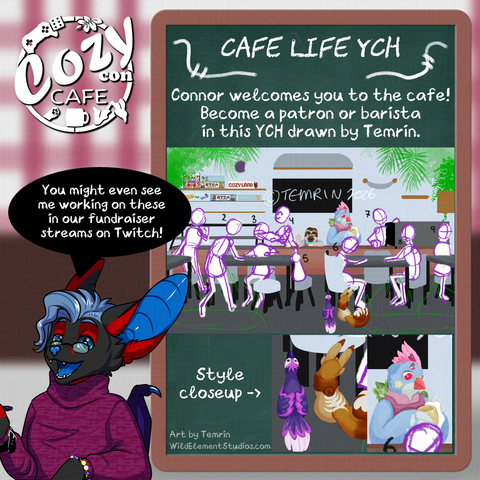
Fundraiser Offering: Limited Spots available in this cafe YCH from @Temrin , accepting anthro/fantasy bipedals or naga-like creatures, and one micro or animal slot, over on https://ko-fi.com/s/6f043bf8c3
#CommsOpen #FurSale #Convention #Kofi #Cafe #YCH #MastoArt #CreativeToots #MadeByHumans #FantasyArt #NOAI
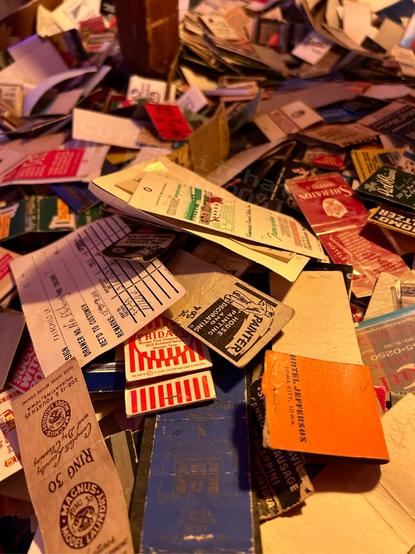
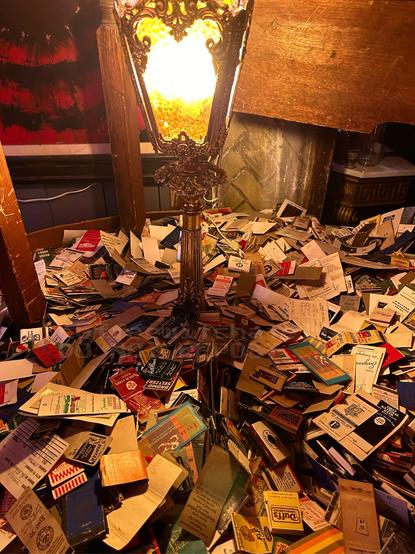
I've published a new blog post: "Human Creations", on the difference in content generation by LLMs, and the creation of text, art and code by humans.
You can find it at https://derickrethans.nl/human-creations.html or at @blog
Last year I wrote about how you can use ActivityPub, through the Fediverse to publish your own content, and being in control of it.
As part of a recent keynote that I gave at the Dutch PHP Conference I returned to this subject, but also reflected on what happens with the content you publish, and your rights over it.
Because in the last year, it has become clear, that lots of large and wealthy companies, don't really care about the latter.
What I mean by this becomes clear with the following examples.
When Gary Gale one day went to visit his Vaguely Rude Places Map site, he found that (AI) bots had eaten through his map tile allowance. He now hosts his site behind Cloudflare, being beholded to a Big Tech™ company again.
When I look at the web server logs for the php.net sites, I see that most of the uncached requests come from bots.
This also happens to other large sites, such as OpenStreetMap, which got hit by AI DDos Scraper Bots requesting an extreme amount of content from 100,000+ IP addresses; or Fediverse instances, such as infosec.exchange, which had to deal with more load.
All this scraping comes at a cost, but to the scrapers, nor the users of these tools.
Although the content is freely available, the services hosting content still need to be funded. Instead of you giving up your privacy, you will need to pay for those with actual money for them to thrive, and exist.
But AI impacts content in other ways as well.
I need to be clear of what I mean with AI. I don't mean the visual recognition models to detect cancer faster, sifting through loads of data to find patterns, fraud detection, speech recognition, translation services, or deciphering my terrible handwriting.
I specifically mean Generative AI through LLMs — for articles, source code, and "art".
I have no beef with the actual technology either, only the exploitative nature of how these currently are created and hyped up.
Just like the Luddites weren't against new technology, but how this technology was used to exploit them.
I have written two books in my life, many years ago. The material in them has been slurped up into the LLMs, and one of them was originally part of the Anthropic law suit where they settled for using pirated copies of the books.
Mind you, not for using the book as training material.
Although the settlement was for 1.5 billion dollars, I still ended up getting nothing, as only American authors were compensated.
There are similarities with the code that I, and many others, have written.
Code, published under an open license. But these licenses often require attribution. How much attribution is now given when one of your chat bots produces parts of my code?
Nothing.
Which means that these tools are in breach of the licences under which the original code was published, and hence shouldn't exist.
Unfortunately, some governments, like mine in the UK, are less concerned about AI companies stealing content, although there are some indications that they've changed their tune.
I never gave permission for any of my content, be it books, code, nor photos, to be used by these tools, but they're still making money of it.
As a matter of fact, they are not only making money of it, but also making it a lot harder to host things ourselves by driving up costs for CPUs, GPUs, memory, and storage.
They are literally stealing things to sell back to us, whilst at the same time making sure we have to use their services as it is becoming too costly to have a decent set up in our homes and offices.
But lets get back to content. I like writing. I am not great at it, but I find it pleasing to show others what I have worked on, and the adventures I have had.
I write for humans, and therefore, I also expect that when I read something, it is also written by humans. I prefer to be able to see the writing style of specific authors, as that is part of the experience. They own their voice.
In my case, that has always been including em-dashes wherever I can.
What I do not like to read is generic and bland text. Text that has no weird grammarisms, flair, or emotions.
That is text that comes out of LLMs: Generic slop.
I feel the same about AI "Art".
Over-polished generic images and logos, that you see more and more on signs in front of shops, the Web, and in presentations at conferences.
Not only do I find them boring, it is also taking work away from actual artists. I thought that computers were around to do the boring monotonous work?
This cartoon, by Tjeerd Royaards, nails it on the head.
Unlike AI companies slurping up all content on the Internet, I asked the author for permission to include this into my presentation.
He said . — "I don't allow the free use of my work, as I depend on my drawing to make a living"
So I went and purchased a digital license.
And this makes perfect sense.
Quality content created by artists, authors, and software professionals is worth something important. And these creators need to be rewarded for their creative work.
Unlike the AI slop generators, I value : Writing, photos, images, and source code.
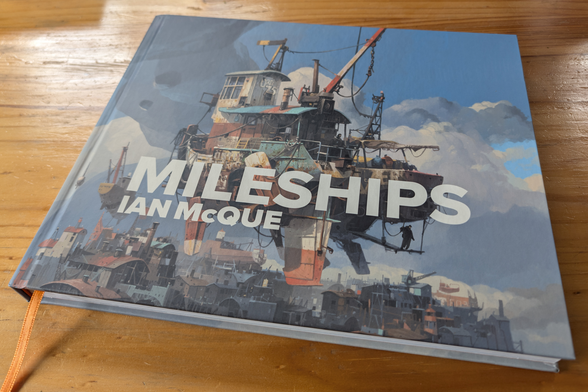
My copy of "Mileships" by Ian McQue has arrived, and it's absolutely magnificent!
Ian McQue is best known for his work as a Concept Artist for films ("Spider-Man: Across the Spider-Verse", "Mortal Engines", various "Star Wars" projects), computer games ("Grand Theft Auto", "Max Payne", "The Signal From Tölva"), as well as art for numerous book covers.
Excellent to see so much fresh art from Ian McQue, and the narrative text by Jim Rossignol expands on this wonderful world-building.
For more of Ian McQue's work, see:
- @ianmcque
- https://bsky.app/profile/ianmcque.bsky.social
- https://www.instagram.com/ianmcque/
#IanMcQue #JimRossignol #Art #MadeByHumans #ConceptArt #DigitalArt #SciFi #ScienceFiction
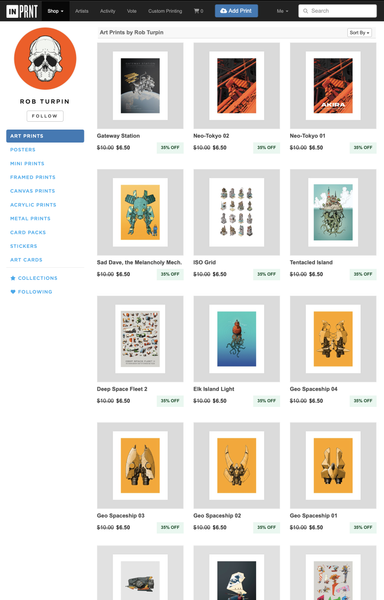
Last push for my print store before Christmas.
Spaceships, robots, tentacled islands, lovecraftian lighthouses…
 WE AND THE COLOR
 Phil Haigh
 CozyCon Online
 Christy I (she/her)
 Derick Rethans
 Derick Rethans' Blog
 Misinformation-Superhighwayman
 Rob Turpin