 Rachel Wright
Looking at the map in #Auxerre, I find a "Boulevard du 11 Novembre" and a "Rue du 4 Septembre", and I am suddenly reminded of that fantastic talk by @WoollyBenguin at #BigMathsJam a few years ago.
 Christian Lawson-Perfect
I have had an idea for a very entertaining but mathematically vacuous #BigMathsJam talk.
 Pozorvlak
I'm thinking of doing a table read of Václav Havel's play The Memorandum (in which ideas from coding theory serve as metaphors for political ideologies) as an evening session at #BigMathsJam this year. Good idea/bad idea?
EDIT: and I see there's an English-language movie version! https://www.imdb.com/title/tt12111594/ Might be hard to get hold of, though.
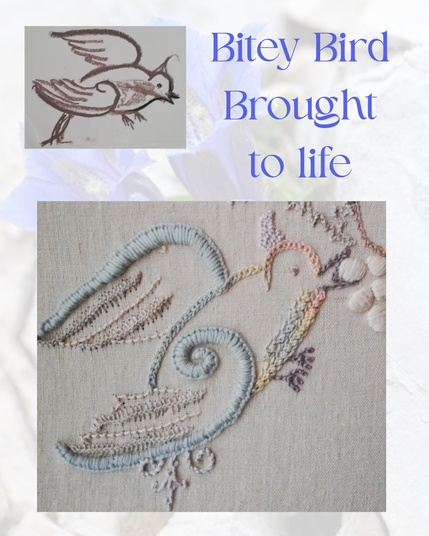
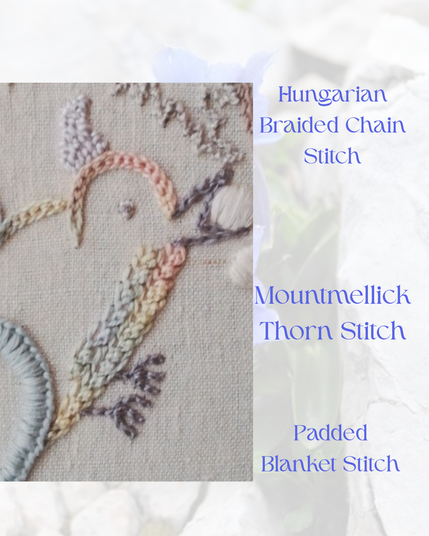
Since I chose to use Mountmellick embroidery and medieval imagery as my inspiration, I got the opportunity to play with textural stitches and some quite strongly raised effects, including two of my favourites, Hungarian Braided Chain and Mountmellick Thorn.
For my #BigMathsJam friends - I was stitching Bitey during the gathering in 2025, and got him finished literally two talks before the end!
Turns out that chips supporting the "monstrosity of an instruction" I showed at #BigMathsJam are being used by SpaceX for inter-satellite networking (with LASERS, no less). Dual numbers IN SPAAAAAAAACE!!!¹
https://newsroom.st.com/media-center/press-item.html/p4733.html
¹ I have no idea whether they're actually using the dual number instructions.

Thanks to @mjd, I've learned that the complex and dual numbers are just two members of a whole zoo of "hypercomplex numbers" - various multidimensional extensions of the real numbers that were studied in the nineteenth century. In the early 20th century matrix representations were found for the various systems of hypercomplex numbers, and the field evolved into the modern field of representation theory. Nowadays we think of representations as homomorphisms from abstract groups (defined by generators and relations) to matrix groups, but back then I guess the groups themselves were too nebulous to work with directly?
This ties in with something I've read about early C19 mathematics - that there was a strong sense that the proper domains of mathematics were numbers and geometry rather than anything more abstract (Boole phrased his logic in terms of numbers and arithmetic operations). I wonder when the "complex numbers are pairs of reals with a multiplication operation defined as follows..." definition I used at #BigMathsJam arose?
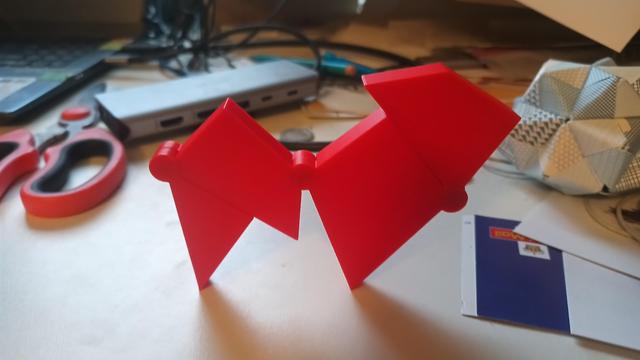
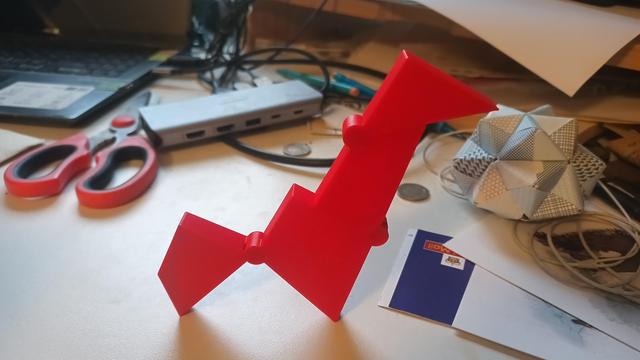
Other members of the Haberdasher's Menagerie: a friendly capybara, an angry swan, and a crafty fox.


Everyone¹ knows the Haberdasher's Puzzle, in which a square can be dissected and reassembled into an equilateral triangle. But only a very small number of extremely cool people know that the same dissection can also be used to make a noble buffalo and a wise llama.
¹ For suitably small values of "everyone".
Now I've given my talk, I have some more questions about dual numbers to investigate - some from here, and some from people who talked to me at #BigMathsJam.
- Apart from the duals and complex numbers, what other interesting degree-2 extensions of the reals exist? (HT George, didn't catch his surname)
- The dual numbers are the "first formal neighbourhood" of the reals - but what does that mean? (HT @RobJLow )
- The dual quaternions can be used to model mechanical linkages - see https://pure.hw.ac.uk/ws/portalfiles/portal/15726128/JMR161273_PURE.pdf How does that work? (HT @robinhouston )
- More generally, is there a connection between dual numbers and Lagrangian mechanics? How about Hamiltonian mechanics?
- I sketched a proof that the soul of f(x + ε) is f'(x) for any function f: R-> R that can be evaluated in finitely many arithmetic operations. Can we extend that to analytic functions? What about functions which are differentiable but not analytic? (HT @RobJLow )
- Let f be an analytic function, and g a polynomial approximation to f in a neighborhood of x. How well does the soul of g(x + ε) approximate f' in that neighbourhood? I guess that's the same as asking how well g' approximates f'...
 Colin the Mathmo
Finally home from #BigMathsJam ...
Time to sleep ....