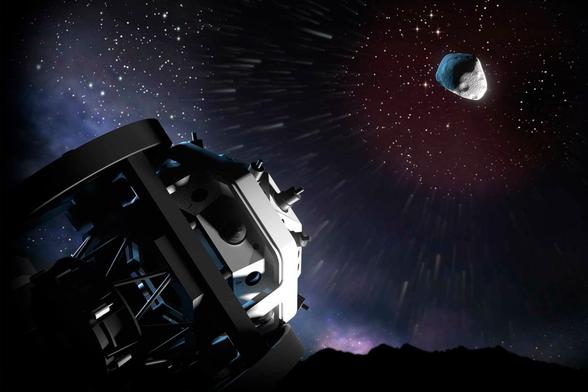
#NASAโ€™s #NEOSurveyor mission is now slated for no earlier than ๐Ÿ“† mid-2027, will spend at least five years scanning for potentially hazardous #asteroids โ˜„๏ธ larger than 140 meters.

#NEOHunter - nearly nine times more massive than #DART - could execute a direct high-energy impact ๐Ÿ’ฅ, delivering approximately 1.5 times the kinetic energy
https://www.nasaspaceflight.com/2026/03/blue-origin-neo-hunter-planetary-defense/

#BlueOrigin #AsteroidThreat

Blue Origin Unveils NEO Hunter: A Hybrid Planetary Defense Concept - NASASpaceFlight.com

Blue Origin has unveiled a new mission concept called NEO Hunter, designed to protect Earthโ€ฆ

NASASpaceFlight.com

#LSST performs very well for large impactors โ˜„๏ธ, discovering about 79.7% of objects larger than 140 m before impact. Only 50.3% of 50โ€“140 m impactors, 26.8% of 20โ€“50 m impactors, and 10.5% of 10โ€“20 m impactors are discovered ๐Ÿ”ญ at all. About 60% of large impactors fail to reach a one-year warning threshold. Upper mid-size objects are usually discovered only a few months before impact ๐Ÿ’ฅ https://www.newplanetarium.com/journal/2026-01-29

#RubinObservatory #AsteroidThreat

Can Rubin Spot an Incoming Asteroid in Time? Testing LSSTโ€™s Early-Warning Power โ€” New Planetarium

This paper evaluates how effectively the Vera C. Rubin Observatoryโ€™s LSST can detect asteroids on a direct collision course with Earth and how much warning time those detections provide. LSST performs well for large, hazardous asteroids but struggles to give long advance warning for smaller impactor

New Planetarium

14:43 - The #Torino scale explained "10 is a really bad day for the #dinosaurs" ๐Ÿฆ• (including a really nice #Trump #parody ๐Ÿ˜„) https://www.youtube.com/watch?v=DK3tW1E615Y

#AsteroidThreat

Asteroids Headed Towards Earth with Rick Binzel

YouTube

A solution to mitigate low #deflection efficiency is to apply multiple low-energy impactors rather than a single high-energy impactor ๐Ÿ’ฅ. A lower kinetic energy impactor results in a smaller crater ๐Ÿ•ณ๏ธ that is less affected by global curvature, increasing momentum transfer efficiency https://www.nature.com/articles/s41467-025-56010-w

#DART #AsteroidDeflection #AsteroidThreat

Elliptical ejecta of asteroid Dimorphos is due to its surface curvature - Nature Communications

Double Asteroid Redirection Test (DART) mission impact on asteroid Dimophos resulted in an elliptical ejecta plume. Here, the authors show that this elliptical ejecta is due to the curvature of the asteroid and makes kinetic momentum transfer less efficient.

Nature

Any useful deflection of a larger #asteroid โ˜„๏ธ would require a far greater shove or need to occur decades ahead of an impending collision ๐Ÿ’ฅ to have a cumulative effect. Youโ€™d need 1,000 #DARTs to get the same deflection https://www.astronomy.com/science/how-we-track-near-earth-asteroids/

Discovery ๐Ÿ”ญ
after closest approach: 69 (46.0%)
< 24 hours : 32 (21.3%)
up to 7 days : 47 (31.3%)
> one week : 2 (1.3%)
> 7 weeks : 0 (0.0%)
> one year : 0 (0.0%)
https://en.wikipedia.org/wiki/List_of_asteroid_close_approaches_to_Earth_in_2025

#Dimorphos #Didymos #AsteroidThreat #AsteroidDeflection #NASA #DART

How we track near-Earth asteroids

These are the planetary defenders who are on the hunt for the next big asteroid that could impact Earth โ€” and how we might stop it.

Astronomy Magazine
As Comet 3I/Atlas Whizzes Past Earth and Clash of Clans is Threatened By a Looming Asteroid, YouTube Scientist Hank Green Says We're Detecting More Space Objects Than Ever โ€” But Should We Really Be Worried?
https://atlas.whatip.xyz/post.php?slug=as-comet-3iatlas-whizzes-past-earth-and-clash-of-clans-is-threatened-by-a-looming-asteroid-youtube-scientist-hank-green-says-were-detecting-more-space-objects-than-ever-but-should-we-really-be-worried
"Exploring Space: Cosmic Wonders and Asteroid Alarms with Hank Green!"
#spaceobjects #cometatlas #asteroidthreat #cosmicconundrums
As Comet 3I/Atlas Whizzes Past Earth and Clash of Clans is Threatened By a Looming Asteroid, YouTube Scientist Hank Green Says We're Detecting More Space Objects Than Ever โ€” But Should We Really Be Worried?

In a thrilling cosmic display, Comet 3I/Atlas made a close pass by Earth, captivating sky gazers worldwide. Amidst this celestial dance, concerns arise as a looming asteroid poses a potential threat t...

Previously overlooked: 900-meter meteorite crater discovered in southern China

In the southern Chinese province of Guangdong, a research team may have discovered one of the largest meteorite craters from the period after the last ice age.

heise online

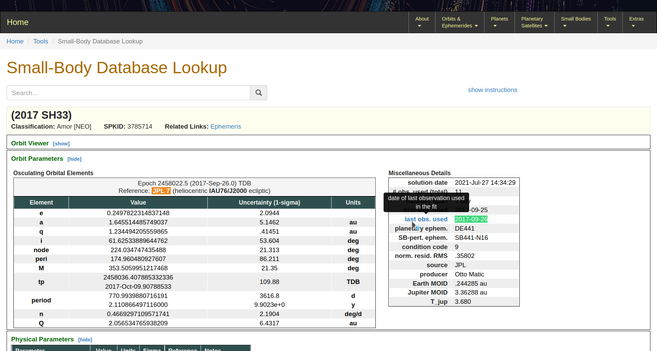
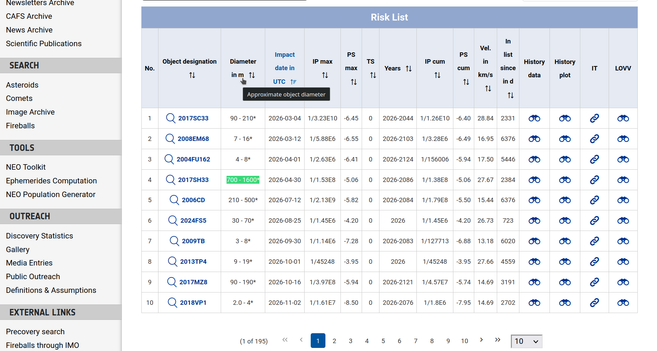
#2025SC79 is the second-fastest #asteroid โ˜„๏ธ, roughly 700 meters long, spotted on Sept. 27 hiding in the sun's โ˜€๏ธ glare. "The most #dangerous asteroids are the most difficult to detect" ๐Ÿ”ญ https://www.space.com/astronomy/asteroids/astronomers-discover-2nd-fastest-asteroid-in-the-solar-system-hiding-in-the-suns-glare

#AsteroidThreat

Astronomers discover 2nd fastest asteroid in the solar system hiding in the sun's glare

A scientist spotted an asteroid hiding in the sun's glare that orbits the sun in just 128 days, making it the second fastest known asteroid in the solar system.

Space

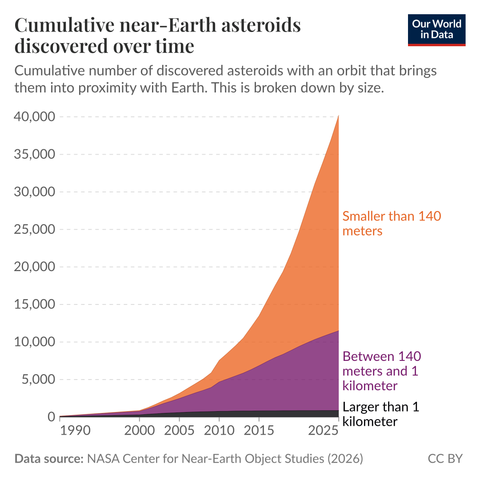
#Roman has the high sensitivity to measure the physical properties, compositions, and orbital trajectories of #NEOs โ˜„๏ธ in order to understand their physical nature and potential #hazards to Earth. Roman's #PlanetaryDefense capabilities complement those of the operational ground-based @VRubinObs ๐Ÿ”ญ and the upcoming #space-based ๐ŸŒŒ #NEOSurveyor https://arxiv.org/abs/2508.14412

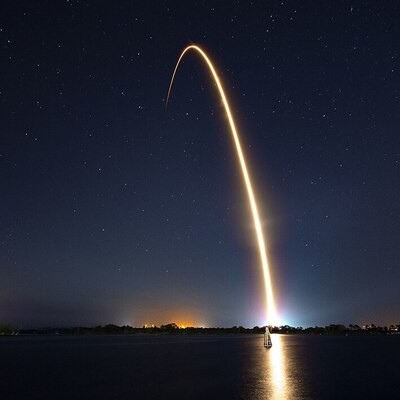
๐Ÿš€ October 2026 - May 2027 https://nextspaceflight.com/launches/details/6983

#AsteroidThreat #SpaceTelescope #RomanSpaceTelescope

The Roman Space Telescope as a Planetary Defense Asset

NASA's Nancy Grace Roman Space Telescope, slated to launch in October 2026, will serve a critical role in the characterization and threat assessment of near-Earth Objects (NEOs), thus contributing to national and international planetary defense objectives. Operating from the Earth-Sun L2 point and observing in the near-infrared, Roman has the high sensitivity and high spatial resolution needed to measure the physical properties, compositions, and orbital trajectories of NEOs in order to understand their physical nature and potential hazards to Earth. Roman's planetary defense capabilities complement those of two wide-field survey missions: the now operational ground-based Vera C. Rubin Observatory's Legacy Survey of Space and Time and the upcoming space-based NEO Surveyor. Rubin, observing in visible light, will discover over 100,000 NEOs. NEO Surveyor, observing in the mid-infrared where NEO thermal emission peaks, will detect 200,000-300,000 NEOs, some as small as ~20 meters in diameter. With investment in developing the pipeline infrastructure required to extract information from moving target streaks, Roman will be able to observe NEOs down to the smallest sizes in order to improve our measurements of NEO orbits by 2-3 orders of magnitude, enable accurate diameter and albedo estimates in conjunction with NEO Surveyor, and reveal the spectral types and bulk compositions of the smallest NEOs. Together, these three US-led facilities will operate across the electromagnetic spectrum to form a comprehensive planetary defense network.

arXiv.org