
DESLOC V150 Plus smart lock integrates a perovskite solar panel, supports 3D face recognition (Crowdfunding)
DESLOC V150 Plus is a smart lock with an integrated perovskite solar panel, which can generate power under low-light conditions, eliminating or at least reducing the need for manual battery charging. The V150 Plus is a two-part system consisting of exterior and interior units connected via wires through the door. The exterior unit includes the perovskite solar panel, two cameras with a 3D facial recognition system, and an AI-assisted fingerprint sensor, while the interior unit houses a 10,000mAh removable battery, a Battery Management System (BMS), and a lock motor. The BMS manages battery charging and power distribution. The rechargeable battery is rated to provide up to 8 months of backup operation when solar charging is unavailable, which is a little longer than the Lockzo AL501 3-in-1 smart door lock we reviewed earlier. DESLOC V150 Plus specifications: SoC – TBD (most probably a chip from Nordic or Espressif) Connectivity - Wi-Fi and Bluetooth Access

Firefly AIBOX-9075 Edge AI box features 200 TOPS Qualcomm IQ-9075 SoC, 36GB LPDDR5, industrial I/Os
The AIBOX-9075 is an industrial Edge AI box built around the Qualcomm IQ-9075 SoC, designed for running AI workloads directly on the device without relying on the cloud. With up to 200 TOPS of AI performance, it is designed for edge computing, private LLM deployment, robotics, computer vision, and more. The system comes with 36GB LPDDR5 ECC memory, 128GB UFS 2.2 storage, and an M.2 PCIe 4.0 NVMe SSD slot. Connectivity options include dual 2.5GbE with TSN, optional Wi-Fi 6, Bluetooth 5.2, and 4G/5G, while peripheral interfaces include eight GMSL2 camera inputs, HDMI 2.0, USB 3.0, CAN-FD, RS485, and opto-isolated digital I/O. Its rugged aluminum enclosure operates from -40°C to 85°C, making it suitable for continuous deployment in industrial and outdoor environments. Firefly AIBOX-9075 specifications: SoC – Qualcomm DragonWing IQ-9075 CPU Octa-core Kryo Gen 6 (Cortex-A78C-based) application cores @ up to 2.36 GHz Quad-core Cortex-R52 real-time cores @ up to 1.85GHz
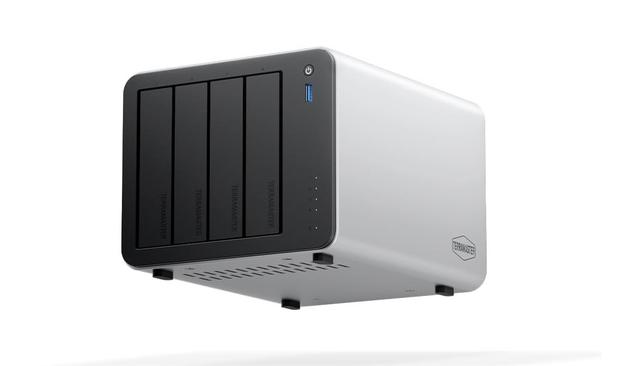
TerraMaster F4-425 Pro 4+3 Hybrid NAS gets Intel Core 3 N350 or Core i3-N305 octa-core CPU
TerraMaster F4-425 Pro 4+3 Hybrid NAS is an update of the F4-425 Plus Intel N150 NAS with a more powerful Intel Core 3 N350 "Twin Lake" octa-core processor or Core i3-N305 octa-core "Alder Lake-N" processor. Apart from the new processors, the new Pro model basically offers the same features with four SATA bays and three M.2 NVMe SSD sockets for storage (hence the 4+3 hybrid moniker), and dual 5GbE networking. It's equipped with 8GB or 16GB DDR5 memory, and also adds four USB 3.2 ports for peripheral expansion, and an HDMI port for terminal access. TerraMaster F4-425 Pro specifications: SoC (one or the other) Intel Core i3-N305 octa-core Alder Lake-N processor @ up to 3.8 GHz (Turbo) with 6MB cache, 32U Intel HD graphics @ 1,250 MHz; TDP: 15W Intel Core 3 N350 octa-core Twin Lake processor @ up to 3.9 GHz (Turbo) with 6MB cache, 32U Intel HD graphics
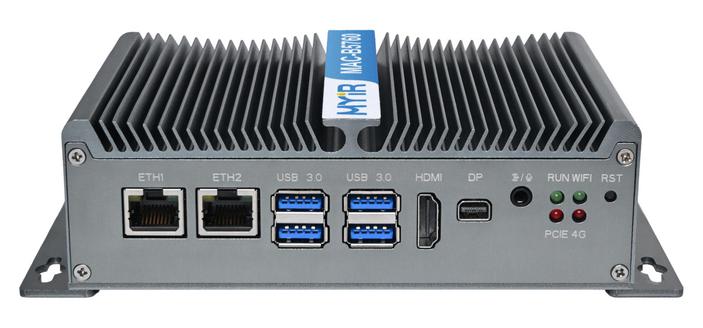
MYiR MAC-B5760 fanless Edge AI industrial PC features Rockchip RK3576 SoC, optional RK1828 LLM/VLM module
MYiR MAC-B5760 is a fanless Edge AI industrial box PC powered by a Rockchip RK3576 SoC with a built-in 6 TOPs NPU, and equipped with 8GB LPDDR5 and 64GB flash by default. The embedded system offers two Gigabit Ethernet ports, four USB 3.0 ports, HDMI and mini DP video outputs, a 3.5mm audio jack, a USB-C port for convenient serial console access, an optional WiFi 6 and Bluetooth 5.4 module, and expansion capability through an M.2 socket for NVMe SSD or AI accelerator, and a mini PCIe socket to add 4G LTE/5G cellular connectivity. MYiR MAC-B5760 specifications: SoC – Rockchip RK3576 CPU 4x Cortex-A72 cores @ 2.2GHz, four Cortex-A53 cores @ 1.8GHz Arm Cortex-M0 MCU at 400MHz GPU – ARM Mali-G52 MC3 GPU with support for OpenGL ES 1.1, 2.0 and 3.2, OpenCL up to 2.0 and Vulkan 1.1 NPU – 6 TOPS (INT8) AI accelerator with support for INT4,

Optocam Zero – A Raspberry Pi Zero 2 W -based DIY digital camera
Inspired by Kodak Charmera and similar toy cameras, the Optocam Zero is a Raspberry Pi Zero 2 W-based DIY digital camera made of off-the-shelf components and 3D-printed parts. It connects the Pi Zero 2 W SBC with a Raspberry Pi Camera Module 3, a 1.3-inch LCD, a 14500 Li-Ion battery holder, and other components. The camera supports autofocus, eight photo filters, USB-C charging, and lasts 70 to 80 minutes on a charge. Optocam Zero camera key features: Based on Raspberry Pi Zero 2 W SBC Display 1.3-inch LCD with 240 x 240 resolution 15–20 FPS camera preview on the screen. Screen dimming when inactive to preserve battery Camera features 2592 x 2592 JPEG image capture. GIF recording and playback support. Autofocus support 8 photo filters included. Misc Image transfer through custom hotspot interface. Fully 3D printed case parts 3D printable TPU protective sleeve and lanyard design is available. 22-second boot

SpacemiT K3 Pico-ITX RISC-V Chassis Kit Review – Part 2: What works, what doesn’t in Bianbu OS 4.0
Last month, I received the SpacemiT K3 Pico-ITX Chassis Kit based on the company's K3 16-core RISC-V SoC, and started the review with an unboxing, a teardown, and a first boot to Bianbu OS 4.0. Since the system features a 10Gbps Ethernet SFP+ cage, I also had to order a 10GbE SFP+ to Copper adapter, as my 10GbE networking gear is exclusively based on RJ45 ports. In this review, I'll check system information in Bianbu OS 4.0.1, run a few benchmarks, test 10GbE, GbE, and WiFi 6 networking performance, play YouTube videos at various resolutions, run AI workloads (LLM), check all/most features work as expected, and measure the power consumption of the SpacemiT K3 "Pico-ITX Chassis Kit" mini PC. Bianbu OS 4.0 System Information Before running anything, I updated the system: 594 packages were updated. For reference, the update also involved updating the EC (Embedded Controller) firmware: Let's double-check the
 cnx-software.com [Unofficial]
 %%sitename%% [Unofficial]
 Homepage [Unofficial]
 The New Yorker [Unofficial]