SDOT is shrinking Airport Way bike lane by one foot

From Adam Bartz via Bluesky.

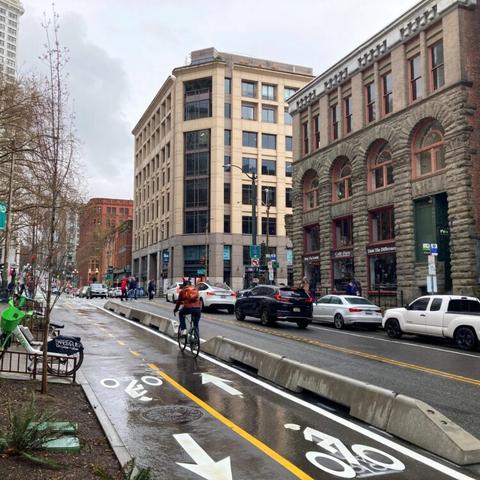
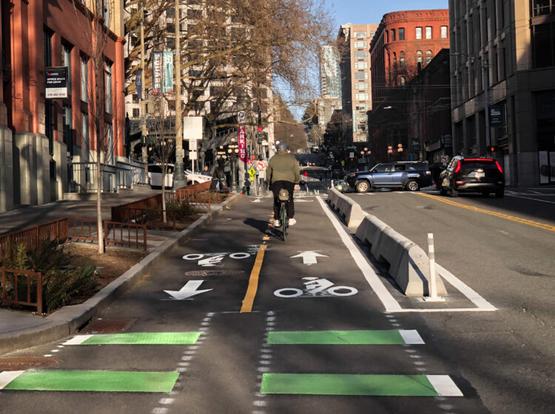
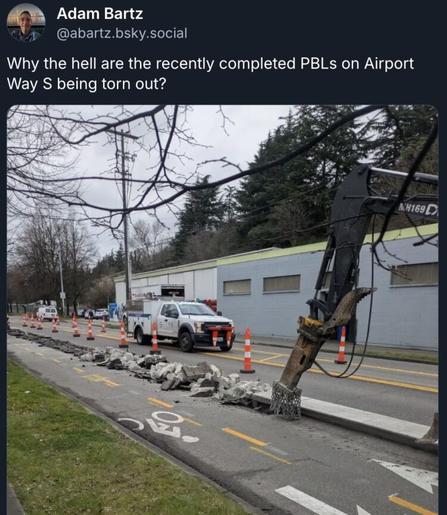
People biking between Georgetown and downtown were surprised yesterday to find construction crews tearing up the concrete barrier protected the bike lane on Airport Way S between S Alaska Street and the bridge. There was little to no notice about the work, though at least there is a sidewalk to help folks get around the closure.

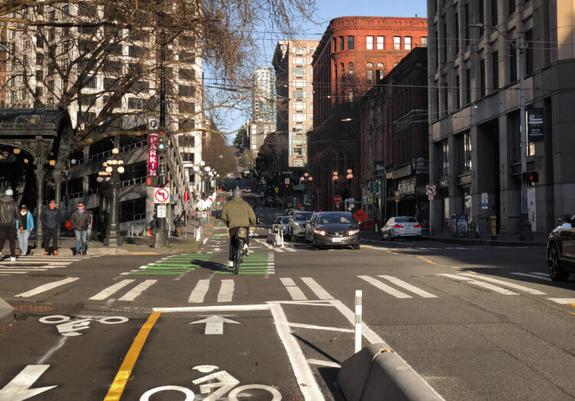
We asked SDOT what was happening after receiving several notes from readers surprised by the work. All of this work is to move the bike lane barrier one foot, reducing the width of the two-way bike lane, to “correct a design error” at a skinny point in the street, according to an SDOT spokesperson. “The center lane needs to be wider so that large trucks and buses have room to turn without hitting the bike lane barrier.”

Rebuilding the barrier will require dry weather, so it is not yet clear when it will be complete though SDOT is hoping to finish next week. The bike lane “will remain at least 8 feet wide,” which is about the minimum width for a two-way bike lane.

The bike lane was created as part of the Georgetown to Downtown Safety Project, which officially opened in September.

The full statement from SDOT:

We are adjusting the bike lane and center turn lane on Airport Way S between S Alaska St and S Edmunds St to make room for buses and trucks. Our plan is to rebuild the concrete curb protecting the bike lane by the end of next week, but this work requires dry weather. We will then return to this area when there is warmer and dryer to put the finishing touches on the striping. 

This work is to correct a design error at a narrow section of the street. The center lane needs to be wider so that large trucks and buses have room to turn without hitting the bike lane barrier. 

The rebuilt bike lanes will remain at least 8 feet wide. Flaggers will be on site during construction to direct people biking and driving. We will tidy up the work zone so people may use the bike lane with caution when we aren’t actively working.

#SEAbikes #Seattle

#حرس #الثورة: دمرنا بالكامل مركز #سدوت #ميخا للاتصالات #الفضائية جنوب #تل #أبيب
#IRGC: We completely destroyed the #Sdot #Micha #satellite #communications center south of #Tel #Aviv

Work underway to build missing Yesler Way bike lane

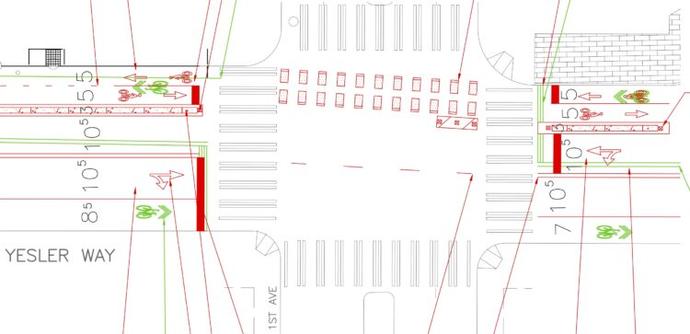
Map from SDOT.

Crews are already working on some underground utilities needed to build two key blocks of missing bike lane on Yesler Way between the Waterfront bikeway and the rest of the downtown bike network, including Occidental, 2nd and 4th Avenues.

It was frustrating when the waterfront bikeway opened with such a small-but-crucial gap. People are constantly confused about where to go after crossing Alaskan Way because the existing two-way bike lane simply ends, stranding people on the wrong side of the road with no clear indication about how they are supposed to reach the rest of the bike network. The only bike symbols in view are the old sharrows on Western Ave, but that’s not the way to get to the 2nd Ave bike lane.

The Yesler Way bike lane project will extend the existing two-way bike lane on the north side of Yesler from its current Terminus at Western to the decade-long bike lane terminus at Occidental Ave. The bike lane will be protected using precast concrete barriers. There will also be new turning restrictions blocking left turns from eastbound Yesler to James Street and right turns from westbound Yesler to 1st Ave.

The one block bike lane stub from 2nd to Occidental was part of the 2014 pilot project on 2nd Ave, the first significant protected bike lane in the city’s downtown core. Extending this connection to the waterfront has been a dozen years in the making.

SDOT hopes to open the bike lane and activate the new signal “as early as March or April,” according to an SDOT blog post.

Building the two blocks of missing bike lane have been complicated due to the need to design modern traffic signals that fit with the look and feel of the historic neighborhood. It’s also always a bit complicated to work in Pioneer Square because much of the street is actually a bridge one floor above the old street level. Painting lines on the street is easy enough, but installing a new traffic signal post at 1st and Yesler, for example, isn’t as simple as digging into the ground. A large part of the work and the timing of the project centers around the traffic signal, which will also include a new all-way walk and bike phase.

Building this connection has been a major advocacy point for both Cascade Bicycle Club and Seattle Neighborhood Greenways, both of which have representation on Mayor Katie Wilson’s transition team and have been pushing for this project.

#SEAbikes #Seattle

Alert 2/25-Mid March: Curved section of Waterfront Bikeway will close to fix standing water issue

Map from the SDOT construction notice (PDF).

The short walled-in section of the waterfront bikeway between the Overlook Walk and Alaskan Way will be closed starting as early as today (February 25) for two weeks as crews work to fix some water drainage issues. People biking can either ride on the street, use the north sidewalk, or use the park promenade to get around the closure.

As always, people biking must yield to people walking. The Waterfront may even instruct people to walk their bikes on the promenade.

The work involves tearing up some of the asphalt and installing new drainage infrastructure, and the bikeway will be closed 24/7.

#SEAbikes #Seattle

SDOT will extend 4th Ave bike lane to Space Needle, Thomas Street this spring

From the SDOT project page.

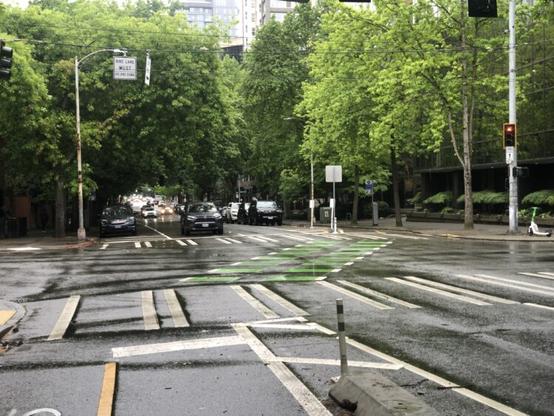
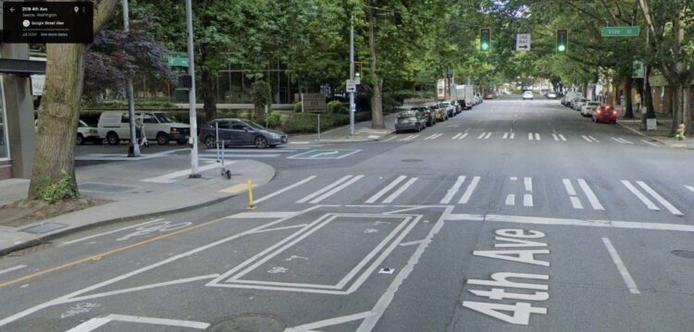
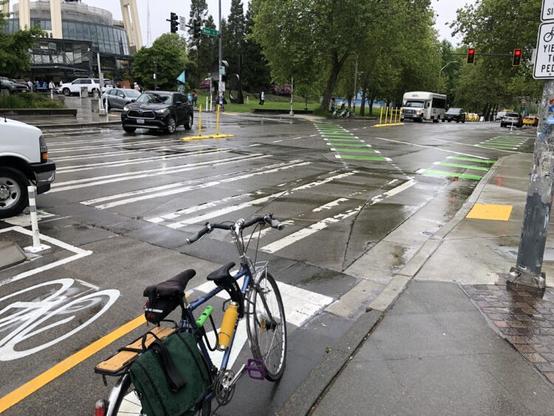
SDOT will begin work in the spring to complete the north end of the 4th Avenue protected bike lane, extending it from its terminus at Vine Street to Seattle Center and Thomas Street. The project is timed to be complete before the World Cup this summer (if it happens).

The design has evolved a bit since the earlier version we wrote about last August, though the diagonal crossing at 4th and Cedar remains and the design for Broad Street is not as ambitious as we had hoped. We spoke with members of the project team to learn the reasoning and restraints behind these compromises.

People will soon be able to bike the most direct route between downtown and the Space Needle entirely within a protected bike lane. People using the 4th Ave bike lanes today are unceremoniously spit out on to a wide, four-lane roadway with only sharrows painted on the ground. This is bad for all users, but it’s especially jarring for people unfamiliar with biking in the city who are just trying to get from the center of downtown to the city’s most iconic and visible landmark. The lane has ended abruptly at Vine since 2021 when the 4th Ave bike lane was finally constructed after years of delays.

The existing bike lane will extend one more block from Vine to Cedar. At Cedar, a new diagonal bike lane crossing will shift the two-way bikeway from the southwest side of 4th Ave where it is through downtown over to the northeast side. We were critical of this diagonal shift in our previous post, but the project team pointed to a few advantages they say make it work better.

One advantage is that most people driving on 4th Ave make a left turn onto Denny Way. There is also a double-lane left turn at that intersection and no crosswalk on the east side. Moving the bikeway so it can cross Denny on the east side will make this intersection much easier and give the bike lane a longer green light since it can be green during the left turn phase. No right turns will be allowed from 4th onto Denny.

One interesting consideration here, though, is that Mayor Katie Wilson has promised bus lanes on Denny Way where they are needed. So if the section of Denny between Broad and 4th got a westbound bus lane, then there would no longer need to be two left turn lanes from 4th to Denny, which would also make it much easier to add back that missing crosswalk and perhaps even move the bike lane to the west side of the street some day. Complete streets, when done right, can trigger a whole chain reaction of safety improvements like these. I hope the Denny Way team and the 4th Ave bikeway team are putting their heads together on how they can link up and support each other’s projects.

Another advantage of moving the bikeway to the east side of the street, however, is that north of Denny the bikeway would not cross in front of the 7-11 or parking lot driveways.

At Broad Street, the bikeway will split into two one-way bike lanes on either side of Broad. Most bike movements would happen during a new all-way walk and bike phase at this intersection in front of the Space Needle driveway.

Broad itself will be reconfigured to expand the amount of drop-off, charter bus, and bike and scooter parking. There will be one general traffic lane in each direction as well as some turn lanes, itself a big win since this street has maintained the design of a highway connector street, a role it has not played since 2014. However, we argued that the city should go even further by making the road one-way and dedicating about half of it to biking, Seattle Center access and maybe even some public art.

The problem is that it is currently designated as the hazardous freight route for trucks carrying cargo that is not allowed in the SR-99 tunnel, under the convention center downtown or on central downtown streets. Instead they must travel on the surface roadway along the waterfront, then travel up Broad to 5th, then to Mercer, then back to I-5. Very few trucks make this movement, but they do need an option. The city can change the hazardous cargo route, but that is likely a whole other project with its own challenges. Surely we can think of a better place than in front of our most popular tourist attraction, but hazardous cargo is also the kind of thing that nobody really wants near them. In the end, it was not something within the scope of this project.

The need to preserve the street for these trucks means that they could not use the monorail pillars to demarcate new car-free space along the edge of Seattle Center, as was Seattle Bike Blog’s suggestion. The team modeled it out and found that large trucks would have difficulty making the turn around the monorail pillar, and a hazmat truck collision with a monorail pillar would be a pretty bad thing to happen. Now, I’m sure it could be done if there were also design changes on 5th Ave N, but again that gets out of the scope of this project.

Finally, the project will add an all-crosswalk phase at the 5th/Broad/Thomas intersection, which will allow people on bikes to connect between the new lanes on Broad to the bikeway on Thomas Street.

The project makes a couple needed connections while leaving a couple big ones hanging. There will be no connection to the existing 5th Ave bikeway north of Memorial Stadium, and there will be no bike lanes on Broad Street between 4th Ave and the new waterfront bikeway. There is a block of protected bikeway on the north side of Broad between 1st and 2nd Avenues, but nothing between 1st and the waterfront or between 2nd and 4th. Completing the Broad Street bike connection was, you guessed it, outside the scope of this project.

Seattle bike network is coming together in patches. Sometimes we get big patches. This one is a small patch. It is frustrating to leave such large gaps open, but it is still a significant improvement over the current state.

#SEAbikes #Seattle

Greenwood Ave a great tailored road case study

There should be little concern about the proposed changes to Greenwood Ave between 85th and 105th/Holman affecting vehicle capacity. According to SDOT data, this stretch handles nearly the same number of cars as the stretch of Greenwood south of 85th, which already has a similar configuration.

Meanwhile, pedestrian, bicycle and vehicle safety should increase dramatically once the changes are made, as has been seen in similar projects around the city. The road is currently over-designed as a four-lane and will be “tailored” (it will catch on!) to fit the needs of current road users. No parking will be removed.

Data, provided by Marybeth Turner at SDOT, shows that in 2008, this stretch of Greenwood Ave handled an average of 12,600 vehicles. The stretch south of 85th handled 12,000. Meanwhile, Stone Way was at 15,200 vehicles in 2008 and has been able to maintain its vehicle capacity after similar changes were made there.

There was an open house last night to discuss the Greenwood changes, but I was a bad bike blogger and forgot about it after riding 33 miles and stuffing my face with Indian food. If anyone went, please share.

In the comments on our original story, one person said: “I strongly disagree with the city plan to road diet Greenwood Avenue. This plan will create a false sense of security for cyclists. I suggest the alternative of Fremont Avenue, a quiet residential street with trail access at 110th street.”

I feel like these thoughts might be common enough, so here’s my opinion. While Fremont is a pretty nice bike boulevard-esque route in this area, these changes to Greenwood Ave are not just about bikes. It is unsafe for pedestrian crossings, it encourages speeding and, yes, it is unsafe for all the bikers who ride on Greenwood instead of going eight blocks out of their way (four there, four back) to take Fremont. You could just as easily ask why the drivers don’t go over to Aurora if they want to drive that fast.

For people riding straight through the area, Fremont is great. I use it a lot. But there are plenty of destinations on Greenwood people may be trying to get to, and if someone is trying to get somewhere west of Greenwood, they are not likely to ride several blocks east to get there.

As for the false sense of security, this is a great chance for a real life case study. Go ride on Greenwood north of 85th, then south of 85th and tell me that the sense of security those changes provide are not real. Same street, practically the same traffic numbers, yet the already completed section is clearly more comfortable and, yes, safer (see Stone Way study above). Sure, I wish the bike lanes weren’t so close to parked car doors (I always ride on the left half of these lanes), but Greenwood north of 85th feels more like a highway than a neighborhood arterial street.

#SEAbikes #Seattle

Greenwood Ave a great tailored road case study

There should be little concern about the proposed changes to Greenwood Ave between 85th and 105th/Holman affecting vehicle capacity. According to SDOT data, this stretch handles nearly the same num…

Seattle Bike Blog
Countdown to construction: Major ‘Revive I-5’ repairs starting for Ship Canal Bridge

Get ready for the next stage of construction on Seattle’s busiest corridor. As early as Jan. 9, the Washington State Department of Transportation (WSDOT) will resume its Revive I-5 preservation wor…

Metro Matters

Mayor-elect Wilson shakes up SDOT leadership + City needs to get back on pace to keep up with the transportation levy’s demands

Adiam Emery (white jacket over blue top) observes a people-protected bike lane demonstration at 4th and Pine April 30, 2025. Emery directed a quick response to the community action, installing a heavier barrier by the end of the day.

With Mayor-elect Katie Wilson less than two weeks from assuming office, we are already seeing signs of change within SDOT leadership. Interim Director Adiam Emery will not continue in that role, with Wilson tapping Angela Brady of the sprawling Office of the Waterfront, Civic Projects and Sound Transit to take on the Interim Director role.

Essentially every new mayor picks a new SDOT Director. Transportation is a massive part of the city’s budget, and SDOT’s work inevitably becomes political because the streets are the part of the public realm people interact with most.

Before outgoing Mayor Bruce Harrell picked Emery for the interim role, she was a Deputy Mayor in his administration. So it is not at all surprising that Wilson would make a change. But Brady will be the second interim director in a row, and the department is coming up on a full year without a permanent director following the February 2025 departure of Greg Spotts.

Though 2025 was a huge year for bike project completion, development of new projects has slowed compared to the heightened pace set by Spotts. Emery’s SDOT has not applied the brakes on project delivery, but it is no longer accelerating like it was. It is vital that SDOT does not fall behind in developing and delivering projects promised to voters who approved the ambitious 2024 Transportation Levy. Failing to scale up delivery after the Move Seattle Levy passed in 2015 was a disaster for the department, which went through an extended period of rudderless leadership amid the extended Mayor Ed Murray scandal followed by Mayor Jenny Durkan’s year-long hesitancy to pick a new SDOT Director. The department does not seem rudderless under Emery like it was in 2017–19, but they have a lot of work to get done before the levy expires in 2032. Under-delivering in the early years will make it nearly impossible to catch up in the later years, and the department is already behind on some of the 2025 projects outlined in their first levy delivery plan. However, to put things in perspective, a year after the Move Seattle Levy passed we wrote, “The biggest story for biking in Seattle in 2016 can be summed up in one terrible word: Delayed.”

SDOT needs a leader with a focus on efficient project development and delivery, someone who can make sure there is always an ambitious yet achievable number of projects in planning/outreach, technical design and construction. The next director, whether interim or permanent, also needs to be willing to take on big and difficult projects like a safe remake of Rainier Ave between S Jackson Street and MLK Way, one of the projects that was supposed to go into planning in 2025 but is behind schedule.

Brady has been working on the Central Waterfront project since 2012 and was the project manager for the Mercer Corridor Project before that. In 2022 she became the Director of the Waterfront Program, which Mayor Harrell expanded in February of this year to become the somewhat confusing mashup known as the Office of the Waterfront, Civic Projects and Sound Transit. Seattle Bike Blog has been quite critical of both the Mercer and Waterfront projects over the years, though it’s hard to say with such massive projects whether Brady is responsible for the many issues on those streets. Most of the problems for both projects stem from there being just too many damn traffic lanes, decisions that came baked into those projects before they were handed to city staff. So I am hopeful that selecting Brady is not a signal that Mayor Wilson wants to see more projects like the eight-lane Mercer Street or nine-lane Alaskan Way.

Wilson has also hired Alex Hudson to serve as a transportation advisor, the Urbanist reported. Hudson is the Executive Director of Commute Seattle and was previously the ED of Transportation Choices Coalition before running for Seattle City Council District 3 in 2023, which she lost to Joy Hollingsworth 53–47.

Wilson’s transportation decisions are being guided in part by a transition team (PDF) that includes representatives from Seattle Neighborhood Greenways and Cascade Bicycle Club/Washington Bikes. Lee Lambert is the Executive Director of Washington Bikes, which not only endorsed Bruce Harrell for mayor but also paid to send mailers promoting that endorsement to Seattle voters. Including him in the transition team is a signal that Mayor-elect Wilson does not plan on holding a grudge, which is great. Anna Zivarts, author of When Driving Is Not An Option and friend of Seattle Bike Blog, has been co-leading the transportation-focused group of the transition team.

But beyond agency leader decisions, Wilson also acknowledged the recent hit and run killing of Alley on Beacon Hill and pledged, “Making our streets safer, especially for the most vulnerable road users — people walking, biking and rolling — will be a high priority for my administration.”

https://bsky.app/profile/wilsonforseattle.bsky.social/post/3ma2uc5jhdk2q

#SEAbikes #Seattle

Seattle is the first test city for a new bike lane barrier made of recycled tires

The pitch is great: Let’s take a car culture waste product that would otherwise be burned and instead turn it into a barrier to protect the lives of people biking. That’s the concept behind Pretred’s new Paceline barriers, which were designed with bike lanes in mind initially in response to Seattle’s trouble acquiring enough pre-cast concrete barriers for SDOT’s ongoing “even better bike lanes” project. The company used the SDOT order as the impetus to invest in the design and tooling to create these Paceline barriers, which are now for sale to any place that wants them.

Pretred Sales Manager Matt Dunn told Seattle Bike Blog that the Paceline barriers are now “the only U.S.-made bike lane barrier that is more significant than a curb and less significant than a full wall.” The project was personal for Dunn, who was hit by a car while riding his bike. “I wish these barriers would have been there when that happened,” he said, noting, “We’re all cyclists in this office.”

Dunn credited Cascade Bicycle Club Executive Director Lee Lambert with connecting SDOT and Pretred. The department had purchased as many of the precast concrete barriers as were available, but it still wasn’t enough. If Pretred can produce a barrier that is competitive with concrete, that would be a win for all North American cities because it would mean more supply and more competition in the market. Concrete creation also requires a lot of energy and is a major source of greenhouse gas emissions. Burning tires also releases a lot of greenhouse gasses. Pretred sells itself as a more environmentally-friendly option both for creating barriers and for recycling tires. The company started in 2020 selling what they call Colorado barriers, which can be used either in place of a Jersey barrier or as a base to support weight.

When fully rebuilding a road engineers can include curbs and barriers from the start, such as the new bike lanes along the waterfront. We cannot wait for full roadway rebuild projects to build out our city’s bike network, so we need tools for medium-term bike lane installs for the time between now and the street’s next major repaving project. Sometimes referred to as “Toronto barriers” for some reason, pre-cast concrete barriers are an excellent option for creating a significant barrier on an existing road surface. The Toronto-style barriers are shorter and skinnier than a highway-style Jersey barrier but provide significantly more deterrence than plastic reflective posts. Cities like Seattle need a barrier that protects bike lanes from motor vehicles without making streets look and feel like highways, and this is a tricky balance. DOTs would also like to avoid the need for constant maintenance.

The new tire-based barriers are a different take on the concept. The come in segments two feet long that link together. The 80-pound segments are lighter than concrete, making them easier to install and to move by hand if necessary, but this also means they are easier for motor vehicles to displace. They lie somewhere between a parking stop and a Toronto barrier, which could be the sweet spot cities are looking for if they can prove durable and effective under the strains of city streets. The material cost is about $24 per foot plus additional costs for the end treatments of each connected segment, Dunn said. Agencies can install posts on the blocks for either signage or additional reflectors, though SDOT did not do so as part of this project. Some reflective plastic posts might not be a bad idea, especially on curves and end points where strikes are more likely, though each block does have front and rear reflectors.

When struck, the tire barrier segments may get gouged but hopefully will be less likely to fully crack and fail. If they do fail, crews should be able to use regular work vehicles and tools to replace the damaged segments more quickly and easily. Concrete barriers are so heavy that they require a forklift or similar piece of machinery to move and install, which could lead to longer waits for repairs as we saw with the bike lane on the Airport Way bridge near Georgetown recently. The barrier was struck (and did its job!), but a section was left sticking into the bike lane for a while before crews could repair it.

The tire-based barriers may not leave as much damage on any vehicles that strike it, but they also should not be as difficult to repair. We don’t need to imagine what this would look like because the test segment has already experienced its first major strike. I went down to Campus Parkway to check it out and found a section under the bridge that clearly got hit by something significant. Not sure if it was a car, truck or bus, though the level of damage makes me think it could have been something more on the bigger side. Bolts were bent and multiple barriers seemed to split at the bolt-mounting point. One barrier section was totally destroyed and was sitting on the roadside. In all, five or six of the segments were damaged. But because of their size and weight, they were not left blocking the bike lane in the meantime, which is nice.

Environmental benefits and concerns

The U.S. wears out a hell of a lot of tires, which are notoriously difficult to dispose of. When burned, they produce a relatively low amount of heat for a long time. That’s why tire fires can last so long. They also release a lot of nasty stuff into the air.

There have been many attempts to find other creative and profitable uses for tire waste, including using tire crumbs as part of an artificial athletic or playground surface. The EPA, CDC and CPSC have been studying the possible health impacts of these surfaces, though there don’t seem to be any clear conclusions yet (though we know it’s bad for kids to eat them). Tires contain a lot of harmful chemicals, researchers just don’t know the extent that using tires in play surfaces might lead to harmful exposure. Meanwhile, researchers at UW have identified a tire chemical — 6PPD-quinone — that is likely a major cause coho salmon population decline. The chemical gets into waterways through wear and tear from cars and trucks driving on roadways.

I asked Dunn if these tire-based barriers might contribute to the problem of tire chemicals in waterways, and he said the blocks are designed to keep tire chemicals contained within them. However, as with any tire those elements could be released if they are broken or crushed. The blocks are made of about 90% tire “crumb,” then Pretred uses polyurethane to encapsulate it and hold it together. When they are just sitting there getting rained on, they are designed not to release tire chemicals into the runoff, he said.

#SEAbikes #Seattle

Tuesday: Community Council forum on ‘scooter public safety’ + It’s time to take bike and scooter share seriously

Seattle was the first major and lasting launch city for Lime back in July 2017, and the city has continued to be one of the company’s strongest markets globally. In the last year (November 2024 through November 2025), Lime and Bird reported an astounding 10.3 million trips in Seattle, according to SDOT’s data dashboard (96% of those trips were on Lime). Over the year, bike and scooter share carried about 60% as many trips as the state’s $2.15 billion SR-99 highway tunnel under downtown Seattle. During summer months, that number may have been more like 80%.

Bike and scooter share is a major part of Seattle’s transportation system today, yet the city still has not fully adapted to support it in a comprehensive manner. While the public subsidizes driving to the tune of billions, these companies actually pay Seattle for permits to operate here. Yet despite some city work to add bike and scooter parking areas in select locations (largely funded by scooter and bike permit fees), the vast majority of the devices are parked on sidewalks wherever users could find a spot. This leads to bikes and scooters blocking walkways, curb cuts and other sidewalk access needs whether due to inconsiderate parking by users or passersby knocking them over. A blocked walkway may be annoying for someone who can step around a fallen device, but it is a serious mobility blockage for people who cannot.

Meanwhile, though the city has been building more protected bike lanes, they are nowhere close to keeping up with the demand for safe bike and scooter routes. The result is the frustrating and persistent problem of people riding scooters on sidewalks. Sidewalk riding is uncomfortable for people walking, and it is also not a good solution for people riding bikes and scooters. Some of the problem may be inconsiderate user habits, but the much bigger problem is a lack of safe bike lanes. You are far more likely to experience someone riding a scooter on a sidewalk along a street filled with car traffic, such as the one where this most often happens to me: NE 45th Street in the U District. Sure, they are supposed to ride in traffic, but have you seen traffic?!?

While bike and scooter share ridership in Seattle is a major success story, problems with sidewalk riding and walkway blockages are a persistent source of justified complaints (along with some over-the-top complaints) that are not going away. The Urban Community Councils of Seattle are hosting a “Scooter Public Safety Forum” 6 p.m. Tuesday (December 2) at Plymouth Church at 6th and University downtown. Unfortunately, the event description only mentions “scooter speeding, sidewalk riding, and parking chaos” and not the safety needs of scooter riders. Hopefully that is also part of the discussion. Here’s the event description:

“Speeding, sidewalk riding, and parking chaos! Join us for a forum with Lime Scooters to talk about steps they are taking to address safety. Scooter safety is top of everyone’s minds these days. Seattle has the third largest Lime ridership in the world and is well-positioned for prioritized solutions. Join us for a presentation and audience Q&A with Lime Scooters on what they are doing to address scooter speeding, sidewalk riding, and parking chaos.”

As with any group, the vast majority of people riding scooters want to behave in a proper manner and would gladly use a safe bike lane if there was one. But when presented with the no-win options of a busy street that feels unsafe or a sidewalk, we cannot be surprised when many people choose the sidewalk. It is human nature to prioritize self-preservation. There are always going to be a few total jerks, especially from a pool of over 10 million rides per year, but most scooter riders just want to get where they’re going like everyone else. This is a mainstream way to get around, and the people riding bike and scooter share are also community members, and I hope Tuesday’s conversation keeps that in mind.

The good news is that we already know the solutions to both the scooter and bike share parking and sidewalk riding problems. For parking, the city needs to install way more parking corrals. We have a mere fraction as many as are needed. Even better, if the city installed enough bike and scooter parking, such as at least one corral at every intersection, then we could change the rules to allow the devices to be parked only within designated areas. I think this is a worthy goal, and it would be great to see the city and the companies work out together what it would take to achieve it.

For sidewalk riding the answer is also obvious: Bike lanes. This is a serious mode of transportation, and it needs dedicated space. Bike lanes not only reduce sidewalk riding, they are also part of street safety projects that can dramatically improve crosswalk safety. Likewise, on-street bike and scooter corrals can be located in the space where it is already illegal to park a car, further improving crosswalk safety by daylighting intersections so people driving can better see people about the cross the street. This strategy was a huge part of how Hoboken, New Jersey, has gone 8 years without a traffic fatality. Seattle has had success with on-street corrals, too, but we need way, way, way more of them. Every commercial intersection would be a start, and there could even be two or four of them at each intersection to cover all the approaches.

How daylighting intersections makes them safer, from the National Association of City Transportation Officials, of which SDOT is a contributing member.

We are still thinking too small about bike and scooter use. It is unreasonable to expect that painting some rectangles on the sidewalk should be enough to handle the huge and increasing number of trips they are carrying around our city. We invest billions in public dollars and reserve the vast majority of public space in order to move people and goods around our city and region, and we need to be willing to dedicate resources to bikes and scooters, as well.

There are more scooters than there used to be

Does it feel like there are more scooters and bikes out there these days? It’s not your imagination, but it’s for a good reason. When Lime added about 2,600 sit-down scooters in May the city did not require them to remove stand-up scooters or bikes to maintain a total fleet count. The sit-down scooters are designed to be more accessible so people who are not able or comfortable riding a bike or stand-up scooter are still able to use Lime to get around. However, stand-up scooters remain the most profitable device type, so if the city required companies to choose between them, profit would direct companies to prioritize stand-up scooters. By allowing an additional allotment, Lime was able to add sit-down scooters without cannibalizing their own business. The data suggests it has been a success.

Lime’s record-smashing year saw a 4.29 million ride increase over the previous year, thanks in part to the company’s rollout of their Glider sit-down scooters (they did a small test starting in late 2024, but didn’t add them in significant numbers until May and June 2025). Lime-reported data shows that users took 6.73 million stand-up scooter trips (about 6,600 deployed), 1.78 million sit-down scooter trips (about 2,600 deployed starting in May) and 1.4 million bike trips (about 3,100 deployed). They are still new enough that we don’t yet know how long the devices will last or how ridership trends will develop, but it seems like they slot in well between bikes and stand-up scooters.

Perhaps most tellingly, adding Gliders did not result in a reduction in stand-up scooter and bike trips, which both saw record ridership on their own. This suggests that Seattle is still in the phase where adding devices results in an even larger increase in ridership, a phenomenon that became very well-known back during the first dockless bike share boom that started in China nearly a decade ago. Companies observed this pattern and responded by adding more and more bikes until the sheer volume of bikes overwhelmed cities, resulting in world-famous photos of towering piles of bike share bikes. SDOT’s strategy for avoiding such a problem was to issue permits that limited the number of devices a company could operate at any given time. This artificial limit means that we do not know what Seattle’s bike and scooter ride ceiling might be if we found a way to responsibly add more devices to the streets. It’s pretty exciting to consider the potential, especially if rides were also more affordable. Perhaps the city could work out a deal to make rides more affordable in return for significant new public investment in bike and scooter parking. The city already requires a reduced cost program for folks who qualify (including anyone with an ORCA Lyft card), but ride prices are also a bit steep for middle-income folks who might otherwise make it a regular part of their transportation habits.

#SEAbikes #Seattle