Making your own programming language is easier than you think (but also harder)
Language Design: Fixing Rust's mistakes – Syntax
pompelmi – ClamAV antivirus scanning for Node.js, zero dependencies

A minimal Node.js wrapper around ClamAV that scans any file and returns a typed Verdict Symbol: - Verdict.Clean - Verdict.Malicious - Verdict.ScanError Zero runtime dependencies. No daemon. No cloud. No native bindings. Works locally via clamscan or remotely via clamd TCP socket (Docker-friendly). npm install pompelmi Repo: https://github.com/pompelmi/pompelmi [https://github.com/pompelmi/pompelmi]
Language Design: Annotations Obsolete Modifiers
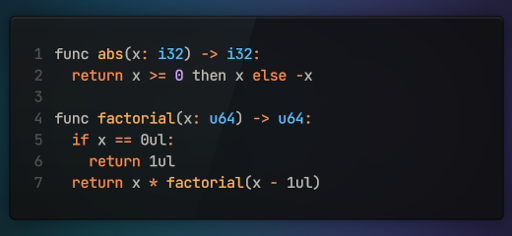
Introducing Brunost: The Nynorsk Programming Language
C3 Programming Language

> The Ergonomic, Safe and Familiar Evolution of C > C3 is a programming language that builds on the syntax and semantics of the C language, with the goal of evolving it while still retaining familiarity for C programmers. > > Thanks to full ABI compatibility with C, it’s possible to mix C and C3 in the same project with no effort. As a demonstration, vkQuake was compiled with a small portion of the code converted to C3 and compiled with the c3c compiler. > A simple and straightforward module system that doesn’t get in the way, with defaults that makes sense.
Lisette — Rust syntax, Go runtime
EYG - A programming language for predictable, useful, and confident development

> EYG’s type system builds upon a proven mathematical foundation by using row typing. > EYG programs are all independent of the machine they run on. Any interaction with the world outside your program is accomplished via an effect. > Any effect can be intercepted using a handler. This allows the response from the outside world to be replaced. > Other languages have the possiblity of closure serialisation, but EYG’s runtime is designed to make them efficient. > Hot code reloading – If you change the code the behaviour will update immediatly if safe. > EYG has a prototyped strongly typed shell environment. > EYG is built to support multiple runtimes. […] In the future EYG will be available in many more places, e.g. arduino, CLI’s and IPaaS. EYG makes this easy by having a carefully designed minimal AST. Code example (from landing page): eyg let initial = 10 let handle = (state, message) -> !int_add(state, 1) let render = (count) -> { let count = !int_to_string(count) !string_append("the total is ", count) } {render: render, handle: handle, init: initial} GitHub Repository [https://github.com/CrowdHailer/eyg-lang/], Apache 2.0
Я написал язык программирования на C — и он работает в Termux
Kite lang Я написал язык программирования на C — и он работает в Termux Почему вообще Всё началось с мечты — написать свой собственный язык программирования. Я смотрел кучу роликов на YouTube, пытался что-то понять, но эти жалкие попытки ни к чему не приводили. В теории я знал как устроен интерпретатор — лексер, парсер, AST. Но как воплотить это в реальный код — не понимал совсем. Потом я наткнулся на один ролик который дал мне надежду. Я вспомнил что DeepSeek неплохо пишет код и решил попробовать — первый Python проект заработал. Я был на седьмом небе от счастья. Но тот проект был сырой и недоделанный. А когда пытаешься сделать на нём что-то серьёзное — DeepSeek выдавал код полный ошибок. Я фиксил один баг, появлялись три новых. Стало ясно что просто просить AI написать язык — не работает. Однажды я снова сидел на YouTube и наткнулся на видео с канала WeaklyHow — он создавал свой язык программирования с помощью нейросетей. Видео было на английском, но я смотрел просто так — контекст был понятен и без перевода.