 DrWeb
DrWebJustice Ketanji Brown Jackson Describes Her Fight Against Injustice | Princeton Alumni Weekly
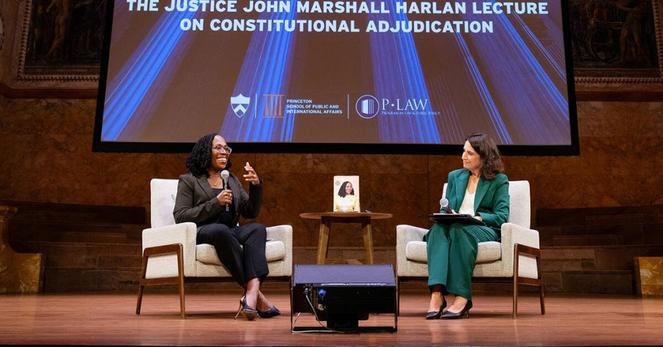
Supreme Court Justice Ketanji Brown Jackson, left, discussed her memoir with Professor Deborah Pearlstein at Richardson Auditorium.Justice Ketanji Brown Jackson Describes Her Fight Against Injustice
In a talk on campus, Jackson discussed her new memoir and highlighted lessons from her mother.
Sameer A. Khan h’21 / SPIA / Princeton University
By Lia Opperman ’25, Published Sept. 29, 2025, 3 min read
Supreme Court Justice Ketanji Brown Jackson, speaking on campus Sept. 10, said that her parents — who grew up in the segregated South — gave her the confidence to fight injustice and navigate the challenges she has faced in her career.
“Part of my mother’s lesson was, you’re going to see the injustices, you may even face them, but you have to understand that focusing on them will end up, at times, taking you away from the work, which is really the most important thing,” she told Deborah Pearlstein, director of the Princeton Program in Law and Public Policy. She explained how her mother helped her learn to choose her battles.
Jackson spoke about her new memoir Lovely One, which describes her path to becoming the first Black woman to serve on the nation’s highest court.
One injustice she discussed in her talk happened during her sophomore year at Harvard, when someone in the main area of the quad where she lived put up a Confederate flag. “You have to remember that the very serious function of racism is distraction, that it keeps you from doing your work,” Jackson recalled her mother saying. She remembered repeating this at a Black Students Association meeting, which she said was helpful for the group to continue its advocacy despite the circumstances.
Later, as an assistant special counsel to the United States Sentencing Commission, she fought to bridge disparities between sentences for drug offenses related to crack and powder cocaine, despite knowing it could jeopardize her chances of becoming appointed as a judge. After Congress changed the mandatory minimum, she worked to have sentences revised for people who had been convicted under the previous guidelines, who were predominately Black. While the commission was bipartisan, she worried about being too forceful with her approach. She delivered a passionate speech on the topic, which she said may have contributed to her appointment as a U.S. district judge in 2012.
Jackson said among her most prized possessions is a copy of a petition filed to the Supreme Court by Clarence Gideon, a poor man who was charged with breaking and entering but was denied court-appointed counsel. He was convicted, but on appeal in 1963, the Supreme Court issued a landmark ruling that any criminal defendant who can’t afford a lawyer be provided one. Jackson said as a former public defender, she understood the significance of his case.
When asked about the Supreme Court’s emergency docket, used to address applications that seek immediate action, and the Trump administration’s frequent use of that process, Jackson said, “I think it’s hard to look at the emergency docket and glean anything right now … about the nature of the court.”
Continue/Read Original Article Here: Justice Ketanji Brown Jackson Describes Her Fight Against Injustice | Princeton Alumni Weekly
#Fight #Injustice #JusticeKetanjiBrownJackson #Justices #PrincetonAlumniWeekly #PrincetonUniversity #ProfessorDeborahPearlstein #RichardsonAuditorium #SCOTUS #SupremeCourt #SupremeCourtOfTheUnitedStates #USSupremeCourt
 Rob 🏳️🌈 Rartsy Humanist
