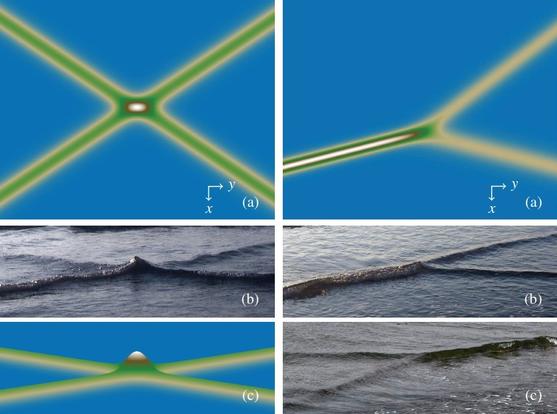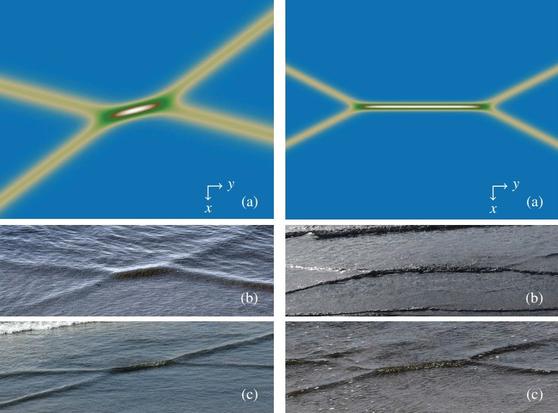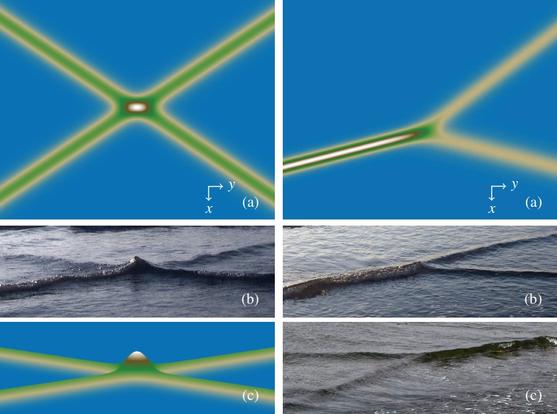
#PhysRevE #Y2012 Nonlinear shallow ocean-wave soliton interactions on flat beaches, by Mark J. Ablowitz and Douglas E. Baldwin https://journals.aps.org/pre/abstract/10.1103/PhysRevE.86.036305 "M.J.A. observed these interactions in Nuevo Vallarta, Mexico, and D.B. observed them on Venice Beach, California (2000 km away). Both authors take thousands of photographs. The water depth was shallow, usually between 5 and 20 cm; the beaches are long and relatively flat; the interactions usually happen within 2 hours before and after low tide; cross-waves produced near a jetty induce these interactions. These X- and Y-type interactions usually come in groups, which last a few minutes. Authors saw many X- and Y-type interactions each day of observations; the relative frequencies of the interactions were different at the two beaches—M.J.A. saw X-type interactions often than D.B."
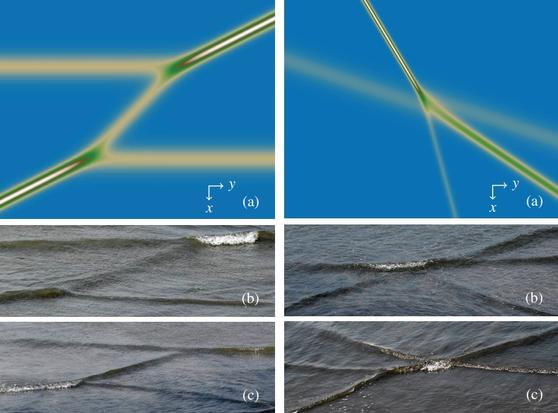
#PhysRevE #Y2012 Nonlinear shallow ocean-wave soliton interactions on flat beaches, by Mark J. Ablowitz and Douglas E. Baldwin journals.aps.org/pre/abstract... "M.J.A. observed these interactions in Nuevo Vallarta, Mexico, and D.B. observed them on Venice Beach, California (2000 km away)"
Bluesky

Bluesky Social
#arXiv Second law of thermodynamics: Spontaneous cold-to-hot heat transfer in a nonchaotic medium https://arxiv.org/abs/2312.09161 cold-to-hot heat transfer allows for production of useful work by absorbing heat from a single thermal reservoir without any other effect. #PhysRevE
Second law of thermodynamics: Spontaneous cold-to-hot heat transfer in a nonchaotic medium

It has long been known that, fundamentally different from a large body of rarefied gas, when a Knudsen gas is immersed in a thermal bath, it may never reach thermal equilibrium. The root cause is nonchaoticity: as the particle-particle collisions are sparse, the particle trajectories tend to be independent of each other. Usually, this counterintuitive phenomenon is studied through kinetic theory and is not considered a thermodynamic problem. In current research, we show that if incorporated in a compound setup, such an intrinsically nonequilibrium behavior has nontrivial consequences and cannot circumvent thermodynamics: cold-to-hot heat transfer may happen spontaneously, either continuously (with an energy barrier) or cyclically (with time-dependent entropy barriers). It allows for production of useful work by absorbing heat from a single thermal reservoir without any other effect. As the system obeys the first law of thermodynamics, it breaks the boundaries of the second law of thermodynamics.

arXiv.org
Cuál es la mejor manera de columpiarse según la física - La Ciencia de la Mula Francis

Aprender a columpiarse solo, sin ayuda, es todo un reto en los parques infantiles. Tras prueba y error acaban aprendiendo a ascender cada vez más alto. El columpio se comporta […]

La Ciencia de la Mula Francis