So, uh, 6 recent #exoplanet arχiv papers that I thought were neat and would encourage people to check out:
Characterizing the atmospheres of 5 hot Jupiters with JWST (1 is completely featureless, so probably cloudy): https://arxiv.org/abs/2603.21273
High-resolution spectroscopic atmospheric studies of 5 hot Jupiters across the edge of the Neptune desert

Hot Jupiters (HJs), especially the Ultra-Hot Jupiters (UHJs), are ideal targets for robust atmospheric characterization, thanks to their high equilibrium temperatures and large atmospheric scale heights, which result from their proximity to their host stars and intense stellar irradiation. Here, we present atmospheric studies of five planets, namely WASP-50b, WASP-117b, WASP-156b, WASP-167b, and WASP-173Ab. These five planets include two UHJs, two classic HJs, and one hot Neptune, with four of them just on the upper and middle borders of the Neptune desert, providing an interesting sample for investigating the connection between planetary atmospheric composition and bulk properties. We have not detected any significant absorption signals exceeding 3$σ$ in the three less-inflated, relatively high-density HJs (WASP-50b, WASP-156b, and WASP-173Ab). We marginally detect H$α$ and Li I with 3.2$σ$ and 3.1$σ$ in WASP-117b, respectively. In WASP-167b, we report tentative detection of H$α$ and Fe I at 4.6$σ$ and $\sim3.4σ$, receptively. In addition, Fe I is significantly detected with a max SNR of 7.3 $σ$ using the cross-correlation technique, which exhibits a blue-shifted signal. For WASP-167b, we perform an atmospheric retrieval and yield the abundances of Fe, Mg, Ca, Ti, V, and equilibrium temperature of ${2479^{+193}_{-174}}$K. Comparing WASP-173Ab and WASP-167b, both are UHJ, but with quite different extents of atmospheric signals, we propose that there may be a transition in $T_{\rm eq}$ between 1900 and 2300K.

arXiv.org
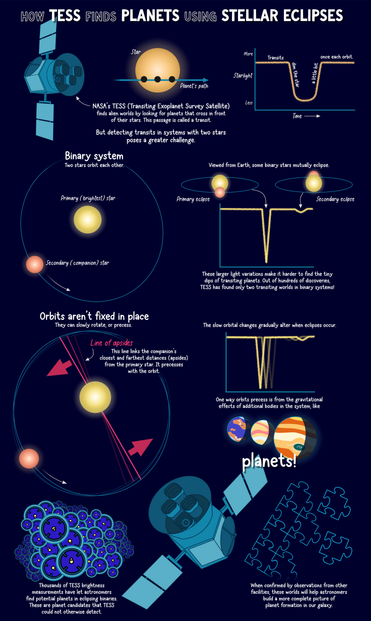
AI approach uncovers dozens of hidden planets in NASA's TESS data

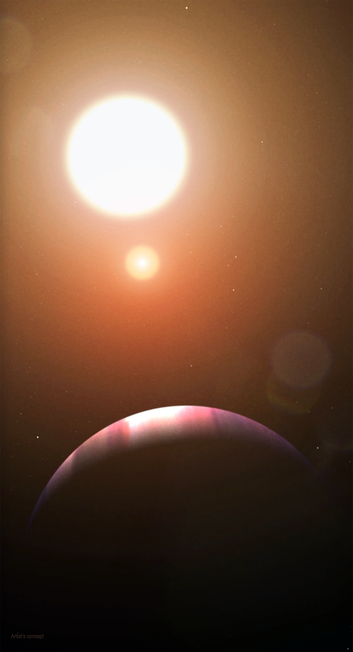
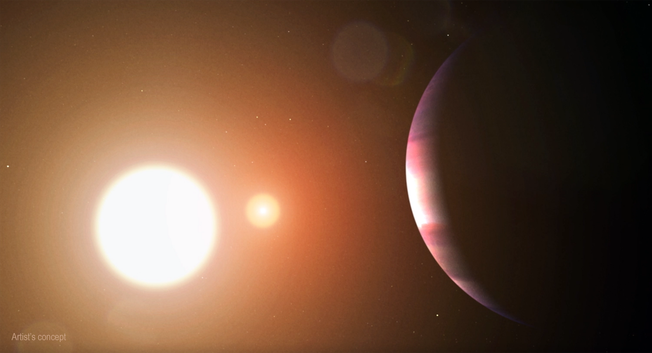
Astronomers at the University of Warwick have validated over 100 exoplanets, including 31 newly detected planets, using a new artificial intelligence tool applied to data from NASA's Transiting Exoplanet Survey Satellite (TESS), a space mission that monitors the sky for the subtle dimming of starlight caused when planets pass in front of their host stars.

Phys.org
There is an entire planet discovered that appears to be made mostly of diamond #Exoplanet #Space #HistoryFacts #DeepSpace #NatureFacts #Exoplanets #OceanFacts

#MPE:
"
Seltener Nachweis zweier Protoplaneten

Ein kosmisches Labor für die Planetenentstehung im WISPIT-2-System
"
".. GRAVITY-Experiment hat zwei sich gerade bildende Exoplaneten beobachtet, die sich noch im Entstehungsprozess um den jungen Stern WISPIT 2 befinden. .. Fund gewährt einen seltenen Einblick in die frühen Stadien der Planetenentstehung .."
https://www.mpe.mpg.de/8188535/news20260314

24.3.2026

#Astronomie #ESO #Exoplanet #GRAVITY #Planetologie #Planetenentstehung #VLTI #WISPIT2 #WISPIT2b #WISPIT2c

Seltener Nachweis zweier Protoplaneten

Zwei Protoplaneten im jungen Sternsystem WISPIT 2 wurden nachgewiesen, was einen seltenen Einblick in die Planetenentstehung bietet. Mit dem GRAVITY-Instrument am VLT Interferometer gelang der Nachweis des neuen Protoplaneten WISPIT 2c, der Kohlenmonoxid in seiner Atmosphäre aufweist. Dies unterstützt die Erkenntnis, dass Planetensysteme parallel entstehen.

Delighted to see our WISPIT team announce the second directly imaged exoplanet from the WISPIT 2 system! Led by Chloe Lawlor (Galway) with Richelle van Capelleveen (Leiden), we also have a spectrum of the inner, more massive planet, showing carbon monoxide features. ☄ #exoplanet #astrodon https://www.eso.org/public/news/eso2604/

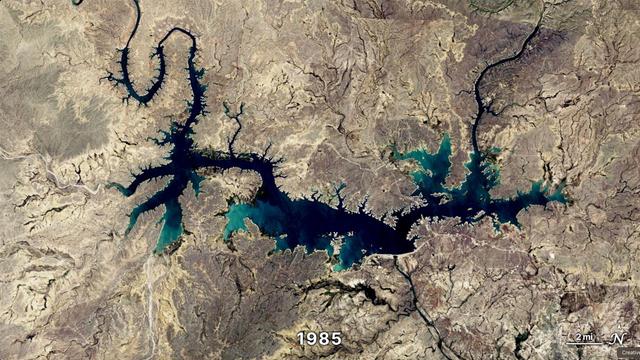
Between Exoplanet 65834 and 65835 lies the Child’s Wall. Which is a bad name, but the astronomer who found it was, a little too literal. For 230 years no one could explain the once-every-423-day phenomenon. It took the invention of FTL travel to clear it up. It’s a bug, or should I say, it’s the emissions of a space bug. Yes, there are space bugs. The Ampnoa bug lives in zero gravity, and uses its, um, backside emissions, to launch itself across space. The reason is, of course, sex, or shall we say, mating. When the sun is closest to the nesting sites of the Ampnoa, they launch themselves back and forth, creating lines of light as they search for the perfect mate. They also evolved a natural form of space docking, but that is a story for another time.

#scifi #exoplanet #MicroFiction #river #nature #photography

Between Exoplanet 65834 and 65835 lies the Child’s Wall. Which is a bad name, but the astronomer who found it was, a little too literal. For 230 years no one could explain the once-every-423-day phenomenon. It took the invention of FTL travel to clear it up. It’s a bug, or should I say, it’s the emissions of a space bug. Yes, there are space bugs. The Ampnoa bug lives in zero gravity, and uses its, um, backside emissions, to launch itself across space. The reason is, of course, sex, or shall we say, mating. When the sun is closest to the nesting sites of the Ampnoa, they launch themselves back and forth, creating lines of light as they search for the perfect mate. They also evolved a natural form of space docking, but that is a story for another time.

#scifi #exoplanet #MicroFiction #stream #nature #river #longexposure
Moons orbiting wandering exoplanets could be habitable—with one catch

Provided they host thick, hydrogen-dominated atmospheres, moons orbiting free-floating exoplanets could retain much of the heat generated deep within their interiors by tidal forces. Led by David Dahlbüdding at the Max Planck Institute for Extraterrestrial Physics and Giulia Roccetti at the European Space Agency, a new study predicts that hydrogen could act as a potent greenhouse gas—potentially providing habitable conditions for billions of years after their host planets are first ejected from their stellar systems. The work has been published in Monthly Notices of the Royal Astronomical Society.

Phys.org
What 'Project Hail Mary' gets right—and wrong—about astrophysics

"Project Hail Mary," the Ryan Gosling-led adaptation of the best-selling sci-fi novel from Andy Weir, is being praised for putting the science in science fiction. Although aliens, sun-draining microorganisms and galaxy-spanning spaceflight are all a part of the story of a scientist sent on a suicide mission to save Earth, the film and its source material are not afraid to delve into the kind of astrophysics that would make most people's heads spin.