 BEGATS AND BEQUEATHALS
Robert Leonard (bef. 1730 – 1780): Discharge Document from British 35th Regiment of Foot (1762)
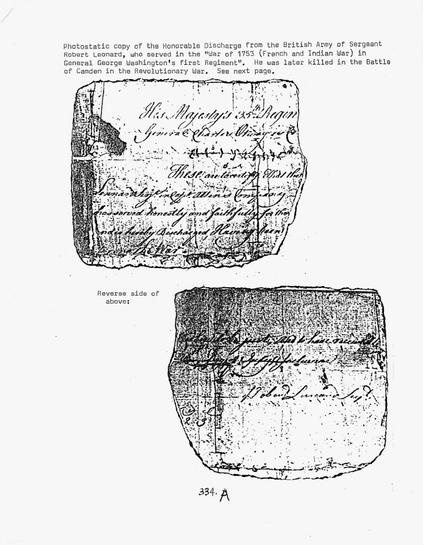
Robert Leonard’s discharge paper (front and back) from British 35th Regiment of Foot, photocopy published in Audrey M. Matthews, The Tennessee Phantoms (Prosser, Washington, 1989)Or, Subtitled: “Lennard Serjt in Capt Allen’s Company has served honestly and faithfully”
And now the military discharge document: As my initial posting in this series about Robert Leonard notes, Thomas D. Leonard states in his “Biography of the Leonards,” “His discharge as a soldier of the English Army is yet in existence. It is in the family of Griffith Leonard in Tenn.; and I have seen it.” (To read the continuation of this posting, please click the numeral 2 below.)
The discharge document is extant. It is now in the Southern Historical Collection at University of North Carolina Chapel Hill, to which a Leonard descendant donated it in 1993. In May 2008, Beverly Dean Peoples, a researcher who descends from Gwendolyn James Dean, a sister of Thomas Leonard’s (1752-1832) wife Hannah James,[1] kindly sent me a valuable set of notes about Robert Leonard’s discharge paper after she examined it carefully at Southern Historical Collection.
Beverly’s notes tell me that the document is (or was then) in an oversize folder tagged “Misc. Records” with no contributor or special collection of any kind noted.[2] In the folder were eight documents, none of which seemed related to the other. Robert’s discharge document is pitifully worn and crumbled, according to Beverly — six rectangles of old paper about 4 x 6 inches each sewn together by hand with tiny stitches. It appeared to Beverly that what had been an original discharge document had been folded and had eventually come apart at the folds, so that the pieces were stitched together to reassemble the parts. Even then, most of the edges of the document are gone, Beverly reported, and often big sections of the page were missing.
Beverly noted that the discharge paper has writing on both sides. She offered the following transcript:
Witt: Forbis.
His Majesty’s 35 Regt.
General Charles Otway
These are to certify that ther
Lennard Sergt. In Capt Allen’s Campaign has served honestly and faithfully for the.
And is hereby discharged having been.
During the War.
24th day of July inclusive
at Havana the 5th day.
Robert Leonard Srgt.
In her book Tennessee Phantoms, Audrey Matthews offers both photographic images of the discharge paper (or of a portion of the paper) and the following transcription:[3]
His Majesty’s 35th Regim ⏤
General Charles Otwayes Co
These are to certify that the ⏤
Lennard Serjt in Capt Allen’s Company
has served honestly and faithfully for ther ⏤
⏤ nd is hereby Discharged Having been
⏤ uns? the War
Within to be just, and to have received
24th Day of July Inclusive
Robert Leneard Serjt
Working with an archivist assisting her at the Southern Historical Collection, Beverly Peoples determined that the discharge papers evidently date from 1760-1764.
So the following important pieces of information may be gleaned from Robert Leonard’s discharge paper:
• He served as a sergeant under Captain Allen in General Charles James Otway’s HM 35th Regiment of Foot.
• He was discharged from this British military unit at Havana on 24 July in a year that appears to fall between 1760-4.
Charles James Otway (1694-1764) was a senior British Army officer who commanded the 35th Regiment of Foot from 1717 until his death in 1764. In April 1756, the 35th Regiment left Ireland, where it was then stationed, for North America for service in the French and Indian War, or as historians often name it, the Seven Years’ War, because the war was a global conflict and not an exclusively North American one.[4] Having landed in New York, the 35th began garrison duties on the northern frontier of the British American colonies, sending detachments to Mobile and up the Mississippi valley. In March 1757, five companies under Lieutenant-Colonel Robert Monro including Captain Richard Allen’s unit marched from Albany toward Fort Edward and Monro assumed command of Fort William Henry.
In August 1757, Fort William Henry fell to French forces under Montcalm and following the surrender of the 35th and other British troops, a massacre occurred in violation of the treaty of surrender, with a number of those in the 35th Regiment among those killed. Soldiers of the 35th then withdrew and re-formed, and in July 1758, took part in the siege and capture of Louisbourg in Nova Scotia. The 35th then played a key role in the battle of Québec in 1759, with the battle of the Plains of Abraham on 13 September 1759 resulting in the capture of Québec by the British.
After Montréal fell following the final and decisive campaign of this North American part of the war between July and September 1760, the 35th, having completed its operations in North America, then took part in a West Indies campaign (1761-2) and was transferred south, taking part in the capture of Martinique in January 1762 and the Spanish stronghold of Havana in the summer of 1762.
Put together the information we can glean from Robert Leonard’s discharge document, the history of HM 35th Regiment of Foot in the period 1756-1762, and Robert Leonard’s documented service on the western Maryland frontier under Dagworthy, and a very interesting picture emerges: as noted previously, we can document that Robert was serving under Dagworthy by 8 February 1755.[5] As I’ll explain in a detail in a subsequent posting focusing on his military service in Maryland, a steady stream of documents then shows Robert continuing to serve Dagworthy’s captain in command at Fort Frederick, Alexander Beall, up to November 1758, when he was discharged from Beall’s military unit. In March 1759, we find Robert witnessing the discharge of another soldier from Beall’s troops, and that may indicate that he was still in Frederick County up to that date before he entered the service of the 35th Regiment and then took part in the Québec campaign in September 1759.
We know from Robert’s discharge paper that he joined Otway’s 35th Regiment and served under Captain Allen in that regiment. We also know from Thomas Dunlap Leonard in his “Biography of the Leonards” that Robert was in the battle of Québec. As we’ve just seen, the pivotal event in that battle took place in the battle of the Plains of Abraham in September 1759, and it can be documented that the 35th, with Allen’s troops included, played an important role in that event. So it appears that by September 1759, Robert Leonard was serving under Otway and Allen.
He was then discharged at Havana — the discharge paper states the place explicitly — on 24 July of an unstated year. Histories of the 35th show it capturing Havana in the summer of 1762. From some point in 1759 through July 1762, then, Robert Leonard served as a sergeant in Captain Richard Allen’s regiment of Otway’s 35th Regiment of Foot. At this point, he evidently returned to his wife Honor and their children in Maryland and then when the American Revolution got underway, it can be documented that he enlisted on 19 August 1779 in Frederick County as a sergeant in Captain John Reynolds’ company of the 7th Maryland Regiment.
Robert Leonard’s discharge document shows a Forbis witnessing the discharge in Havana in July 1762. This was Major William Forbes, who served with the 35th Foot during its campaigns across North America and the Caribbean and was in command of the unit at Pensacola in 1763.
Though one descendant of Robert Leonard has sought to convince me that the man of that name serving as a sergeant at Fort Frederick in the 1750s is a different person than the sergeant who was discharged from the 35th Regiment in July 1762, it’s clear to me that these are the very same man, the Robert Leonard to whose son Thomas and his descendants the military discharge document passed down. Thomas’ grandson Thomas D. Leonard, who would likely have had this information from Thomas and his wife Hannah, explicitly tells us that Robert Leonard was a soldier of the English army in the “War of 1760” who was at the battle of Québec (in 1759), and that he had seen Robert’s discharge paper at the house of Thomas Leonard’s son Griffith James Leonard.
Then in a power of attorney Robert’s widow Honor made with sons Thomas and Robert and son-in-law Colin Campbell in 1800, we’re told that Robert Leonard served as a “Sergeant in the war of 1753” connected to Washington, who was headquartered at Fort Cumberland in 1755 when we have every reason to think Robert Leonard was at that fort serving under Dagworthy. Document after document subsequently places Robert at Fort Frederick after that fort was built in 1756. In these documents as in the discharge document, Robert Leonard has the rank of sergeant, a rank the very same Robert Leonard subsequently held when he joined Maryland troops during the Revolutionary War.
In my next posting, I’ll look closely at the documentation we have for Robert Leonard’s service in the French and Indian War.
[1] See Beverly Dean Peoples and Ralph Terry Dean, Country Cousins: Descendants of Samuel Dean, 2nd ed. (Franklin, North Carolina: Genealogy Publishing Service, 2001),
[2] Working with an archivist, Beverly determined that the discharge paper had been donated to Southern Historical Collection in 1993 by Shirley Leonard of New Mexico.
[3] The Tennessee Phantoms (Prosser, Washington, 1989).
[4] See A.E. Readman, ed., Records of the Royal Sussex Regiment (Chichester: West Sussex County Council, 1985); Richard Trimen, An Historical Memoir of the 35th Royal Sussex Regiment of Foot (Southampton: The Southampton Times Newspaper and Printing and Publishing Co., 1873); Seven Years’ War Journal of the Proceedings of the 35th Regiment of Foot (1757), available digitally at Archive.org; John M. Kitzmiller, In Search of the “Forlorn Hope” (Ogden, Utah: Meridian, 1988); and University of New Brunswick Library, “Muster Books and Pay Lists (WO 12/4949): 35th (Dorsetshire) Regiment of Foot: 1760-61, 1765-1782,” (Great Britain, War Office, PRO WO 12/4949) in The Loyalist Collection.
[5] Frederick County, Maryland, Land Record Bk. E, pp. 659-660.
#35thRegimentOfFoot #AlexanderBeall #AmericanRevolution #BattleOfPlainsOfAbrahamQuébecCanada #BattleOfQuébec #CharlesJamesOtway #ColinCampbell #FortCumberlandAlleganyCoMaryland #FortFrederickWashingtonCoMaryland #FortWilliamHenryLakeGeorgeNewYork #FrederickCoMaryland #FrenchAndIndianWar #genealogy #GeorgeWashington #GriffithJamesLeonard #HannahJames #HavanaCuba #history #HonorPritchard #JohnDagworthy #LouisJosephDeMontcalm #Martinique #MontréalCanada #PensacolaFlorida #QuébecCanada #RichardAllen #RobertLeonard #RobertMonro #SevenYearsWar #ThomasDunlapLeonard #ThomasLeonard #WestIndies #WilliamForbes